Roald Amundsen: First at the Pole, by Both Leaders' Records
Published Last substantive revision
How to read this page: each point is marked as a cross-checked fix, a single record (“according to”), or inference (“by dead reckoning”).
TL;DR: Roald Amundsen's party reached the South Pole on December 14, 1911, by his own published account, and Robert Falcon Scott's party reached it on January 17, 1912, 34 days later, by Scott's journal. Amundsen climbed to the polar plateau by the Axel Heiberg Glacier and Scott by the Beardmore Glacier; Scott's polar party of five did not return.
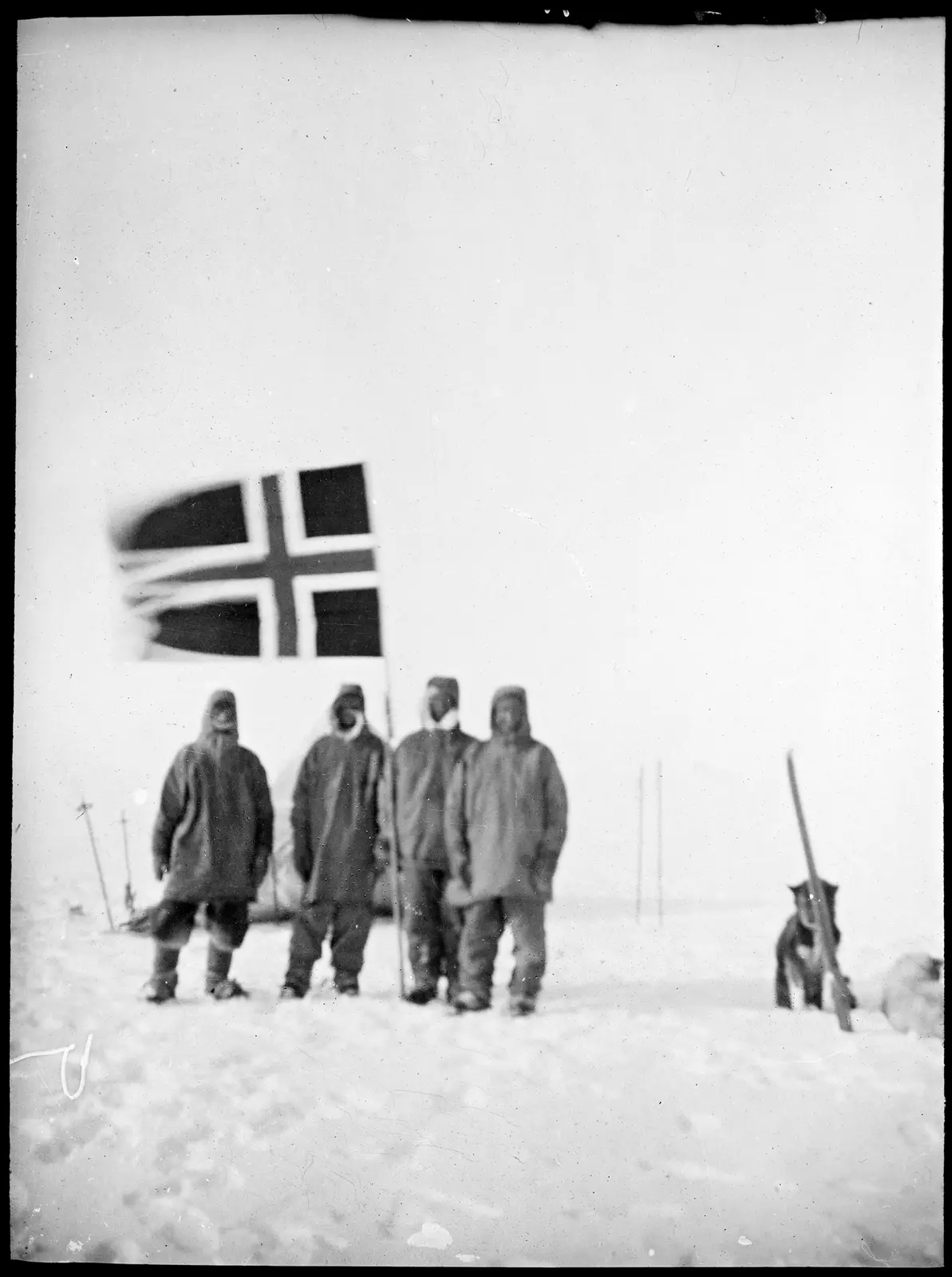
"Oscar Wisting, Olav Bjaaland, Sverre Hassel og Roald Amundsen på Sydpolen" by Helmer Hanssen / National Library of Norway — https://commons.wikimedia.org/wiki/File:Oscar_Wisting,_Olav_Bjaaland,_Sverre_Hassel_og_Roald_Amundsen_p%C3%A5_Sydpolen_14.12.1911_(7635391194).jpg — CC BY 2.0 (https://creativecommons.org/licenses/by/2.0/)
Who reached the South Pole first?
Roald Amundsen's party reached the South Pole on December 14, 1911; Robert Falcon Scott's arrived 34 days later. Each date comes from the leader's own record, and the two records were kept separately, one by each party. Amundsen's book, The South Pole, puts his halt at three in the afternoon, when the drivers checked their sledge-meters and found that all of them showed the full distance: “our Pole by reckoning.” Scott's journal entry for Wednesday, January 17, 1912, opens, after the camp number and temperatures, with two words: “The Pole.”
Fix: the Norwegians were at the Pole before Scott's party, a point on which Amundsen's book and Scott's journal agree from opposite sides. On January 16, Scott writes, Henry Bowers spotted a black speck ahead that proved to be a black flag tied to a sledge bearer, close to sledge tracks, ski tracks and “the clear trace of dogs' paws.” Two days later Scott's party reached a small tent holding a record of five Norwegians, dated 16 Dec. 1911. Amundsen's book calls that tent Polheim.
Fix: what the Norwegians left inside the tent, where the two accounts largely match. Amundsen writes that he left a letter to the King of Norway, “a short epistle to Captain Scott,” a sextant with a glass horizon, a hypsometer case and reindeer-skin foot-bags. Scott lists a note from Amundsen asking him to forward a letter to King Haakon, three half bags of reindeer skin holding mitts and sleeping socks, a sextant, a Norwegian artificial horizon and “a hypsometer without boiling-point thermometers.” Scott also lists a second sextant and hypsometer “of English make,” which Amundsen's list does not mention.
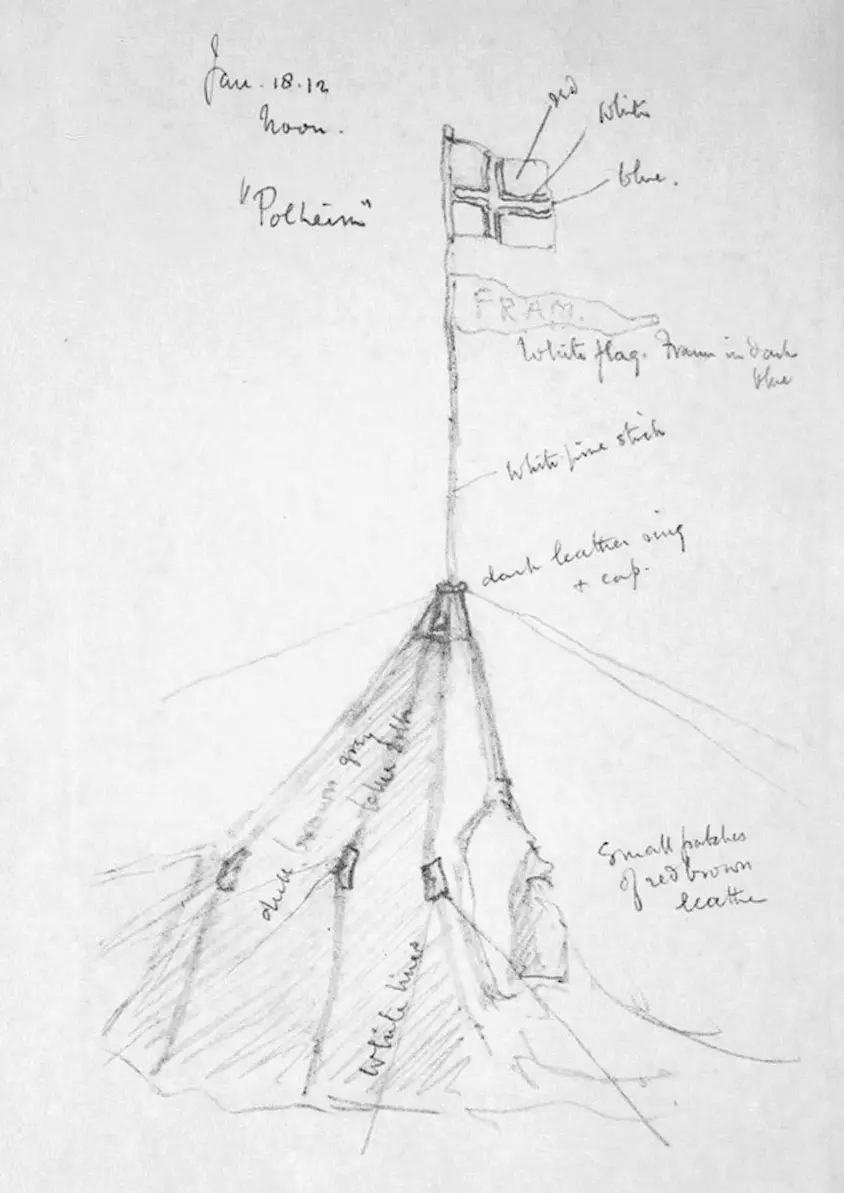
"Amundsen's tent at the South Pole" by Edward A. Wilson — https://commons.wikimedia.org/wiki/File:Amundsen%27s_tent_at_the_South_Pole.jpg — Public domain (US: published in Scott's Last Expedition (New York, 1913), before 1931; EU and UK: Edward Wilson died in 1912, more than 70 years ago)
The sources disagree on one detail. Scott, writing later on January 18, guessed that the Norwegians “arrived at the Pole on the 15th Dec. and left on the 17th.” Amundsen's book gives the 14th for the arrival and the 17th for the start home.
Scott also thought, from the Norwegian sledge tracks he followed on January 17, that there were “only two men.” The record in the tent, as he copied it, named five. Scott left a note of his own in the tent to say he had visited it; a far older polar record, found in a cairn in 1859, is the subject of the Franklin Expedition entry.
Day by day: two latitude records
Both books give dated latitudes on the way south, though not for every day. A latitude is a position measured north or south of the equator, and the South Pole lies at 90° S. Some figures in the books come from sun sights, some from reckoning, and some are stated without saying which.
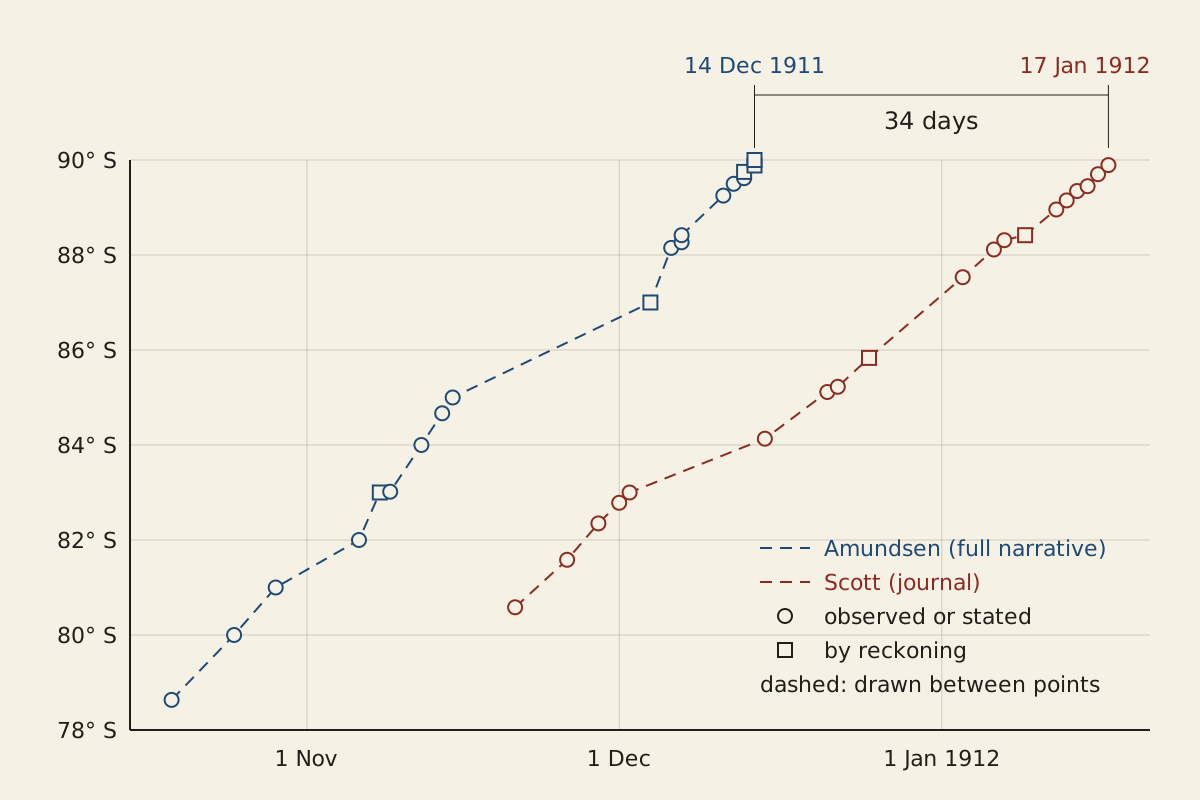
Figure: From the Surviving Record, CC BY 4.0
Full credit line for reuse
"Latitude by date, Amundsen and Scott, October 1911 to January 1912" by From the Surviving Record, CC BY 4.0. Source: https://fromthesurvivingrecord.com/expeditions/race-to-the-south-pole/ — License: https://creativecommons.org/licenses/by/4.0/
Data: Roald Amundsen, The South Pole: An Account of the Norwegian Antarctic Expedition in the “Fram,” 1910–1912, trans. A. G. Chater, vol. 2 (1912), retrieved 2026-11-01, public domain; Robert F. Scott, Scott's Last Expedition, vol. 1, arranged by Leonard Huxley (New York, 1913), retrieved 2026-11-01, public domain
| Date | Party | Latitude, as printed | How it was found |
|---|---|---|---|
| Oct. 19, 1911 | Amundsen | 78° 38′ S (Framheim) | stated |
| Oct. 29, 1911 | Amundsen | 81° S | stated |
| Nov. 15, 1911 | Amundsen | 85° S | stated |
| Nov. 21, 1911 | Scott | 80° 35′ S | stated |
| Dec. 2, 1911 | Scott | 83° S | stated |
| Dec. 7, 1911 | Amundsen | 88° 16′ S | observed |
| Dec. 13, 1911 | Amundsen | 89° 37′ S | observed |
| Dec. 14, 1911 | Amundsen | the Pole | reckoned |
| Dec. 21, 1911 | Scott | 85° 7′ S | stated |
| Jan. 7, 1912 | Scott | 88° 18′ 40″ S | observed |
| Jan. 16, 1912 | Scott | 89° 42′ S | observed |
| Jan. 17, 1912 | Scott | 89° 53′ 37″ S | observed |
Table: a selection; Amundsen's rows follow his full narrative, and the CSV adds more dated latitudes from both books, including the First Account's, each with its chapter or journal date.
Download the table (CSV, race-to-the-south-pole-latitudes.csv) (file notes: sources and license) Data: Roald Amundsen, The South Pole: An Account of the Norwegian Antarctic Expedition in the “Fram,” 1910–1912, trans. A. G. Chater, vol. 1 (1912), retrieved 2026-11-01, public domain; Roald Amundsen, The South Pole: An Account of the Norwegian Antarctic Expedition in the “Fram,” 1910–1912, trans. A. G. Chater, vol. 2 (1912), retrieved 2026-11-01, public domain; Robert F. Scott, Scott's Last Expedition, vol. 1, arranged by Leonard Huxley (New York, 1913), retrieved 2026-11-01, public domain
Each party wrote down the moment it left known ground. At 82° S on November 6, Amundsen wrote: “Now the unknown lay before us.” Scott passed the farthest south of Ernest Shackleton's earlier walk on January 9, 1912, by his own reckoning, and wrote: “All is new ahead.” By then Amundsen's party had been heading home for more than three weeks.
The pace on the high plateau can be read from the latitudes alone. By the full narrative's dates, Amundsen's party gained about 104 nautical miles of latitude in the 7 days from its sight of 88° 16′ S on December 7 to its Pole by reckoning, close to 15 a day; the First Account puts that sight on December 8, which leaves 6 days. Scott's party gained about 95 in the 10 days from 88° 18′ 40″ S on January 7 to its sight of January 17, close to 9.5 a day. These are changes in latitude, not miles walked, and each is worked out twice, at 60 nautical miles to a degree and along the Earth's curved meridian; the two methods agree to within 1 percent.
Two routes, two glaciers
The two parties set out from different bases and climbed to the plateau by different glaciers. By his own book, Amundsen started from Framheim, his winter hut, at 78° 38′ S, and steered due south across the Barrier, as both books call the great ice shelf. Scott started from Cape Evans, and his journal shows a party that changed its way of hauling as it went.
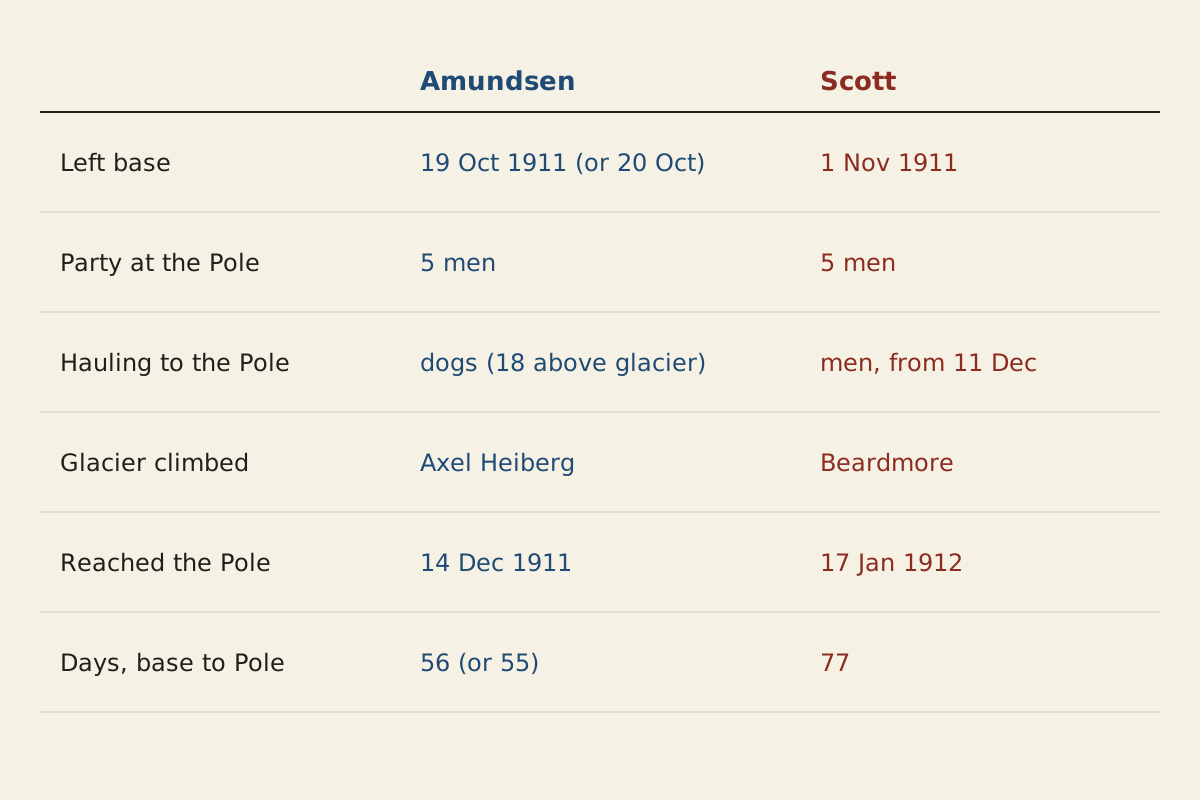
Figure: From the Surviving Record, CC BY 4.0
Full credit line for reuse
"Amundsen and Scott compared, from their own books" by From the Surviving Record, CC BY 4.0. Source: https://fromthesurvivingrecord.com/expeditions/race-to-the-south-pole/ — License: https://creativecommons.org/licenses/by/4.0/
Data: Roald Amundsen, The South Pole: An Account of the Norwegian Antarctic Expedition in the “Fram,” 1910–1912, trans. A. G. Chater, vol. 1 (1912), retrieved 2026-11-01, public domain; Roald Amundsen, The South Pole: An Account of the Norwegian Antarctic Expedition in the “Fram,” 1910–1912, trans. A. G. Chater, vol. 2 (1912), retrieved 2026-11-01, public domain; Robert F. Scott, Scott's Last Expedition, vol. 1, arranged by Leonard Huxley (New York, 1913), retrieved 2026-11-01, public domain
| Amundsen | Scott | |
|---|---|---|
| Left base | Oct. 19, 1911 (Oct. 20 in two other accounts in his book) | Nov. 1, 1911 (motor sledges left Oct. 24) |
| Men at the Pole | 5 | 5 |
| Hauling at the start | 4 sledges, 13 dogs to each | ponies, dog teams, motor sledges |
| Hauling to the Pole | dogs; 18 kept above the glacier | men pulling the sledges from Dec. 11 |
| Glacier to the plateau | Axel Heiberg, climb begun Nov. 17 (Nov. 18 in the First Account) | Beardmore, Dec. 10 to 21 |
| Reached the Pole | Dec. 14, 1911 | Jan. 17, 1912 |
| Days, base to Pole | 56 (55 from Oct. 20) | 77 |
| Return | back at Framheim Jan. 25, 1912 | the polar party did not return |
Download the table (CSV, race-to-the-south-pole-compare.csv) (file notes: sources and license) Data: Roald Amundsen, The South Pole: An Account of the Norwegian Antarctic Expedition in the “Fram,” 1910–1912, trans. A. G. Chater, vol. 1 (1912), retrieved 2026-11-01, public domain; Roald Amundsen, The South Pole: An Account of the Norwegian Antarctic Expedition in the “Fram,” 1910–1912, trans. A. G. Chater, vol. 2 (1912), retrieved 2026-11-01, public domain; Robert F. Scott, Scott's Last Expedition, vol. 1, arranged by Leonard Huxley (New York, 1913), retrieved 2026-11-01, public domain
Amundsen's plan for the dogs was written down before the climb. According to his narrative, the plan was to take all 42 dogs up to the plateau, kill 24 there and go on with 18; his First Account records that 24 were killed there and 18 kept. Scott's journal records that the ponies were shot on December 9, the day before the climb up the Beardmore began, and that the dog teams turned back on December 11. From then on, men pulled the sledges.
Scott's journal records that on January 3, 1912, he told his last supporting party to turn back, and that from the next day he went on with five: himself, Edward Wilson, Henry Bowers, Lawrence Oates and Edgar Evans. His journal ends with an entry dated March 29, 1912, and none of the five came back.
By dead reckoning, the start dates alone do not explain the 34 days. Amundsen left 13 days earlier by his full narrative, but he also took fewer days from base to Pole, 56 against 77, and moved faster on the plateau by the latitudes above. Dogs, route, weather and loads all differ between the two books, and neither book tests one choice against another, so this page does not name a single reason.
How close to the Pole did each party get?
Neither party could be sure of standing on the exact spot, and both books say so. Amundsen's halt on December 14 was by dead reckoning, a position worked out from the course steered and the distance covered, which on this march was measured by the sledge-meters. He wrote that “every one of us knew that we were not standing on the absolute spot.”
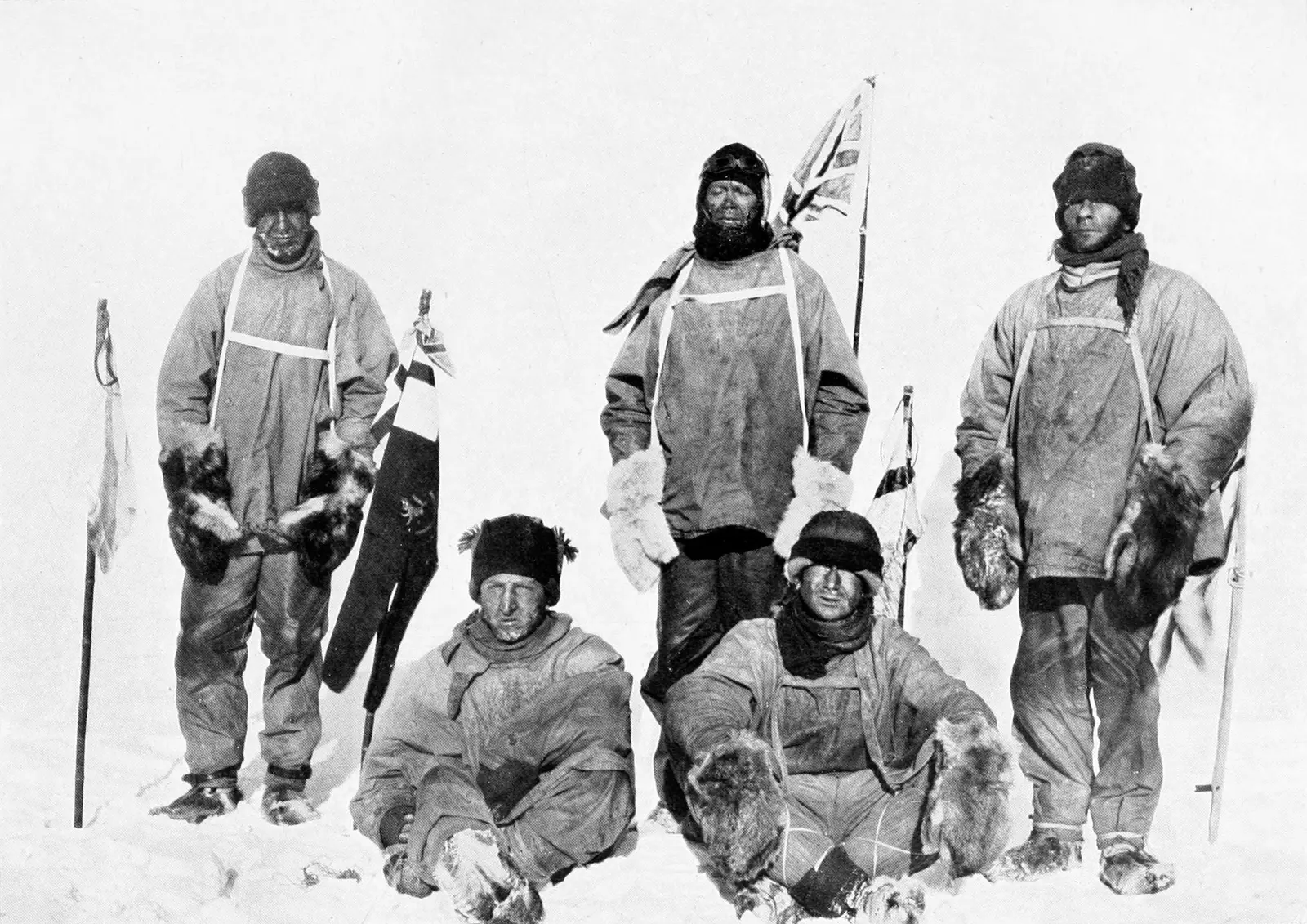
"Scott's party at the South Pole" by Henry Bowers — https://commons.wikimedia.org/wiki/File:Scott%27s_party_at_the_South_Pole.jpg — Public domain (US: published in Scott's Last Expedition, vol. 1 (New York, 1913), before 1931; EU and UK: Henry Bowers died in 1912, more than 70 years ago)
So the Norwegians kept measuring. Sun sights that night gave 89° 56′ S, by the full narrative, while the First Account gives 89° 55′ for the next day's work, and three men went out in three directions to mark a circle with a radius of about twelve and a half miles around the camp. The party then went on about five and a half geographical miles and set up the Polheim camp. In an appendix to the book, Anton Alexander later worked through the hourly sights taken there on December 16 and 17 and put Polheim at roughly 89° 58.5′ S, “barely three kilometres” from the Pole.
Scott's party used sun sights too, worked out by Bowers in the tent. On the morning of January 18, Scott “decided after summing up all observations that we were 3.5 miles away from the Pole.” By lunch, after a further march, the sights put them “1/2 to 3/4 of a mile from the Pole,” and they built a cairn there and raised the Union flag.
Where Amundsen's book disagrees with itself
The South Pole tells the march twice, and the two versions do not always give the same day. Volume 1 includes a short report called “The First Account,” and volume 2 carries the full narrative. Between October and early December, the First Account's dates run one or two days later than the narrative's for the same events.
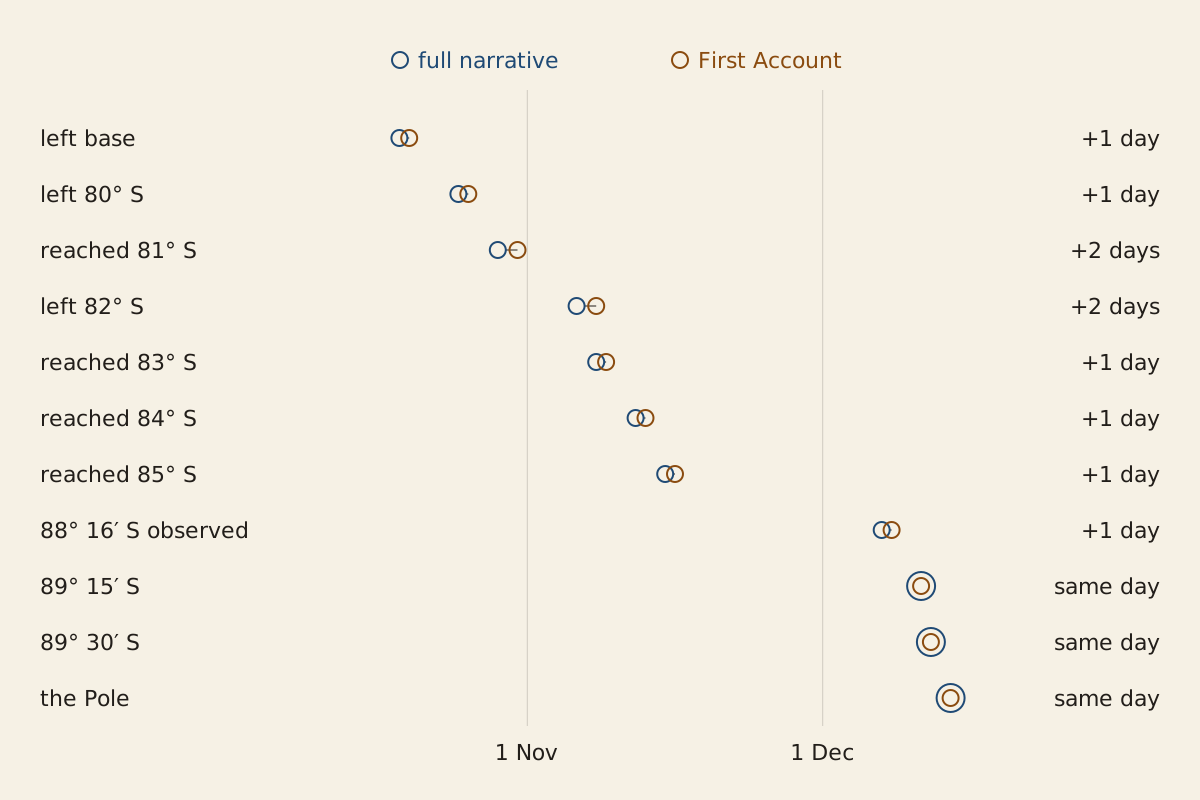
Figure: From the Surviving Record, CC BY 4.0
Full credit line for reuse
"Amundsen's two accounts of the march: dates for the same milestones" by From the Surviving Record, CC BY 4.0. Source: https://fromthesurvivingrecord.com/expeditions/race-to-the-south-pole/ — License: https://creativecommons.org/licenses/by/4.0/
Data: Roald Amundsen, The South Pole: An Account of the Norwegian Antarctic Expedition in the “Fram,” 1910–1912, trans. A. G. Chater, vol. 1 (1912), retrieved 2026-11-01, public domain; Roald Amundsen, The South Pole: An Account of the Norwegian Antarctic Expedition in the “Fram,” 1910–1912, trans. A. G. Chater, vol. 2 (1912), retrieved 2026-11-01, public domain
The start is the clearest case. The narrative says, “At last we got away, on October 19.” The First Account gives October 20, and so does Lieutenant K. Prestrud, who saw the party off and wrote his own chapter of the book. From December 11 on, the two versions agree day by day, and both give December 14 for the Pole.
The two versions also measure distance over different spans. The First Account puts the distance from winter quarters to the Pole at about 870 English miles, while the narrative sums up the whole trip, there and back, as “Ninety-nine days” and “about 1,860 miles.” Counted as elapsed days, October 19 to January 25 is 98; the book's 99 matches a count that takes in both the first day and the last.
By dead reckoning, the arrival date is the firmest of Amundsen's dates on this page, because both versions of his book give it, and the start date is the weakest. Each day count here is computed twice, from calendar dates and from day numbers, and the two methods agree.
Still missing:
- Why the two versions of Amundsen's book differ. The book prints both sets of dates without comment, and the narrative's sledge-meter readings are not printed day by day; how distance and direction add up to a position is set out under dead reckoning.
- What the men who turned back recorded. This page reads only Scott's own journal, the first of the expedition's two volumes. The same limit, one leader's book standing for a whole party, runs through the Shackleton Expedition.
Cite this page
From the Surviving Record. “Roald Amundsen: First at the Pole, by Both Leaders' Records.” First published 2026-11-01. https://fromthesurvivingrecord.com/expeditions/race-to-the-south-pole/ (accessed add the date you read it).
Sources
- Roald Amundsen, The South Pole: An Account of the Norwegian Antarctic Expedition in the “Fram,” 1910–1912, trans. A. G. Chater, vol. 2 (1912), chs. X–XIII and XV, Appendix IV. www.gutenberg.org/ebooks/3415 Read: chapters X to XIII in full, the opening of chapter XV, and Appendix IV.
- Roald Amundsen, The South Pole: An Account of the Norwegian Antarctic Expedition in the “Fram,” 1910–1912, trans. A. G. Chater, vol. 1 (1912), “The First Account.” www.gutenberg.org/ebooks/3414 Read: “The First Account” in full.
- Robert F. Scott, Scott's Last Expedition, vol. 1, Being the Journals of Captain R. F. Scott, arranged by Leonard Huxley (New York, 1913), chs. XV–XIX and the journal to 29 March 1912. www.gutenberg.org/ebooks/11579 Read: the journal from 18 October 1911 to 19 January 1912; later entries only for their dates; the note after the last entry.
Spotted an error? Write to contact@fromthesurvivingrecord.com (the link fills in this page's title as the subject). Changes are logged in the corrections log and at the foot of the entry; the evidence levels page explains how sources are weighed.
Related entries
-
Expeditions
Shackleton Expedition: His Own Dates Give 497 Days Off Land
By the dates in Shackleton's South, the 28 men of the Endurance went 497 days without land. Each phase dated and counted, with the partial stores ledger as CSV.
Picture credit
Illustration: From the Surviving Record. Generated schematic image — not a photograph or historical record. © From the Surviving Record, all rights reserved.
-
Expeditions
Franklin Expedition: Two Notes on One Page, 11 Months Apart
What happened to the Franklin expedition? A sheet found in 1859, as McClintock printed it, holds two notes: “All well” in 1847, ships deserted in April 1848.
Picture credit
"The Erebus & Terror in a Gale in the Pack of the Ice" by Charles Hamilton Smith — https://commons.wikimedia.org/wiki/File:Charles_Hamilton_Smith_-_The_Erebus_%5E_Terror_in_a_Gale_in_the_Pack_of_the_Ice_-_B1978.43.1820(55)_-_Yale_Center_for_British_Art.jpg — CC0 1.0 (https://creativecommons.org/publicdomain/zero/1.0/)