Silver Bridge Collapse: NTSB Traced It to One Hidden Crack
Published Last substantive revision
How to read this page: each point is marked as a cross-checked fix, a single record (“according to”), or inference (“by dead reckoning”).
TL;DR: The National Transportation Safety Board found that the Silver Bridge at Point Pleasant, West Virginia, fell on December 15, 1967, because one eyebar in its north suspension chain broke at a flaw that had grown “over the 40-year life of the structure” through stress corrosion and corrosion fatigue. The Board also found that the flaw sat where visual inspection could not reach, and that no inspection method known in 1970 could have found it without taking the joint apart.
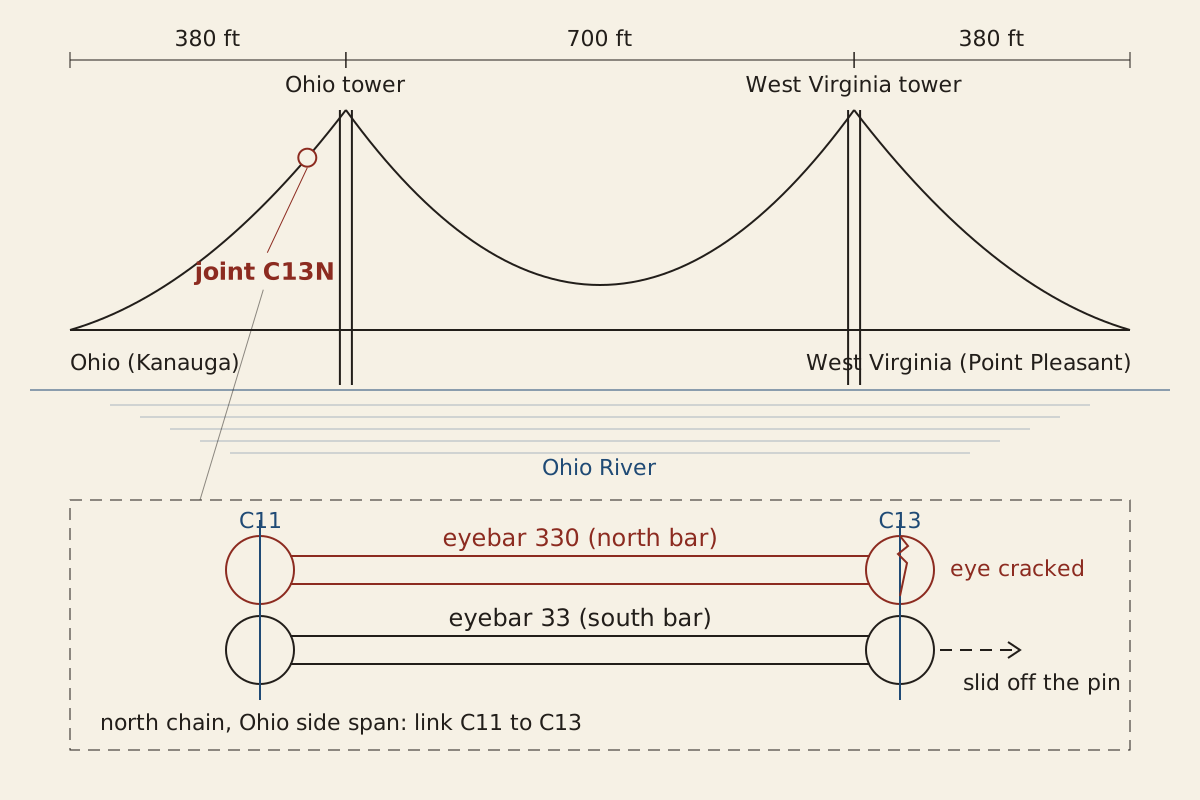
Figure: From the Surviving Record, CC BY 4.0
Full credit line for reuse
"Silver Bridge: north eyebar chain and joint C13N" by From the Surviving Record, CC BY 4.0. Source: https://fromthesurvivingrecord.com/failures/silver-bridge/ — License: https://creativecommons.org/licenses/by/4.0/
Data: National Transportation Safety Board, Highway Accident Report NTSB-HAR-71-1, Collapse of U.S. 35 Highway Bridge, Point Pleasant, West Virginia (1970), retrieved 2026-11-01, public domain
What broke first?
On December 15, 1967, the Silver Bridge between Point Pleasant, West Virginia, and Kanauga, Ohio, collapsed in about a minute. The National Transportation Safety Board (NTSB) gives that timing and puts the collapse at about 5 p.m.; by its count, 46 people died and nine were injured. Of the 37 vehicles on the bridge, 31 fell with it, 24 into the Ohio River and seven onto the Ohio shore, the report says.
The bridge hung from chains, not wire cables. Each chain was made of eyebars, flat steel bars with a ring-shaped eye at each end, pinned to the next pair like the links of a bicycle chain. By the report's figures, the center span was 700 feet long (213 m) and each side span 380 feet (116 m). The NTSB's report mostly calls the structure the Point Pleasant Bridge; one of its figures and several of the studies it cites use the name Silver Bridge.
The first part to fail, the NTSB found, was eyebar 330, the north bar of a pair in the north chain between joints C11 and C13 (C13 was the first joint west of the Ohio tower). In the report's sequence, the lower half of the eye at the C13 end cracked straight across, then the upper half tore. Its partner, eyebar 33, slid off the end of the pin. The chain came apart.
The NTSB reached eyebar 330 by elimination. The U.S. Army Corps of Engineers raised the wreckage from the river, and by October 1969, the report says, about 90 percent of the available pieces had been identified and laid out at a reassembly site. Both towers had fallen toward the West Virginia shore, which, the Board reasoned, placed the break in the Ohio side span, where the only failure in the chain was at C13N. An Army ordnance team found no sign of explosions in the salvaged vehicles, and a check with nearby military bases found no aircraft likely to explain the “sonic boom” some witnesses described.
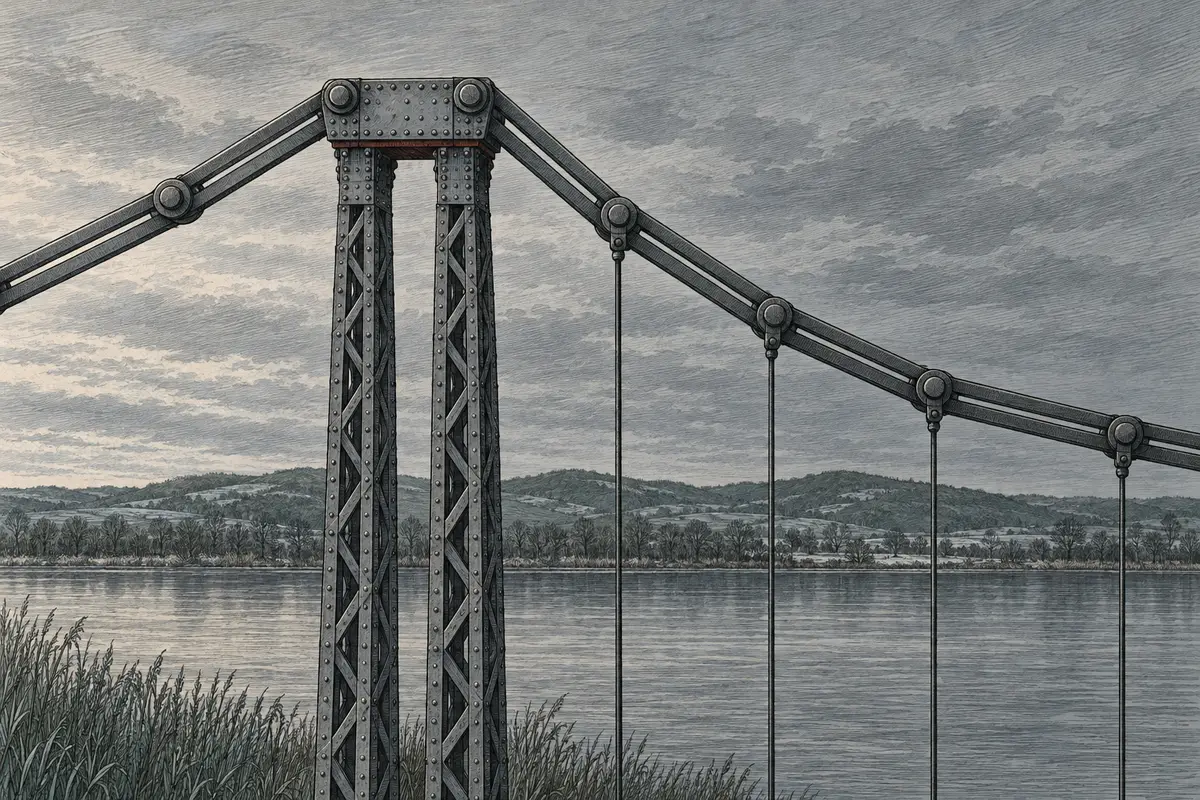
Illustration: From the Surviving Record. Generated schematic image — not a photograph or historical record. © From the Surviving Record, all rights reserved.
The NTSB set out its finding as one cause and three numbered contributing causes; all four, with two of its conclusions and the report's page numbers, are in the file below. A 1915 British inquiry into a sinking worded its findings quite differently, as the entry on the Lusitania inquiry shows.
Download the table (CSV, silver-bridge-cause.csv) (file notes: sources and license) Data: National Transportation Safety Board, Highway Accident Report NTSB-HAR-71-1, Collapse of U.S. 35 Highway Bridge, Point Pleasant, West Virginia (1970), retrieved 2026-11-01, public domain
Why did one link matter so much?
Each link of the Silver Bridge's chains had two eyebars side by side. At C13N, the NTSB found, the second bar slipped off the pin once the first had broken.
By dead reckoning, when one bar of a two-bar link breaks, the whole pull of that link falls on the other bar, twice its usual share if the two had shared it equally and the pull stays the same.
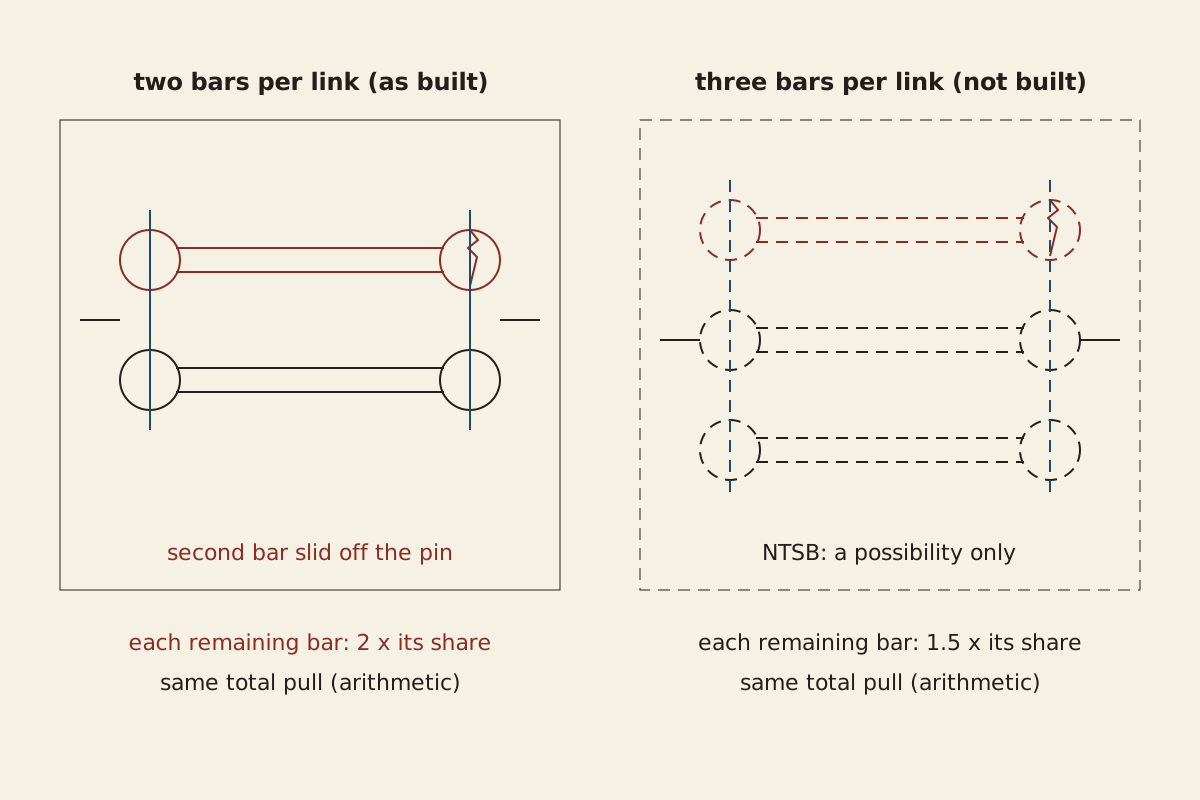
Figure: From the Surviving Record, CC BY 4.0
Full credit line for reuse
"Two-bar and three-bar eyebar links after one bar breaks" by From the Surviving Record, CC BY 4.0. Source: https://fromthesurvivingrecord.com/failures/silver-bridge/ — License: https://creativecommons.org/licenses/by/4.0/
Data: National Transportation Safety Board, Highway Accident Report NTSB-HAR-71-1, Collapse of U.S. 35 Highway Bridge, Point Pleasant, West Virginia (1970), retrieved 2026-11-01, public domain
In its conclusions the NTSB listed the two-bar link as one of the elements that contributed to the failure: “The use of only two eyebars per link in the eyebar chain.” That choice, the report says, made total failure of the chain “inevitable” once eyebar 330 fractured. With three or more bars per link, it added, there “would have been the possibility” that losing one bar “would not have led to disaster.”
The rest of the structure, in the NTSB's account, could not take up the slack either. Once the north chain separated at C13N, total collapse “was a certainty due to its design with the towers resting on rocker seats.” A rocker seat is a curved bearing that lets a tower lean slightly as the chains stretch and shrink.
By dead reckoning, the bridge had what engineers call a single load path: one route for the force, with no second route to carry it if a part failed. The NTSB does not use that phrase, but its conclusion on two-bar links describes the same idea. A different failure, in a cantilever bridge under construction, is traced in the 1908 Quebec Bridge inquiry, which put its main finding on the design of the lower chords.
How did the crack grow?
The crack that started it all was small. Laboratory work by the National Bureau of Standards (NBS), as summarized in the NTSB report, found a semicircular crack about 1/8 inch (3.2 mm) in radius, with a smaller one about 1/16 inch (1.6 mm) beside it. The NBS traced both to the inside surface of the pinhole, where the pin bore on the eye.
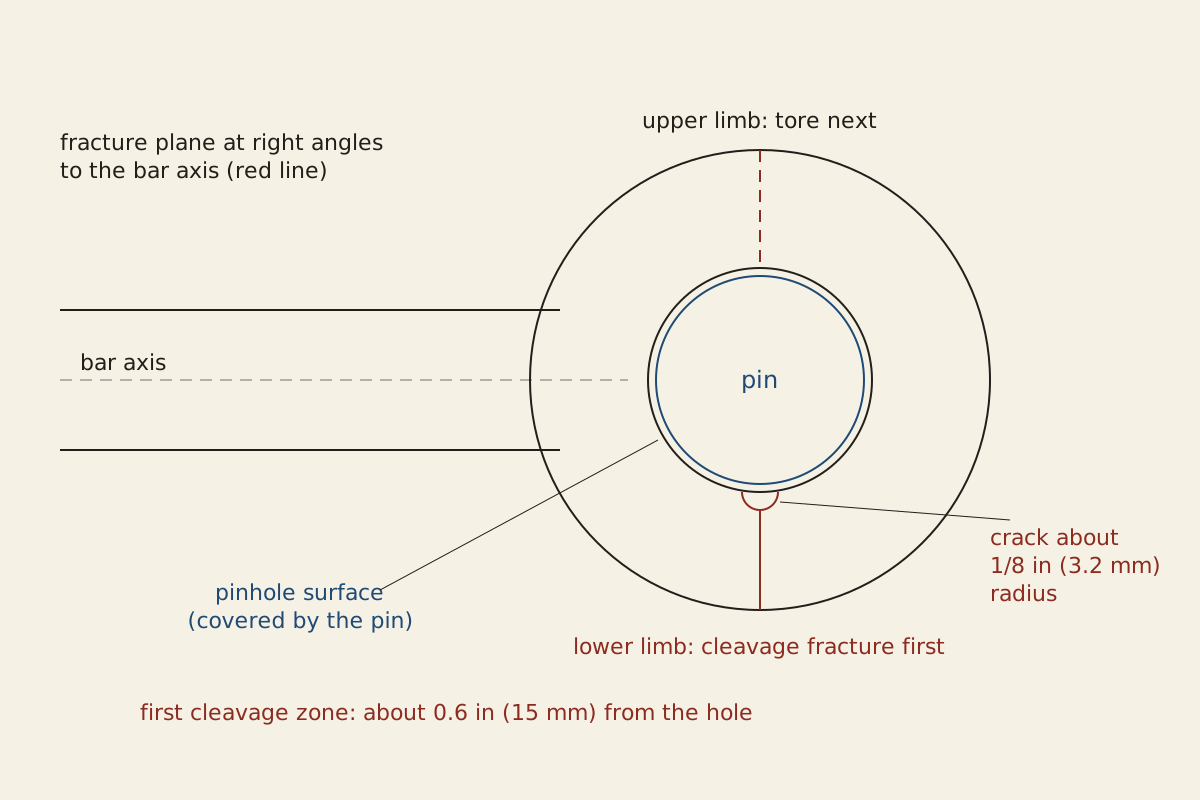
Figure: From the Surviving Record, CC BY 4.0
Full credit line for reuse
"Where the crack in eyebar 330 began" by From the Surviving Record, CC BY 4.0. Source: https://fromthesurvivingrecord.com/failures/silver-bridge/ — License: https://creativecommons.org/licenses/by/4.0/
Data: National Transportation Safety Board, Highway Accident Report NTSB-HAR-71-1, Collapse of U.S. 35 Highway Bridge, Point Pleasant, West Virginia (1970), retrieved 2026-11-01, public domain
According to the report, the crack probably began at a small corrosion pit. Its surfaces carried more sulfur compounds than normal, which, the report says, indicates that sulfur-bearing gases in the air may have worked into it. The NTSB said the crack grew by two processes acting together: stress corrosion, in which steel under steady stress cracks slowly in a corrosive setting, and corrosion fatigue, in which repeated loading does the same. Its analysis leaned toward stress corrosion, but its conclusions say the evidence could not settle which mattered more.
The steel itself met its specification, the NBS found. In the NBS tests it was a heat-treated carbon steel with limited toughness at 32°F (0°C), which the report gives as the approximate temperature when the bridge fell. The eyebars were designed to work at 50,000 psi, two-thirds of the steel's specified elastic limit, and the report says that typically 75 to 80 percent of the stress came from the bridge's own weight.
The NTSB's cause says “the 40-year life of the structure,” and the same report gives three design dates: 1926 in its foreword, 1926 and 1927 for design and erection, and 1927 in its first contributing cause. It dates completion to 1928. From 1927 to 1967 is 40 years; from 1928 it is 39. The report does not say which year it counted from.
Could an inspection have found it?
The NTSB answered this directly. Its second and third contributing causes read: “The location of the flaw was inaccessible to visual inspection,” and “The flaw could not have been detected by any inspection method known in the state of the art today without disassembly of the eyebar joint.” Today, in that sentence, means 1970.
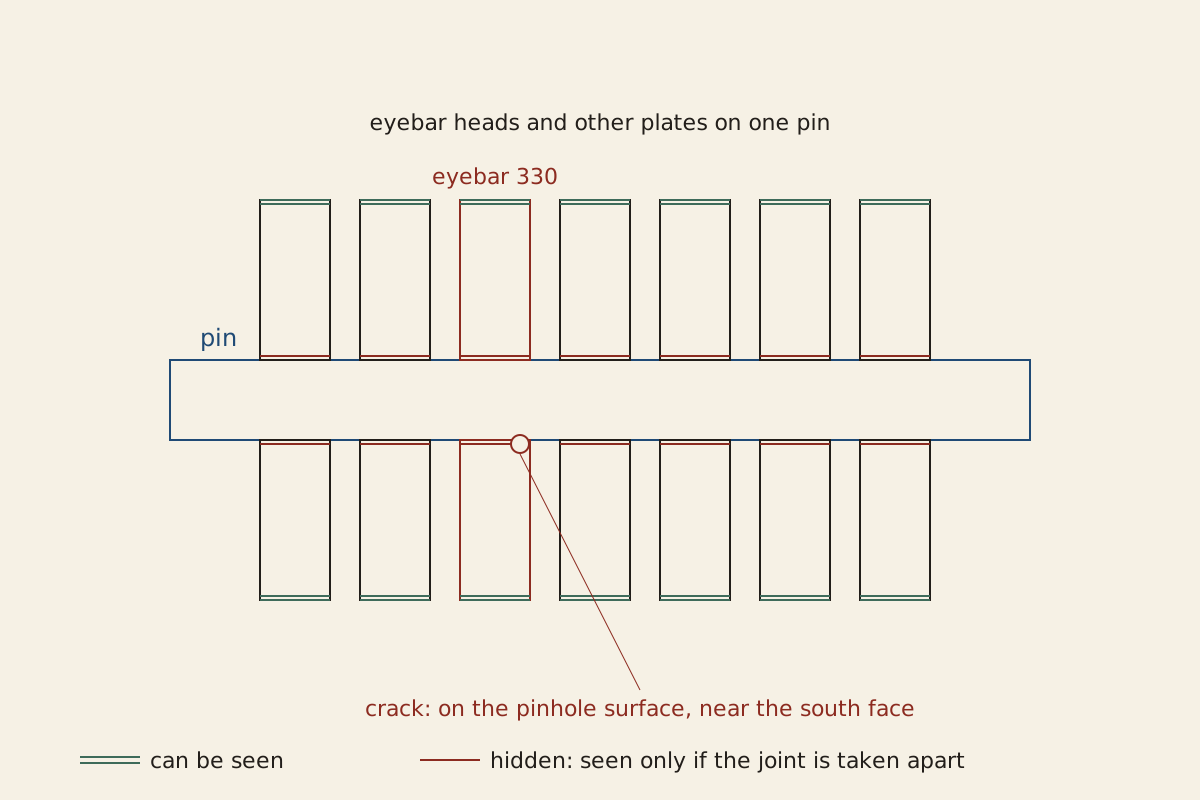
Figure: From the Surviving Record, CC BY 4.0
Full credit line for reuse
"What an inspector could see at an eyebar pin joint" by From the Surviving Record, CC BY 4.0. Source: https://fromthesurvivingrecord.com/failures/silver-bridge/ — License: https://creativecommons.org/licenses/by/4.0/
Data: National Transportation Safety Board, Highway Accident Report NTSB-HAR-71-1, Collapse of U.S. 35 Highway Bridge, Point Pleasant, West Virginia (1970), retrieved 2026-11-01, public domain
The conclusions add the reason. The crack was small, and it sat on the inside surface of the hole, with the pin filling the hole. A gap between pin and hole let rainwater in, and the report calls the spot a “water collection pocket” next to a point of high stress. That point, it says, “was not accessible for inspection.”
The Board had said much the same two years earlier. In a press release of December 31, 1968, as the final report sums it up, the Board said such cracks “may be entirely undetectable in the present state of the art of bridge inspection without disassembly of members.” The same release noted that West Virginia had closed the St. Marys Bridge, which the report calls a sister structure.
The report's wider conclusions point the same way. Better inspection, it said, would “certainly detect” bridges weakened by surface corrosion, impact damage and other visible defects. But in some steels prone to slow crack growth, it added, the critical flaw size is undetectable by “present inspection devices and methodology.”
By dead reckoning, a routine look at C13N in any year before 1967 would have shown the outside of the joint and nothing of the crack. That rests on contributing causes 2 and 3 and on conclusion 5; no inspection record for the joint is among the pages read.
From design to collapse to rule
The dates below come from the NTSB report, the 1968 statute and the 1971 rule. Each interval is counted two ways, by calendar date and by day number. The two agree.
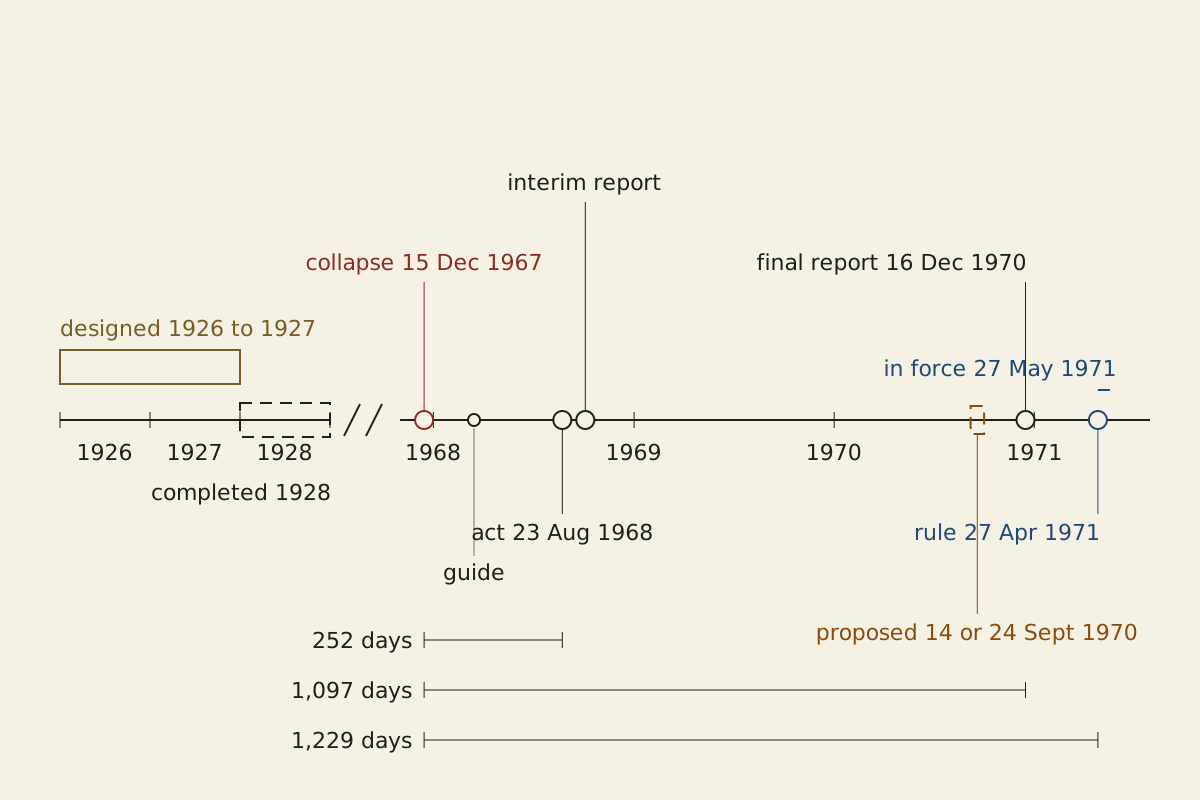
Figure: From the Surviving Record, CC BY 4.0
Full credit line for reuse
"Silver Bridge: from design to the 1971 inspection rule" by From the Surviving Record, CC BY 4.0. Source: https://fromthesurvivingrecord.com/failures/silver-bridge/ — License: https://creativecommons.org/licenses/by/4.0/
Data: National Transportation Safety Board, Highway Accident Report NTSB-HAR-71-1, Collapse of U.S. 35 Highway Bridge, Point Pleasant, West Virginia (1970), retrieved 2026-11-01, public domain; Federal-Aid Highway Act of 1968, Public Law 90-495, 82 Stat. 815 (1968), retrieved 2026-11-01, public domain; National Bridge Inspection Standards, 23 CFR Part 25, Federal Register vol. 36, pp. 7851-7852 (1971), retrieved 2026-11-01, public domain
| Date | Event | Source |
|---|---|---|
| 1926 to 1927 | Bridge designed (the report gives both years) | NTSB, pp. 2, 114, 126 |
| 1928 | Bridge completed | NTSB, p. 1 |
| 15 Dec 1967 | Collapse, at about 5 p.m. | NTSB, p. 9 |
| March 1968 | Inspection guide sent to all states | NTSB, p. 82 |
| 23 Aug 1968 | Federal-Aid Highway Act of 1968 approved | 82 Stat. 815 |
| 4 Oct 1968 | NTSB interim report | NTSB, p. 1 |
| 14 or 24 Sept 1970 | Inspection standards proposed (the sources differ) | Federal Register; NTSB, p. 83 |
| 16 Dec 1970 | NTSB final report adopted | NTSB, cover |
| 27 Apr 1971 | Inspection standards published | Federal Register, p. 7851 |
| 27 May 1971 | Standards in force, 30 days after publication | Federal Register, p. 7851 (date reckoned) |
Download the table (CSV, silver-bridge-timeline.csv) (file notes: sources and license) Data: National Transportation Safety Board, Highway Accident Report NTSB-HAR-71-1, Collapse of U.S. 35 Highway Bridge, Point Pleasant, West Virginia (1970), retrieved 2026-11-01, public domain; Federal-Aid Highway Act of 1968, Public Law 90-495, 82 Stat. 815 (1968), retrieved 2026-11-01, public domain; National Bridge Inspection Standards, 23 CFR Part 25, Federal Register vol. 36, pp. 7851-7852 (1971), retrieved 2026-11-01, public domain
The act came 252 days after the collapse, before the NTSB had determined what caused the fracture. The final report followed 1,097 days after the collapse, and the inspection standards 1,229 days after it.
What changed after?
The change that can be traced is a set of rules for looking at bridges, which this site calls the quiet retrofit: a design or rule change made after a failure, checked for what changed, how public it was, and the reason the documents give.
Fix: the national bridge inspection standards rest on section 26 of the Federal-Aid Highway Act of 1968. The act's text adds the duty to 23 U.S.C. 116(d), the 1971 rule cites that section as its authority, and the NTSB report describes the act as requiring the standards.
Section 26, approved on August 23, 1968, told the Secretary of Transportation to “as soon as possible establish national bridge inspection standards” for bridges on the Federal-aid highway system. The standards were to set the inspection method, “the maximum time lapse between inspections” and who was qualified to inspect. The rule published on April 27, 1971, gave the answer on timing: each bridge “at regular intervals not to exceed 2 years.” It also set minimum qualifications for whoever ran a state's inspections, such as registration as a professional engineer or ten years of inspection experience plus a training course, and gave 1972 and 1973 deadlines for a bridge inventory.
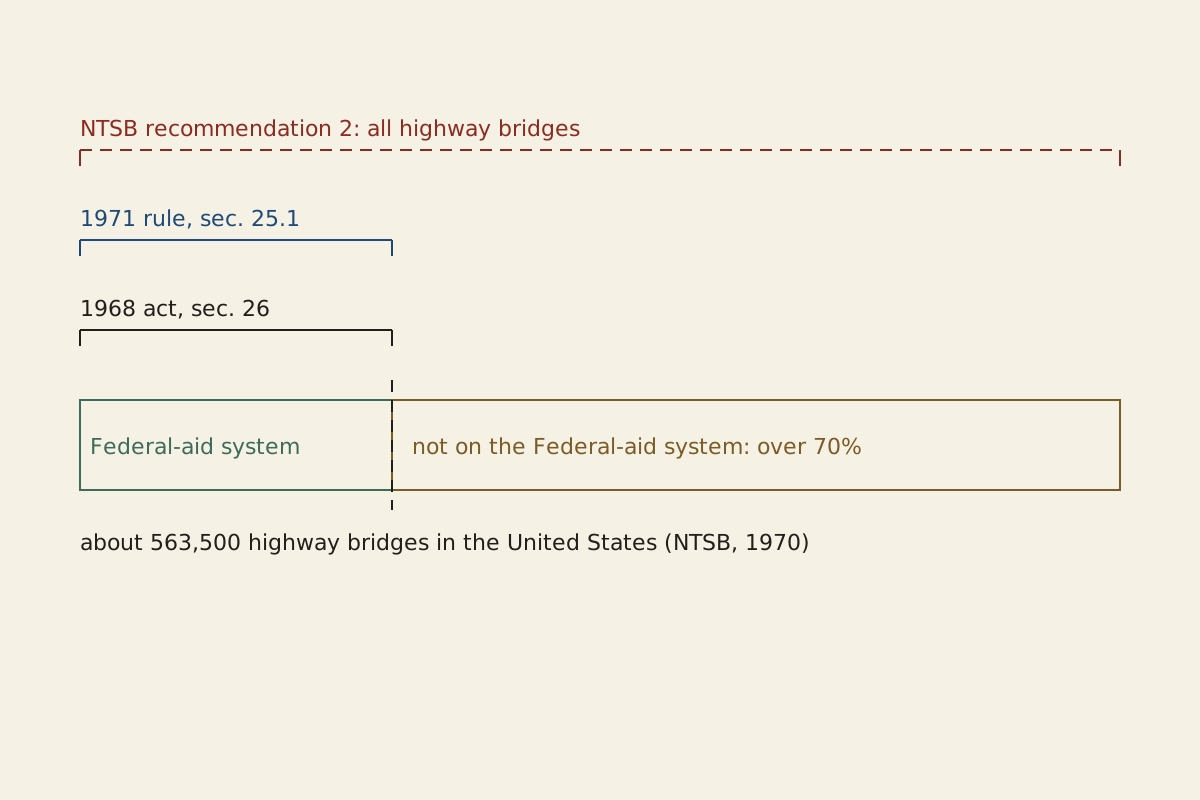
Figure: From the Surviving Record, CC BY 4.0
Full credit line for reuse
"Which bridges the 1968 act, the 1971 rule and NTSB recommendation 2 cover" by From the Surviving Record, CC BY 4.0. Source: https://fromthesurvivingrecord.com/failures/silver-bridge/ — License: https://creativecommons.org/licenses/by/4.0/
Data: National Transportation Safety Board, Highway Accident Report NTSB-HAR-71-1, Collapse of U.S. 35 Highway Bridge, Point Pleasant, West Virginia (1970), retrieved 2026-11-01, public domain; Federal-Aid Highway Act of 1968, Public Law 90-495, 82 Stat. 815 (1968), retrieved 2026-11-01, public domain; National Bridge Inspection Standards, 23 CFR Part 25, Federal Register vol. 36, pp. 7851-7852 (1971), retrieved 2026-11-01, public domain
| Record | What it says | Covers | Names the Silver Bridge? |
|---|---|---|---|
| 1968 Act, sec. 26 | Inspection standards to be set “as soon as possible” | Federal-aid highway system | No |
| 1971 rule, 23 CFR Part 25 | Inspection at intervals not over 2 years; inspector qualifications; inventory | Bridges on Federal-aid systems | No |
| NTSB recommendation 2 (1970) | Explore making the act's bridge safety rules mandatory for all highway bridges | All US highway bridges | Not in rec. 2; the report does, as the Point Pleasant Bridge |
Download the table (CSV, silver-bridge-quiet-retrofit.csv) (file notes: sources and license) Data: National Transportation Safety Board, Highway Accident Report NTSB-HAR-71-1, Collapse of U.S. 35 Highway Bridge, Point Pleasant, West Virginia (1970), retrieved 2026-11-01, public domain; Federal-Aid Highway Act of 1968, Public Law 90-495, 82 Stat. 815 (1968), retrieved 2026-11-01, public domain; National Bridge Inspection Standards, 23 CFR Part 25, Federal Register vol. 36, pp. 7851-7852 (1971), retrieved 2026-11-01, public domain
Both the statute and the rule were public: one in the Statutes at Large, the other in the Federal Register, after a proposal that drew 145 comments, according to the rule's preamble. Neither text names the Silver Bridge or Point Pleasant. The NTSB report describes the 1968 act in its section on bridge inspection but does not say the collapse prompted it. On the record here, the link between them is a sequence of dates, not a stated reason.
The NTSB's own recommendation went further than the rule. Its report gives about 563,500 highway bridges in the United States and says over 70 percent were outside the Federal-aid system. It asked the Secretary to explore making the 1968 act's bridge safety requirements mandatory for all of them. The 1971 rule, by its first section, applied to bridges on the Federal-aid highway systems.
The last good decision
By dead reckoning, three points on this timeline could be candidates for the last good decision: the design of 1926 and 1927, later inspection, and the loads the bridge carried. Each is tested against what could be known at the time, not what the NTSB learned afterward.
The design is the strongest candidate on paper and the weakest on the record. The NTSB says that in 1927 stress corrosion and corrosion fatigue “were not known to occur” in these materials in rural exposure, so the hazard that grew the crack was not available to the designers. A third bar per link was an option open to them, and the NTSB names it, but the pages read do not show whether the designers weighed it.
Inspection offers no candidate. The NTSB's contributing causes 2 and 3 say no method known even in 1970 could find the flaw without taking the joint apart, and the pages read show no reason anyone had in those years to take the joint apart.
The loads offer none either. The investigation's bridge design review group, as the NTSB reports, found that stresses in the chain at the moment of collapse were well below the maximum allowed in the original design. On the NTSB's findings, the last good decision cannot be determined from the record read here. The limit of this analysis is that only the final report was read, not the design files or the inspection history it drew on.
Still missing:
- When the crack began. The NTSB calls it pre-existing only “in the sense that it was present prior to the initiation of collapse,” not necessarily when the bridge was built, and gives no start date or growth rate.
- How this finding compares with a failure blamed on the ground. The 1928 inquiry into the St. Francis Dam looked beneath the structure rather than inside one part: St. Francis Dam: The 1928 Inquiry Blamed the Rock Beneath It.
- What came of recommendation 2. Whether the Secretary acted on the call to cover all highway bridges is not in the sources on file.
Cite this page
From the Surviving Record. “Silver Bridge Collapse: NTSB Traced It to One Hidden Crack.” First published 2026-11-01. https://fromthesurvivingrecord.com/failures/silver-bridge/ (accessed add the date you read it).
Sources
- National Transportation Safety Board, Highway Accident Report: Collapse of U.S. 35 Highway Bridge, Point Pleasant, West Virginia, December 15, 1967, Report No. NTSB-HAR-71-1 (Washington, D.C., adopted December 16, 1970). www.ntsb.gov/investigations/AccidentReports/Reports/HAR7101.pdf Read: front matter and pages 1–39, 82–85, 93–102 and 114–132, including the synopsis, conclusions, cause, recommendations and references.
- Federal-Aid Highway Act of 1968, Pub. L. No. 90-495, 82 Stat. 815 (August 23, 1968), sec. 26 (82 Stat. 829), adding 23 U.S.C. 116(d). www.govinfo.gov/content/pkg/STATUTE-82/pdf/STATUTE-82-Pg815.pdf Read: full text of section 26, the title page and the approval date; the whole act searched for mentions of the bridge.
- Federal Highway Administration, "National Bridge Inspection Standards," 23 CFR Part 25, Federal Register 36, no. 81 (April 27, 1971): 7851–7852. www.govinfo.gov/content/pkg/FR-1971-04-27/pdf/FR-1971-04-27.pdf Read: full text of the rule and its preamble; the whole issue searched for mentions of the bridge.
Spotted an error? Write to contact@fromthesurvivingrecord.com (the link fills in this page's title as the subject). Changes are logged in the corrections log and at the foot of the entry; the evidence levels page explains how sources are weighed.
Related entries
-
Engineering Failures
St. Francis Dam: The 1928 Inquiry Blamed the Rock Beneath It
Why did the St. Francis Dam fail in 1928? A state commission blamed defective foundations. Its findings, the flood's timeline and what it asked the state to do.
Picture credit
"The St. Francis Dam" by H. T. Stearns, U.S. Geological Survey — https://commons.wikimedia.org/wiki/File:The_St._Francis_Dam.jpg — Public domain (US: work of a U.S. Geological Survey employee in the course of his duties, not protected by copyright (17 U.S.C. 105); EU: rule of the shorter term (Term Directive art. 7(1)) for a work of US origin with no US term; accepted for federal works by site ruling of 2026-11-01)
-
Engineering Failures
Quebec Bridge Collapse: The 1908 Inquiry Blamed Chord Design
Why did the Quebec Bridge collapse in 1907? Canada's 1908 Royal Commission blamed the design of its lower chords and found its weight had been set too low.
Picture credit
"Pont de Québec vers 1917" by William Notman and Son — https://commons.wikimedia.org/wiki/File:Pont_de_QC_1917_Notman.jpg — Public domain (Canada: photograph made before 1 January 1949 (PD-Canada); US: published before 1931 (PD-US-expired on the file page); EU: a studio work with no individual photographer named on the file page or in the museum record, treated as an anonymous work under the site ruling of 1 November 2026; published before 1931 (PD-US-expired on the file page), so more than 70 years have passed since publication)