Quebec Bridge Collapse: The 1908 Inquiry Blamed Chord Design
Published Last substantive revision
How to read this page: each point is marked as a cross-checked fix, a single record (“according to”), or inference (“by dead reckoning”).
TL;DR: A Royal Commission reported in 1908 that the Quebec Bridge fell on August 29, 1907, because the lower chords of its anchor arm failed “due to their defective design,” under stresses that “might be expected in the regular course of erection.” It also found that the bridge's own weight had been assumed too low and never revised, an error it said would have condemned the bridge even if those chords had been strong enough.
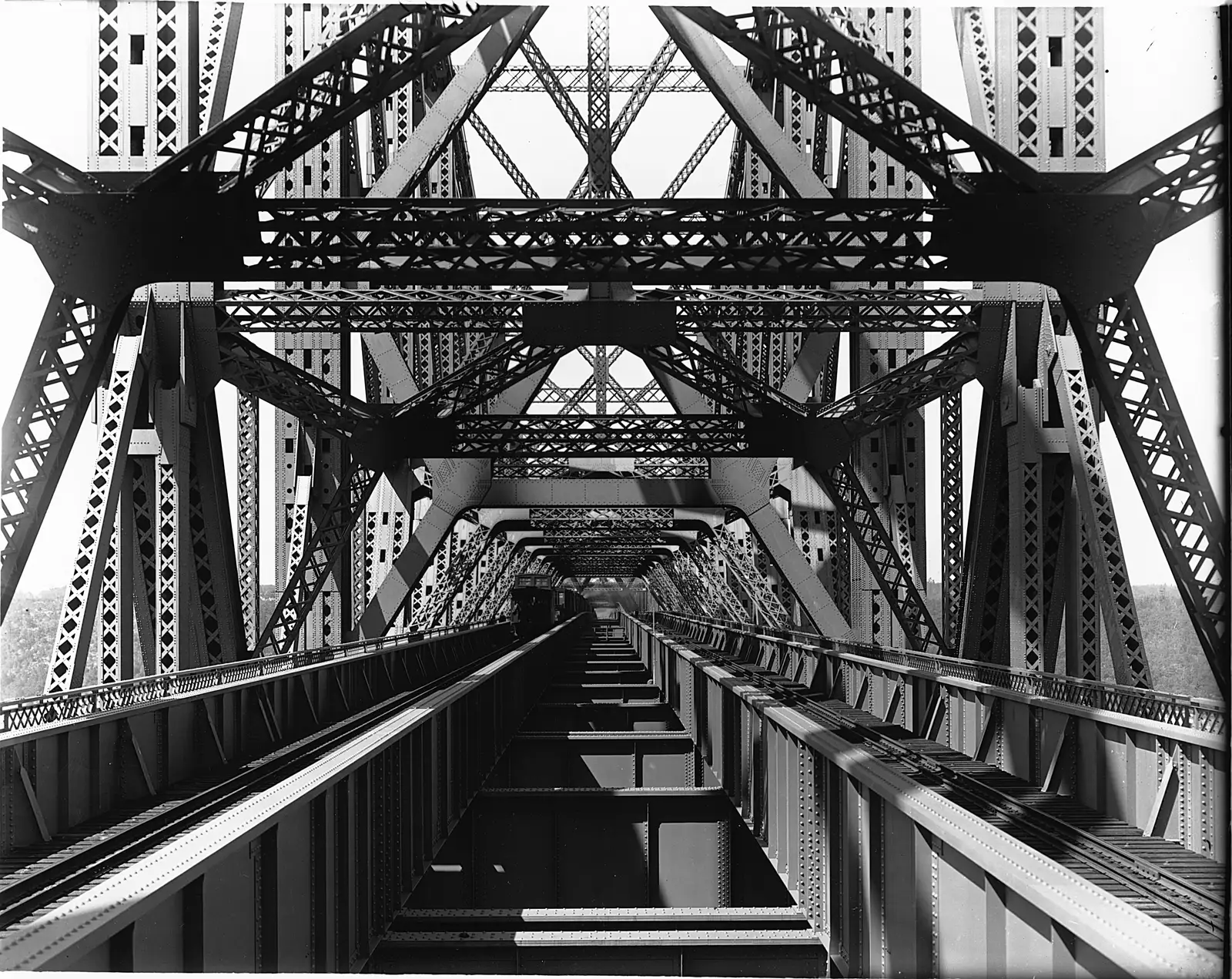
“Pont de Québec vers 1917” by William Notman and Son, Public domain
Full credit
"Pont de Québec vers 1917" by William Notman and Son — https://commons.wikimedia.org/wiki/File:Pont_de_QC_1917_Notman.jpg — Public domain (Canada: photograph made before 1 January 1949 (PD-Canada); US: published before 1931 (PD-US-expired on the file page); EU: a studio work with no individual photographer named on the file page or in the museum record, treated as an anonymous work under the site ruling of 1 November 2026; published before 1931 (PD-US-expired on the file page), so more than 70 years have passed since publication)
What fell on August 29, 1907?
On August 29, 1907, the south half of the unfinished Quebec Bridge fell, its outer arm into the St. Lawrence. Of the 86 men on the work, the Royal Commission later wrote, “only eleven escaped with their lives.” It put the whole fall at no more than 15 seconds.
The bridge was a cantilever design. A cantilever is a beam held at one end and free at the other. Here each main pier was to carry a steel arm reaching out over the river, balanced by an anchor arm tied down on the shore, with a suspended span hung between the tips of the two river arms.
According to the Report on Design of Quebec Bridge that C. C. Schneider wrote for the government in January 1908, the main span measured 1,800 feet (548.6 m) between the centres of the piers. It was made of two cantilever arms of 562 feet 6 inches and a suspended span of 675 feet. With two anchor arms of 500 feet each, the whole came to 2,800 feet (853.4 m), not counting the approach spans.
By the commission's account, erection began at the south anchor pier on July 22, 1905. The south anchor arm and nearly all of its cantilever arm were up by the end of 1906, and on the day of the collapse the fourth panel of the suspended span was being put in place. The report describes the north half's steel as made and inspected, not erected.
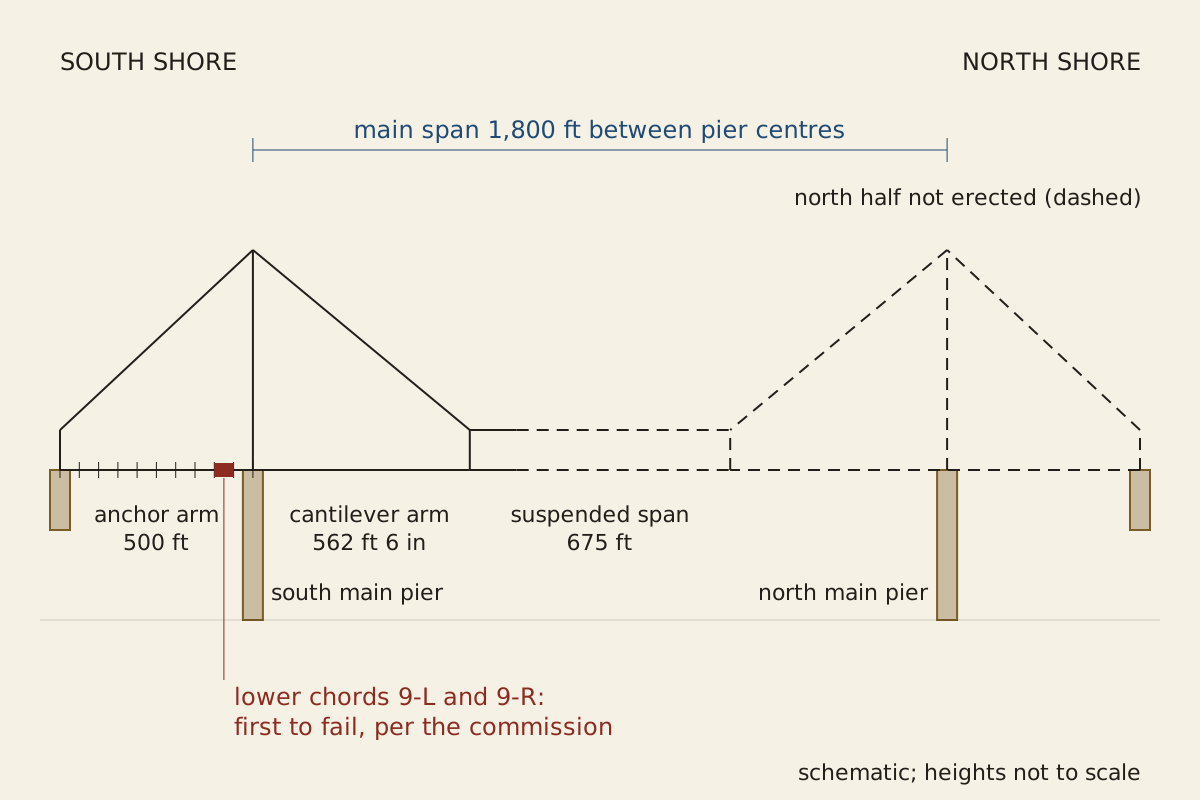
Figure: From the Surviving Record, CC BY 4.0
Full credit line for reuse
"Quebec Bridge as designed and what stood on 29 August 1907" by From the Surviving Record, CC BY 4.0. Source: https://fromthesurvivingrecord.com/failures/quebec-bridge/ — License: https://creativecommons.org/licenses/by/4.0/
Data: Royal Commission, Quebec Bridge Inquiry, Report, with C. C. Schneider, Report on Design of Quebec Bridge (Sessional Paper No. 154, Ottawa, 1908), retrieved 2026-11-01, public domain
What is a lower chord, and why did these fail?
A truss is a frame of straight steel members joined in triangles. Its chords are the long members along the top and the bottom. In this bridge's anchor arm, the lower chords were squeezed along their length. Engineers call that compression.
None of these chords was one solid bar. Schneider describes them as “four separate ribs,” steel plates standing side by side. Small bars riveted across the ribs, called latticing, were meant to tie the four together so they would act as one member.
The government named a Royal Commission of three engineers the day after the collapse: Henry Holgate, J. G. G. Kerry and John Galbraith. Their report, signed at Montreal on February 20, 1908, opens its findings with a short one: “The collapse of the Quebec bridge resulted from the failure of the lower chords in the anchor arm near the main pier. The failure of these chords was due to their defective design.”
The second finding rules out weather and accident. The stresses “were not due to abnormal weather conditions or accident,” but were those to be expected while the bridge was being built.
Fix: the latticing that tied the lower chords near the main pier together was too weak for its job. The Royal Commission concluded from the evidence and its own tests that “the latticing of the lower chords near the main pier was too weak to carry the stresses to which it was subjected.” Schneider, hired separately by the Department of Railways and Canals, worked from the drawings and wrote in his own report that the most pronounced defect of this kind was in the lower chords, whose ribs were not tied strongly enough “to make them act as a unit.”
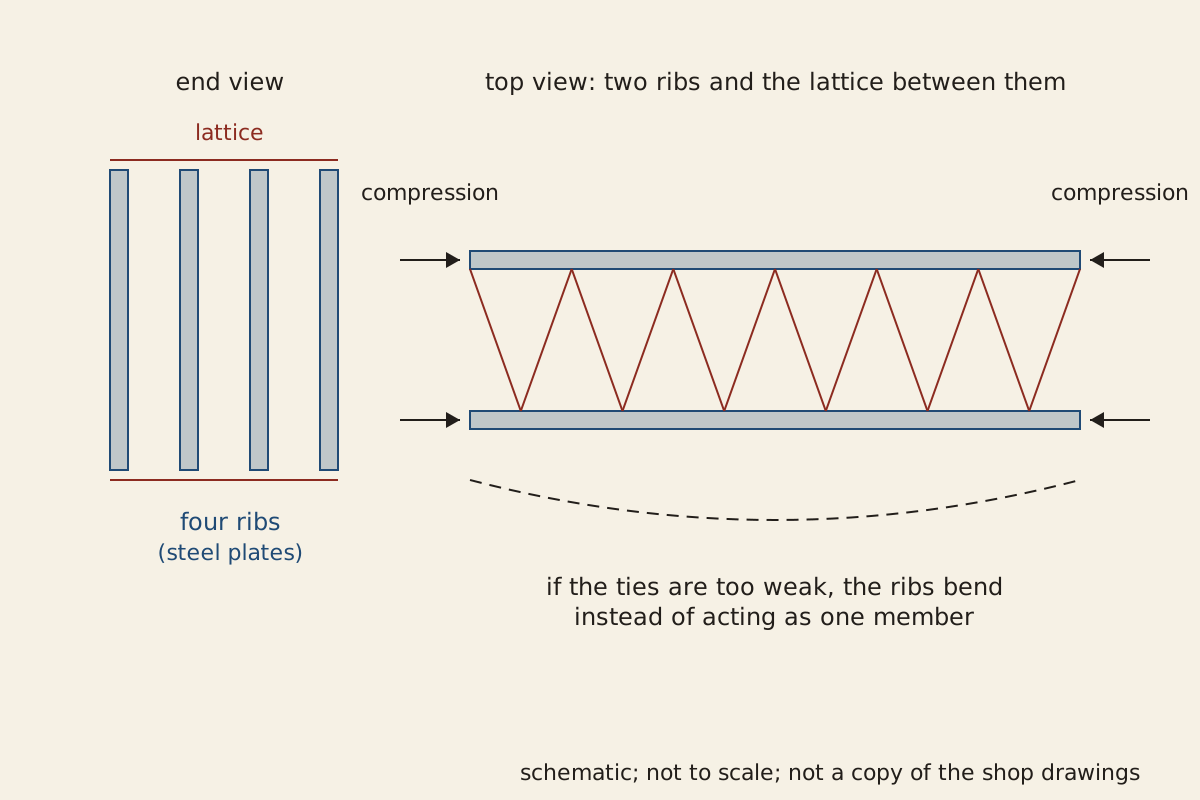
Figure: From the Surviving Record, CC BY 4.0
Full credit line for reuse
"A built-up lower chord: four ribs tied by lattice bars" by From the Surviving Record, CC BY 4.0. Source: https://fromthesurvivingrecord.com/failures/quebec-bridge/ — License: https://creativecommons.org/licenses/by/4.0/
Data: Royal Commission, Quebec Bridge Inquiry, Report, with C. C. Schneider, Report on Design of Quebec Bridge (Sessional Paper No. 154, Ottawa, 1908), retrieved 2026-11-01, public domain
The commission added a limit to its own finding. The stresses that broke chords 9-L and 9-R, which it judged “the first to fall,” came partly from weak details at the chord ends and from loose or missing splice plates during erection. It had no evidence that the chords would have failed if loaded straight along their axis. It still judged them “dangerously weak in the body” for the work they had to do.
Why did the bridge's weight matter?
The dead load of a bridge is the weight of the bridge itself, as opposed to the trains it will carry. The report explains the usual method: a designer begins “by assuming what its weight will be,” then corrects that figure from the drawings as the design takes shape. The specification for this bridge said the dead weight used for the stresses “must not be less than the actual weight of structure when completed.”
That check was not made in time. According to the commission, shop work on the steel began in July 1904 without it. By early 1905 the anchor arm drawings were complete enough to compute its weight within about two per cent, and the report finds “no evidence” that anyone did.
Cooper, the consulting engineer, did not learn of the error, the report says, until he received a report on material dated February 1, 1906, by which time six panels of the anchor arm were already in place. He estimated that it raised the unit stresses by seven to ten per cent and let the work go on.
| Part | Weight assumed for the design (lb) | Weight as determined on June 25, 1907 (lb) | Increase |
|---|---|---|---|
| Half suspended span | 4,842,000 | 5,694,000 | 17.6% |
| Cantilever arm | 13,205,200 | 15,804,000 | 19.7% |
| Anchor arm | 13,317,600 | 17,318,000 | 30.0% |
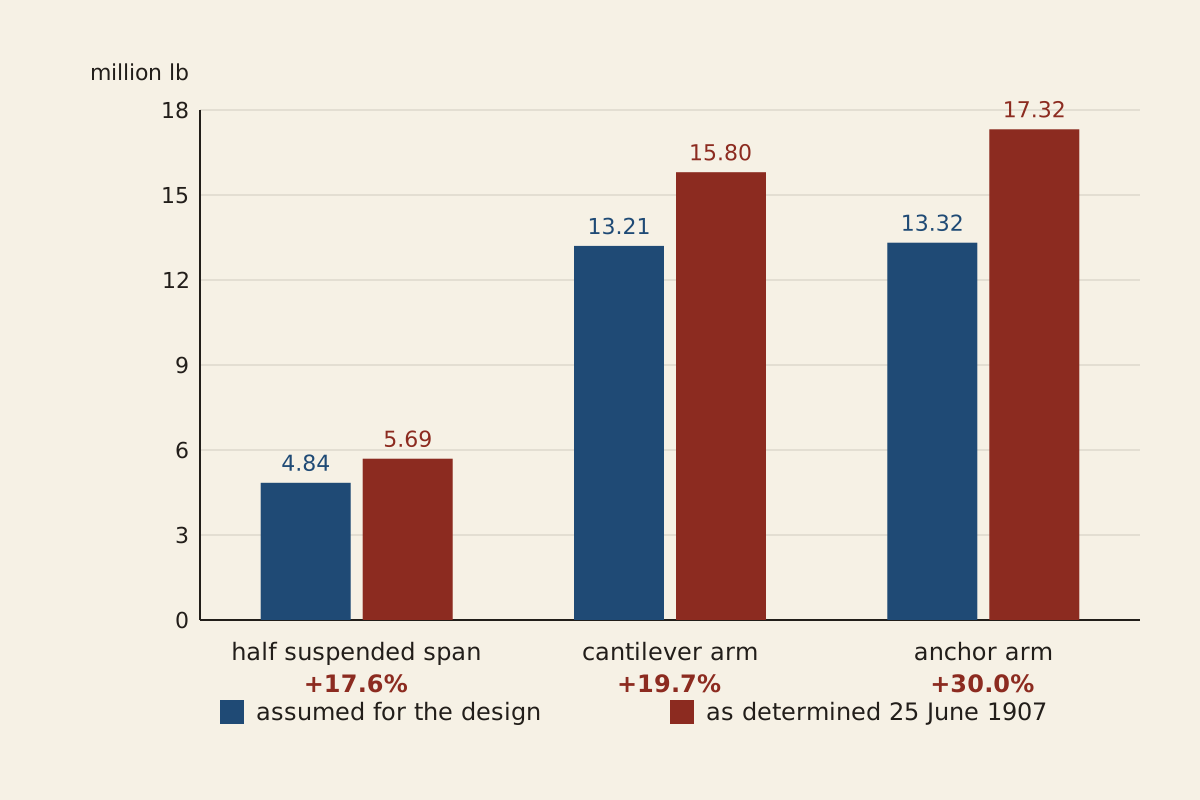
Figure: From the Surviving Record, CC BY 4.0
Full credit line for reuse
"Dead load assumed in the design against the June 1907 figures" by From the Surviving Record, CC BY 4.0. Source: https://fromthesurvivingrecord.com/failures/quebec-bridge/ — License: https://creativecommons.org/licenses/by/4.0/
Data: Royal Commission, Quebec Bridge Inquiry, Report, with C. C. Schneider, Report on Design of Quebec Bridge (Sessional Paper No. 154, Ottawa, 1908), retrieved 2026-11-01, public domain
The anchor arm's figure rose from 13,317,600 to 17,318,000 pounds, about 6,041 to 7,855 tonnes. The commission put the resulting error in the stresses of the main chords near the centre posts at “fully 10 per cent.” Schneider's tables found the stresses in the anchor arm chords above the specification's limits by 11 to 20 per cent.
The commission's comparison rests on the figures determined on June 25, 1907, before the collapse. Schneider worked from the shipping weights of the steel and wrote in his report that “the actual weight of the steel superstructure is in excess of that estimated.”
Download the table (CSV, quebec-bridge-dead-load.csv) (file notes: sources and license) Data: Royal Commission, Quebec Bridge Inquiry, Report, with C. C. Schneider, Report on Design of Quebec Bridge (Sessional Paper No. 154, Ottawa, 1908), retrieved 2026-11-01, public domain
The commission kept this finding separate from the cause. In finding (h), it called the weight error “grave” and said it would have “required the condemnation of the bridge, even if the details of the lower chords had been of sufficient strength.” It said only that the error “tended to hasten the disaster.”
By dead reckoning, the two errors met in the same members: a heavier bridge put more load on chords that the commission already judged too weak. The report does not say how much sooner the extra weight brought the fall, so no figure is offered here.
August 27 to 29, 1907
The warning came two days before the fall. At about 9:30 a.m. on August 27, according to the report, a bend in lower chord 9-L of the anchor arm was found to have “greatly increased.” The men at the site measured it and argued over it, and an inspector named McLure was sent to New York to consult Cooper. The commission was satisfied that “no one connected with the work was expecting immediate disaster.”
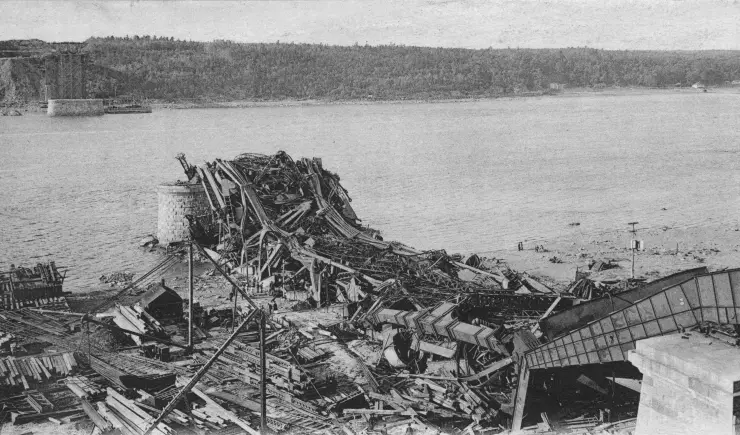
“Le pont de Québec après son écroulement” by Neurdein frères, Public domain
Full credit
"Le pont de Québec après son écroulement" by Neurdein frères — https://commons.wikimedia.org/wiki/File:Pont_de_Quebec_1907.jpg — Public domain (US: published 1908 (PD-US-expired); EU and France: the Neurdein brothers died in 1914 and 1918, more than 70 years ago; if the view was taken by an unnamed assistant, an anonymous work published in 1908)
On August 29, the builder's office in Phoenixville, Pennsylvania, told the Quebec company's chief engineer that the chords were in the same condition as when they left the shop. In New York, Cooper reached his office shortly after 11 a.m. and, after a brief talk with McLure, wired the Phoenix Bridge Company: “Add no more load to bridge till after due consideration of facts.” The message reached Phoenixville at 1:15 p.m. The report prints the telegram under the heading “August 27, 1907,” with the time 12:16 p.m., though its own account places it on the 29th.
| Date (1907) | Event, per the 1908 report | Page |
|---|---|---|
| August 27, about 9:30 a.m. | Bend in chord 9-L found “greatly increased” | p. 86 |
| August 29 | Builder's office assures the site the chords are unchanged | p. 91 |
| August 29, after 11 a.m. | Cooper wires “Add no more load”; received 1:15 p.m. (the printed telegram is headed August 27, 12:16 p.m.) | p. 91 |
| August 29, afternoon | Builder's office decides to wait until morning | p. 91 |
| August 29 | South half of the bridge falls | pp. 9, 95 |
Download the table (CSV, quebec-bridge-timeline.csv) (file notes: sources and license) Data: Royal Commission, Quebec Bridge Inquiry, Report, with C. C. Schneider, Report on Design of Quebec Bridge (Sessional Paper No. 154, Ottawa, 1908), retrieved 2026-11-01, public domain; A. A. Chesterfield, photograph of the Quebec Bridge centre span, 1916, Library and Archives Canada C-003623 (date from its archive record), retrieved 2026-11-01, CC BY 2.0; Wm. Notman & Son, photograph of the Quebec Bridge, about 1917, McCord Stewart Museum VIEW-6190.1 (date from its museum record), retrieved 2026-11-01, public domain
The chief engineer of the Phoenix company found the telegram at about 3 p.m. After McLure arrived, the office decided to postpone action until the morning. In the report's words, “This decision was made almost at the minute that the bridge fell.”
The commission then judged what could have been done. In finding (i), it said the fall could not have been prevented by anything done after August 27, since bracing or taking down the structure would have put lives at obvious risk. In finding (j), it said the loss of life “might have been prevented by the exercise of better judgment” by those in charge for both companies.
These are the commission's own judgments about where the outcome could have changed. They sit close to what this site calls the last good decision, with one difference. That term names a by-dead-reckoning test applied to a timeline. Findings (i) and (j) come from a body that heard witnesses under oath, so they are reported here as the commission's view.
What did the commission say about the engineers?
The report names two men. The chords were designed by P. L. Szlapka, the Phoenix Bridge Company's designing engineer, and approved by Theodore Cooper, consulting engineer to the Quebec Bridge and Railway Company. The failure, in finding (e), could not be laid “directly to any cause other than errors in judgment on the part of these two engineers.”
The next finding limits that blame. The errors could not be put down “to lack of common professional knowledge, to neglect of duty, or to a desire to economize.” Instead, the commission wrote, their ability “was tried in one of the most difficult professional problems of the day and proved to be insufficient for the task.” Finding (o) says Cooper's record justified his appointment.
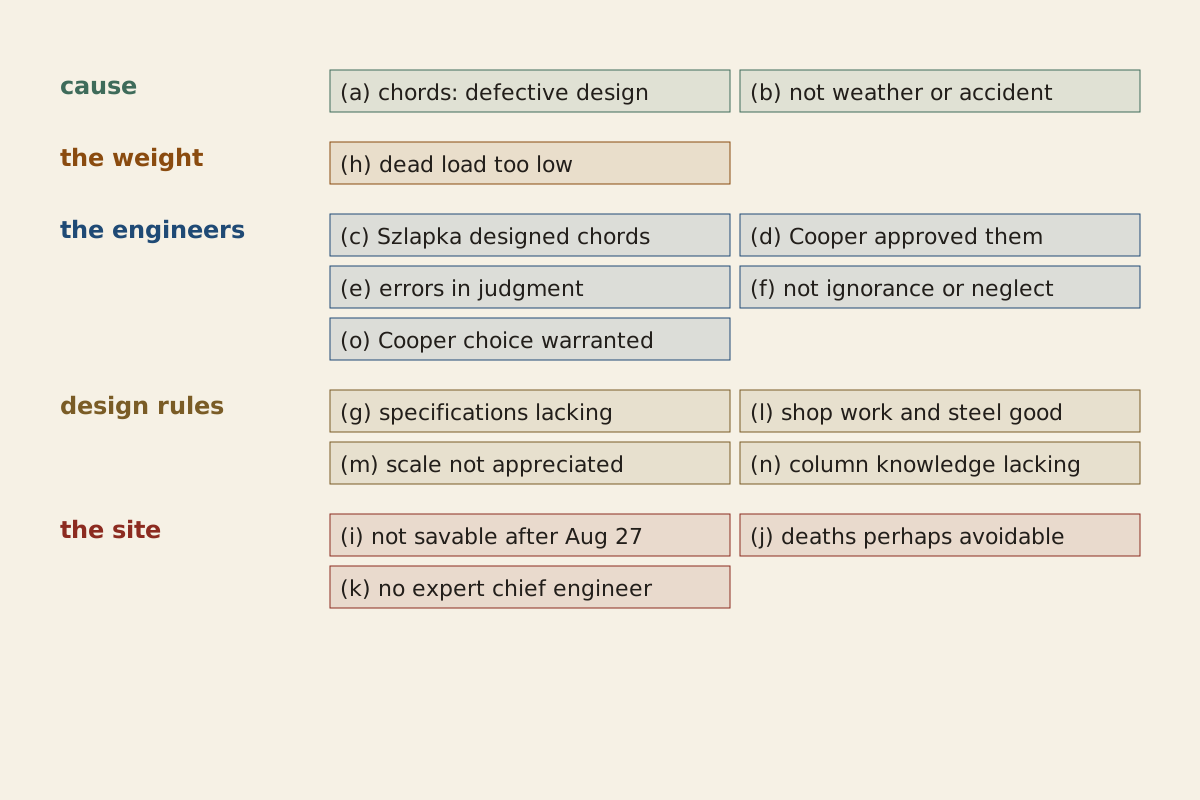
Figure: From the Surviving Record, CC BY 4.0
Full credit line for reuse
"The Royal Commission findings (a) to (o), grouped by subject" by From the Surviving Record, CC BY 4.0. Source: https://fromthesurvivingrecord.com/failures/quebec-bridge/ — License: https://creativecommons.org/licenses/by/4.0/
Data: Royal Commission, Quebec Bridge Inquiry, Report, with C. C. Schneider, Report on Design of Quebec Bridge (Sessional Paper No. 154, Ottawa, 1908), retrieved 2026-11-01, public domain
| Subject | Findings | What they say, in short |
|---|---|---|
| Cause | (a), (b) | Lower chords failed from defective design, under ordinary erection stresses |
| The weight | (h) | Dead load assumed too low and never revised; a separate error |
| The engineers | (c), (d), (e), (f), (o) | Szlapka designed, Cooper approved; errors of judgment, not ignorance or neglect |
| Design rules | (g), (l), (m), (n) | Specifications allowed stresses beyond past practice; workmanship and steel were good |
| The site | (i), (j), (k) | Fall not preventable after August 27; lives might have been saved; no experienced chief engineer |
Download the table (CSV, quebec-bridge-findings.csv) (file notes: sources and license) Data: Royal Commission, Quebec Bridge Inquiry, Report, with C. C. Schneider, Report on Design of Quebec Bridge (Sessional Paper No. 154, Ottawa, 1908), retrieved 2026-11-01, public domain
Finding (k) turned to the owner. The Quebec Bridge and Railway Company's failure “to appoint an experienced bridge engineer” as its chief engineer was “a mistake,” and supervision was loose as a result. Finding (l) cleared the shop work and the steel: “The serious defects were fundamental errors in design.” Twenty years later, a California commission reached the other kind of answer about a failed dam, looking to the ground rather than the design: St. Francis Dam: The 1928 Inquiry Blamed the Rock Beneath It.
What changed after the reports?
The changes on record are recommendations, which is where the quiet retrofit begins: the design or rule changes that can be traced after a failure. Schneider concluded that the trusses as designed were “inadequate to carry the traffic or loads specified,” and that the steel already made could not be reused. The design “should, therefore, be discarded and a different design adopted for the new bridge,” keeping only the span lengths so the existing piers could serve.
The commission's finding (n) set the limit of the engineering of 1908. A bridge of this span that would “unquestionably be safe” could be built, it said, but only with “a considerably larger amount of metal” than better knowledge of steel columns might allow. Both reports were printed by order of Parliament in 1908, so the reasons for change were in print the same year.
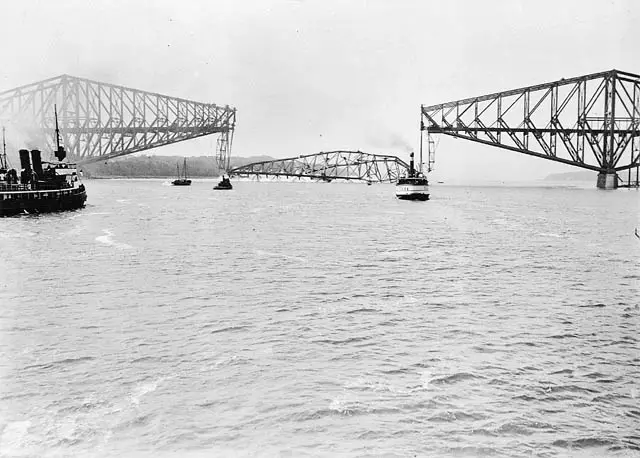
"Collapse of the centre span of the Quebec Bridge" by A. A. Chesterfield. Library and Archives Canada, C-003623 — https://commons.wikimedia.org/wiki/File:Collapse_of_the_centre_span_of_the_Quebec_Bridge_Effondrement_de_la_trav%C3%A9e_centrale_du_pont_de_Qu%C3%A9bec_(4055477989).jpg — CC BY 2.0 (https://creativecommons.org/licenses/by/2.0/)
What was actually built is not in the sources read for this page. A photograph dated September 11, 1916, in the record of Library and Archives Canada, shows a centre span in the river between two finished cantilever arms. A photograph from about 1917 shows a completed bridge. Neither record says how the second design differed from the first, or why that span fell.
It is commonly said that the Iron Ring worn by many Canadian engineers is tied to this collapse, a claim this page has not been able to check.
The 1908 reports end with the piers standing and the first design rejected. Between that verdict and the bridge photographed complete about 1917, the record on file holds only the photograph of 1916.
Still missing:
- How the bridge was redesigned, and why the new centre span fell in 1916. The 1908 reports predate the redesign, and no later report is among the sources on file.
- How a design failure compares with one traced to a single part. The Silver Bridge, which the NTSB dates as completed in 1928, came down in 1967, and the NTSB traced its fall to one cracked eyebar: Silver Bridge Collapse: NTSB Traced It to One Hidden Crack.
- How far an unchecked starting figure can carry an error. The weight here began as an estimate that was not recomputed; a ship's position kept by dead reckoning builds on its starting figures in the same way until a fix corrects it.
Cite this page
From the Surviving Record. “Quebec Bridge Collapse: The 1908 Inquiry Blamed Chord Design.” First published 2026-11-01. https://fromthesurvivingrecord.com/failures/quebec-bridge/ (accessed add the date you read it).
Sources
- Henry Holgate, J. G. G. Kerry and John Galbraith, Royal Commission, Quebec Bridge Inquiry: Report (Sessional Paper No. 154, Ottawa: Printed by Order of Parliament, 1908), signed at Montreal, February 20, 1908, with appendices. archive.org/details/19071908v42i18p154_0540 Read: the commission's report (pages 5–11) and the appendices on design, weights, erection, the events of the collapse, the fallen structure, stresses and specifications (pages 37, 56–110, 149–151).
- C. C. Schneider, Report on Design of Quebec Bridge (Philadelphia, January 1908), printed with Sessional Paper No. 154 (Ottawa, 1908), pp. 153–160. archive.org/details/19071908v42i18p154_0540 Read: full report (pages 153–160), without its appendices of tables.
- A. A. Chesterfield, Collapse of the centre span of the Quebec Bridge, photograph, 1916, Library and Archives Canada, C-003623, via Wikimedia Commons (CC BY 2.0). commons.wikimedia.org/wiki/File:Collapse_of_the_centre_span_of_the_Quebec_Bridge_Effondrement_de_la_trav%C3%A9e_centrale_du_pont_de_Qu%C3%A9bec_(4055477989).jpg Read: the photograph and its archive record.
- Wm. Notman & Son, Pont de Québec vers 1917, photograph, McCord Stewart Museum, VIEW-6190.1, via Wikimedia Commons. commons.wikimedia.org/wiki/File:Pont_de_QC_1917_Notman.jpg Read: the photograph and its museum record.


Spotted an error? Write to contact@fromthesurvivingrecord.com (the link fills in this page's title as the subject). Changes are logged in the corrections log and at the foot of the entry; the evidence levels page explains how sources are weighed.
Related entries
-
Engineering Failures
Silver Bridge Collapse: NTSB Traced It to One Hidden Crack
Why did the Silver Bridge fall in 1967? The NTSB traced it to one eyebar's hidden flaw. Its cause, the two-bar chain, and the inspection rule that followed.
Picture credit
Illustration: From the Surviving Record. Generated schematic image — not a photograph or historical record. © From the Surviving Record, all rights reserved.
-
Engineering Failures
St. Francis Dam: The 1928 Inquiry Blamed the Rock Beneath It
Why did the St. Francis Dam fail in 1928? A state commission blamed defective foundations. Its findings, the flood's timeline and what it asked the state to do.
Picture credit
"The St. Francis Dam" by H. T. Stearns, U.S. Geological Survey — https://commons.wikimedia.org/wiki/File:The_St._Francis_Dam.jpg — Public domain (US: work of a U.S. Geological Survey employee in the course of his duties, not protected by copyright (17 U.S.C. 105); EU: rule of the shorter term (Term Directive art. 7(1)) for a work of US origin with no US term; accepted for federal works by site ruling of 2026-11-01)