RMS Lusitania: Witnesses Disagree on a Second Explosion
Published Last substantive revision
How to read this page: each point is marked as a cross-checked fix, a single record (“according to”), or inference (“by dead reckoning”).
TL;DR: A British inquiry chaired by Lord Mersey found in 1915 that two torpedoes from a German submarine struck the Lusitania off southern Ireland on May 7, 1915, and it counted 1,198 lives lost. In 1918 a U.S. judge found that the evidence favored two but wrote that the number fired “cannot be determined with certainty,” and no record on file settles what the second blast was.
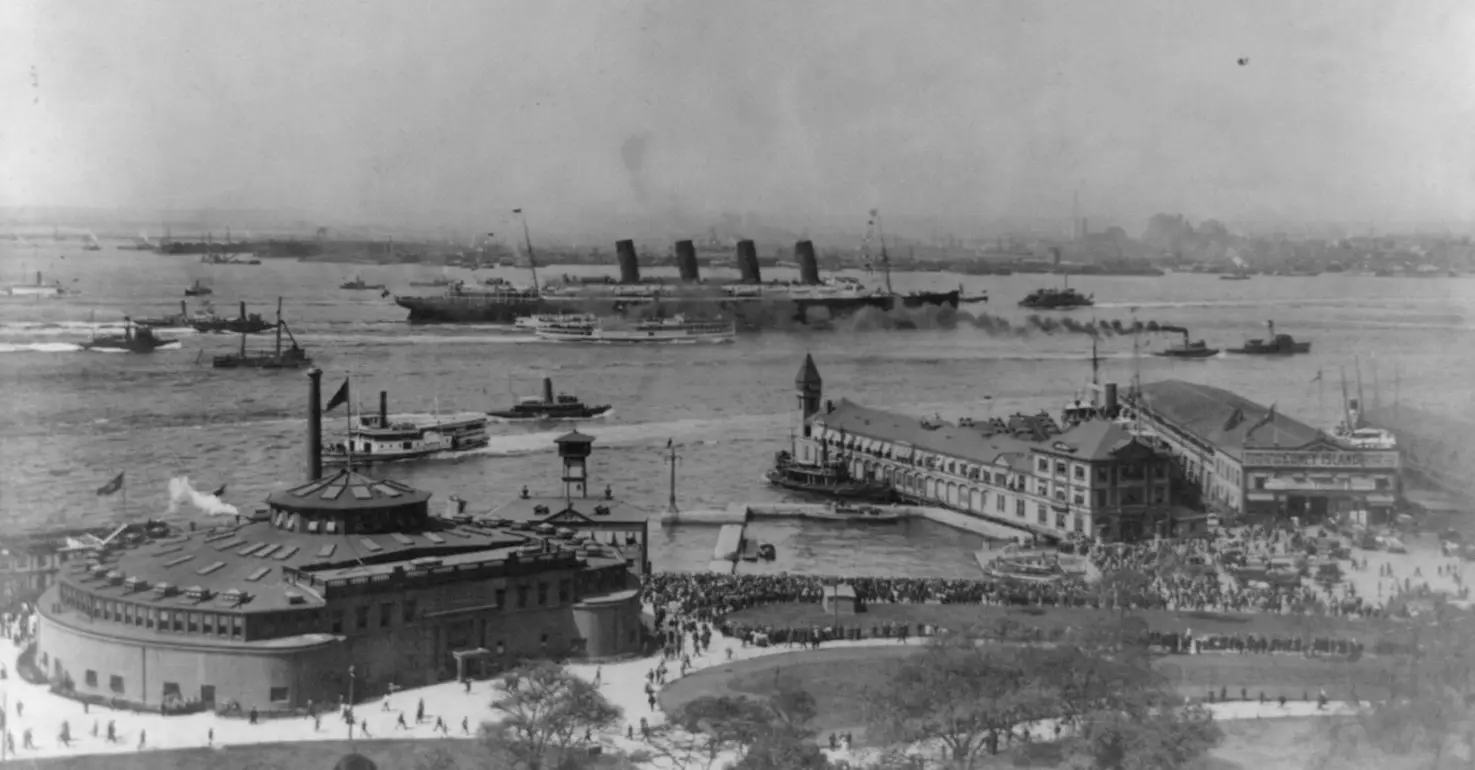
“The "Lusitania's" first appearance in New York Harbor, Sept. 13,…” by Unknown photographer, Public Domain Mark
Full credit
"The "Lusitania's" first appearance in New York Harbor, Sept. 13, 1907" by Unknown photographer — https://commons.wikimedia.org/wiki/File:The_%22Lusitania%27s%22_first_appearance_in_New_York_Harbor,_Sept._13,_1907._LCCN2002721293.jpg — Public domain (US: a 1907 photographic print entered with the U.S. Copyright Office (Library of Congress record notes H100466), published before 1931; EU: no photographer is named and the print was made public in 1907, so the 70-year term for anonymous works has ended); modified: cropped: the typed title line and the sky above it at the top, and the print edges on all four sides, removed; ship, harbor and waterfront untouched
What happened on May 7, 1915?
On May 7, 1915, the Lusitania went down off southern Ireland, and a British inquiry counted 1,198 lives lost. Its report, signed by Lord Mersey as Wreck Commissioner on July 17, 1915, puts the attack at 2.15 in the afternoon, ten to fifteen miles off the Old Head of Kinsale. The report has her leaving New York at noon on May 1 with 1,959 people on board: 1,257 passengers and a crew of 702.
The inquiry's account of that morning is a record of speed and course changes. It has the ship slowing from 21 to 18 knots at 8 a.m. (a knot is one nautical mile an hour), so that she would reach the bar outside Liverpool at about 4 a.m. the next day, when the tide served. Fog then cut her to 15 knots for a time, and when it lifted a little before noon she went back to 18 knots, a speed the report says was “never subsequently changed.”
The report has the captain turning toward the land at 12.40 p.m. to make a better landfall; at 1.40 he sighted the Old Head of Kinsale and turned back to his old course, and at 1.50 he began a four-point bearing on it. At 2.15, according to the report, the second officer called out, “There is a torpedo coming, sir.”
Mersey's 1915 report and the 1918 opinion of a U.S. District Court in New York give the same times for the turn back at 1.40 p.m. and the start of the bearing at 1.50 p.m. They are not independent records, since the 1918 court's record included the testimony heard by Mersey. On the rest of the afternoon the sources disagree. The 1918 court puts the attack at “approximately 2:10,” says the ship sank “in about 18 minutes,” and gives the loss of life as 1,195.
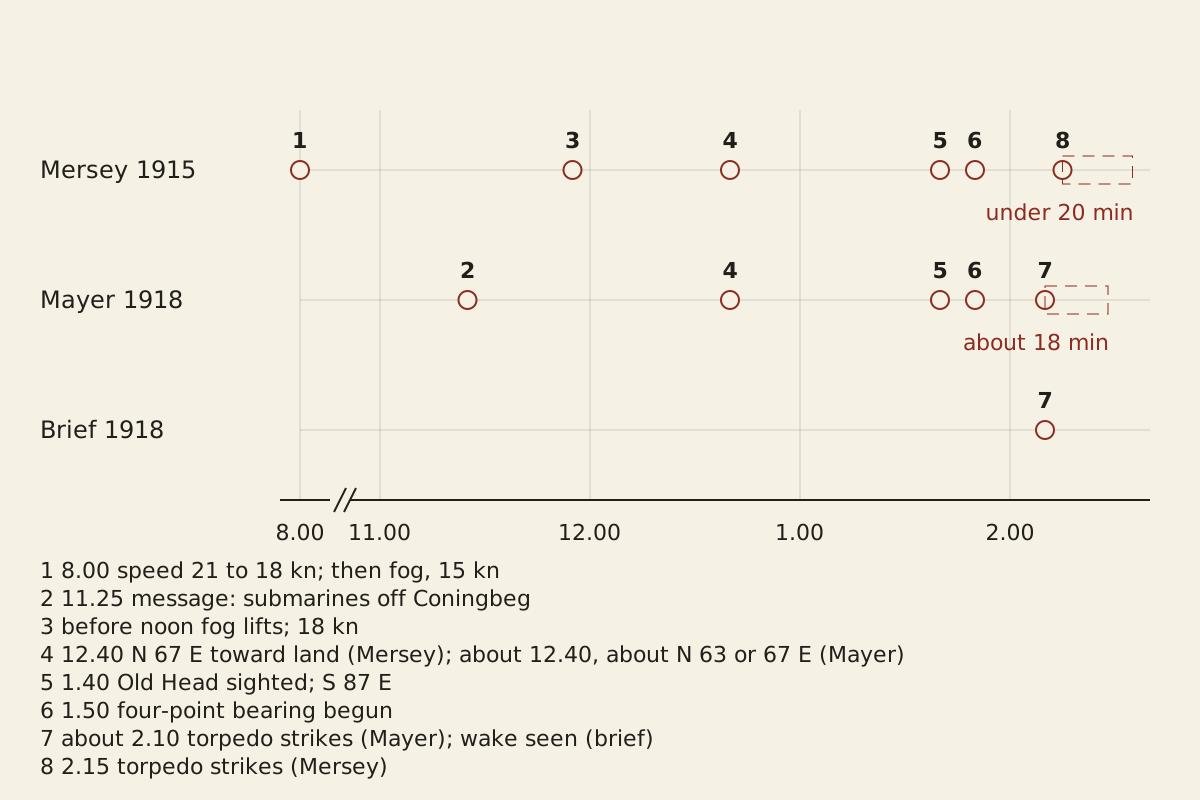
Figure: From the Surviving Record, CC BY 4.0
Full credit line for reuse
"Lusitania, 7 May 1915: the day as each record times it" by From the Surviving Record, CC BY 4.0. Source: https://fromthesurvivingrecord.com/shipwrecks/lusitania/ — License: https://creativecommons.org/licenses/by/4.0/
Data: Report of a Formal Investigation into the foundering of the Lusitania, Cd. 8022 (HMSO, 1915), retrieved 2026-11-01, public domain; The Lusitania, 251 F. 715, Federal Reporter vol. 251 (1918), retrieved 2026-11-01, public domain; Brief on the Facts for the Petitioner, Cunard Steamship Co., U.S. District Court S.D.N.Y. (1918), retrieved 2026-11-01, public domain in the US
| Time on May 7 (as printed) | Event | Record |
|---|---|---|
| 8 a.m. | Speed cut from 21 to 18 knots; fog then cuts it to 15 for a time | Mersey report |
| 11.25 a.m. | Message: submarines last heard of 20 miles south of Coningbeg light vessel | 1918 opinion |
| A little before noon | Fog lifts; back to 18 knots | Mersey report |
| 12.40 p.m. | Course N. 67 E., toward the land (the 1918 court: about 12.40, about N. 63 or 67 E.) | Both |
| 1.40 p.m. | Old Head of Kinsale sighted; back to S. 87 E. | Both |
| 1.50 p.m. | Four-point bearing begun | Both |
| About 2.10 p.m. | Torpedoed on the starboard side | 1918 opinion; Cunard's brief |
| 2.15 p.m. | Torpedo sighted and the ship struck | Mersey report |
| Less than twenty minutes | Sank (the 1918 court: about 18 minutes) | Both, differing |
Table: compiled from the three documents under Sources; each row of the file below gives the page.
Download the table (CSV, lusitania-timeline.csv) (file notes: sources and license) Data: Report of a Formal Investigation into the foundering of the Lusitania, Cd. 8022 (HMSO, 1915), retrieved 2026-11-01, public domain; The Lusitania, 251 F. 715, Federal Reporter vol. 251 (1918), retrieved 2026-11-01, public domain; Brief on the Facts for the Petitioner, Cunard Steamship Co., U.S. District Court S.D.N.Y. (1918), retrieved 2026-11-01, public domain in the US
By the inquiry's count, 413 of the crew and 785 of the passengers were lost, which makes its total of 1,198. The same pages count 761 people saved. The 1918 court's figure of 1,195 is three lower. Neither document explains the difference.
Where was she when the torpedo struck?
The inquiry places the ship “ten to fifteen miles off the Old Head of Kinsale,” and its heading says south. The ship's own distress call, as the report quotes it, gave one figure: “Come at once, big list, 10 miles south Head Old Kinsale.”
The captain had been working out that distance when the torpedo came. A four-point bearing finds how far a ship is off a landmark by timing her run between two compass bearings on it. Mersey was advised that it “would occupy 30 or 40 minutes.” By the inquiry's own clock, the ship was struck 25 minutes after the bearing began; by the 1918 court's, about 20 minutes.
By dead reckoning, the bearing was never finished, so the distance off that it was meant to measure was not known on the bridge when the ship was hit. The 1918 opinion records that it was urged in court that he should have taken a two-point bearing or a cross-bearing, “which would have occupied less time.”
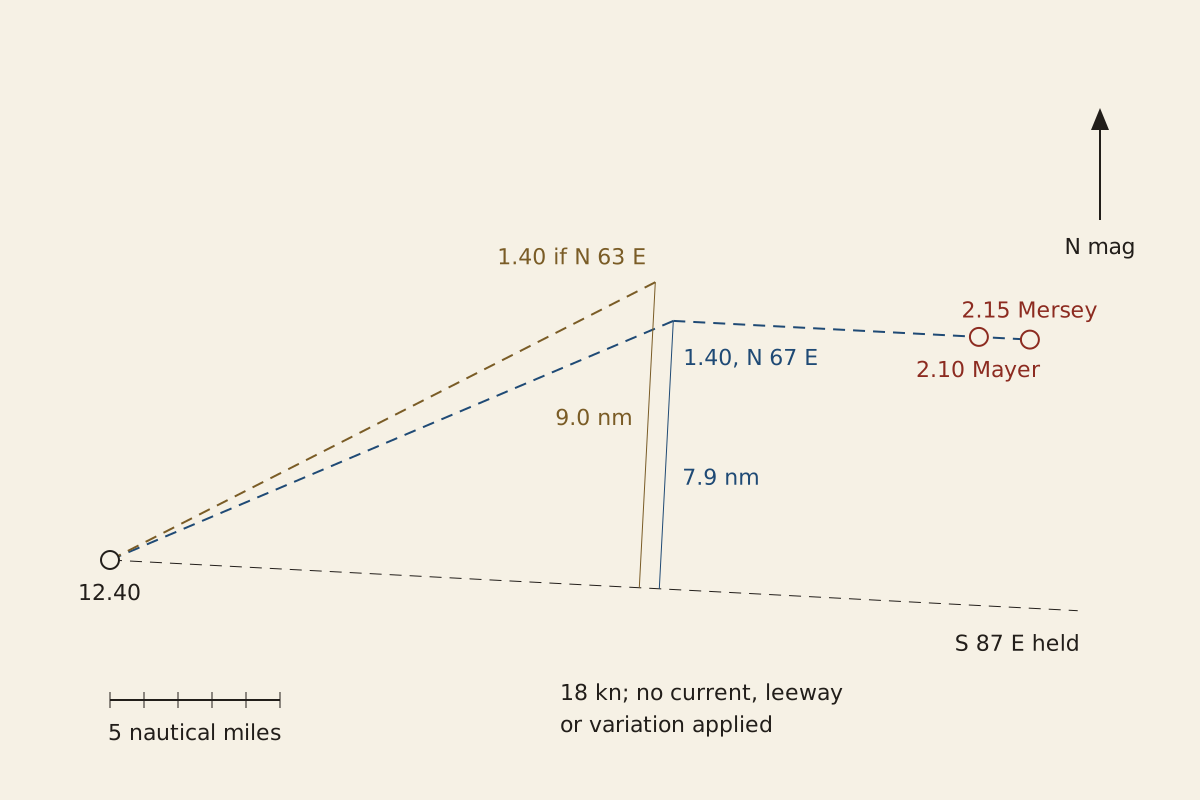
Figure: From the Surviving Record, CC BY 4.0
Full credit line for reuse
"Lusitania, 7 May 1915: the reckoned track from 12.40 p.m." by From the Surviving Record, CC BY 4.0. Source: https://fromthesurvivingrecord.com/shipwrecks/lusitania/ — License: https://creativecommons.org/licenses/by/4.0/
Data: Report of a Formal Investigation into the foundering of the Lusitania, Cd. 8022 (HMSO, 1915), retrieved 2026-11-01, public domain; The Lusitania, 251 F. 715, Federal Reporter vol. 251 (1918), retrieved 2026-11-01, public domain
The turn at 12.40 is where the two records part slightly. Mersey gives N. 67 E. The 1918 court says the course was altered “by about 30 degrees to about N. 63° or 67° E.,” and that the captain “did not recall which.”
By dead reckoning, an hour at 18 knots on N. 67 E. put the ship about 7.9 nautical miles nearer the land than she would have been on her old course; on N. 63 E. the figure is 9.0. Each figure is worked two ways, on a flat plane and on the earth's ellipsoid, and the two agree. The courses are magnetic as printed, and no current or leeway is applied, so the result is a sketch of the turn, not a position on a chart.
How many torpedoes did the inquiry find?
Mersey's report is plain on the count. After the first hit, “A second torpedo was fired immediately afterwards, which also struck the ship on the starboard side. The two torpedoes struck the ship almost simultaneously.”
Asked by the Board of Trade whether the ship was struck by one or more torpedoes, the court answered, “By two practically simultaneously.” It added that the ship never sighted the submarine, that no warning of any kind was given, and that the firing distance was “variously estimated at from two to five hundred yards.”
The report credits Leslie Morton, an 18-year-old extra lookout on the forecastle head, with being “the first to observe the approach of the two torpedoes.” It also records a witness who heard less. Leith, the ship's wireless operator, was in the second-class dining saloon and “speaks of but one explosion,” the report notes, in answering a passenger's claim of a blast in the cargo.
The documents do not place the hits in the same spot. The inquiry says the first struck “somewhere between the third and fourth funnels.” Morton's own words, as quoted in the brief filed for Cunard in 1918, put the first “between Nos. 2 and 3 funnels” and the second “just under No. 3.” The 1918 court located the hits by boiler room instead: one abreast of No. 2, the other abreast of No. 3 or between Nos. 3 and 4.
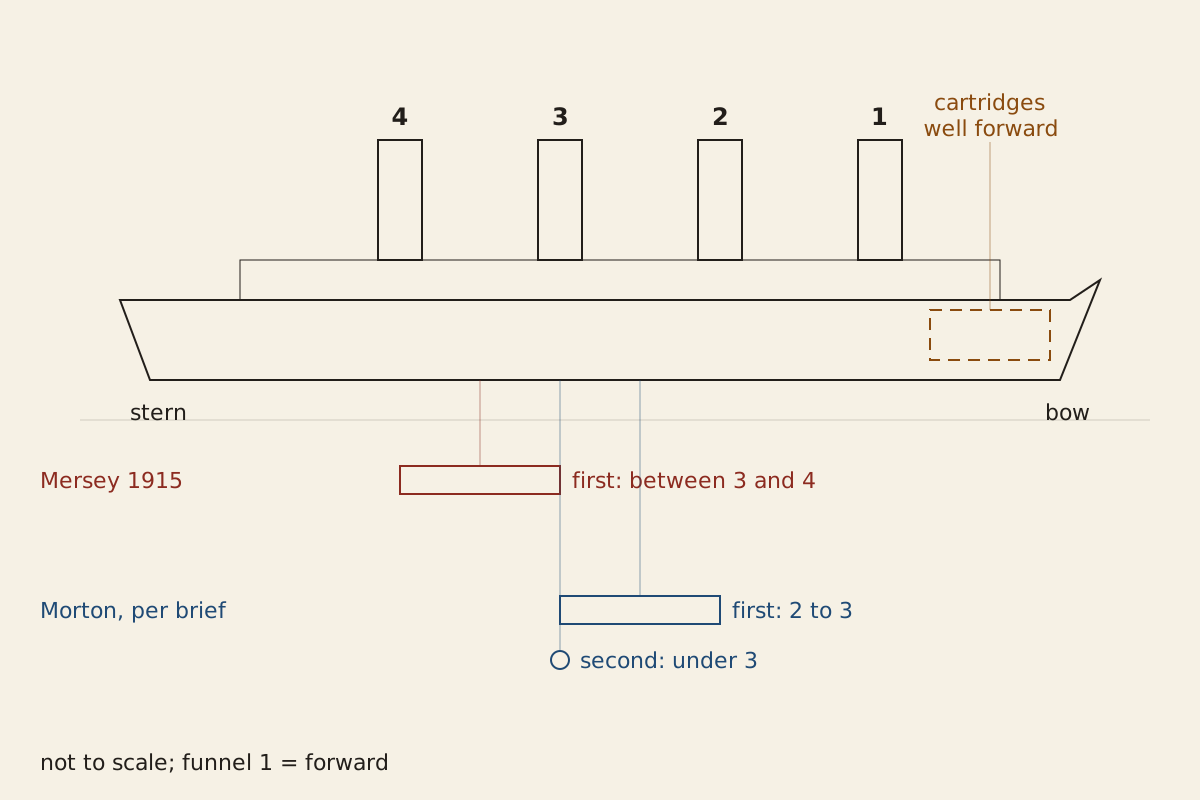
Figure: From the Surviving Record, CC BY 4.0
Full credit line for reuse
"Lusitania: where the torpedoes struck, by source" by From the Surviving Record, CC BY 4.0. Source: https://fromthesurvivingrecord.com/shipwrecks/lusitania/ — License: https://creativecommons.org/licenses/by/4.0/
Data: Report of a Formal Investigation into the foundering of the Lusitania, Cd. 8022 (HMSO, 1915), retrieved 2026-11-01, public domain; Brief on the Facts for the Petitioner, Cunard Steamship Co., U.S. District Court S.D.N.Y. (1918), retrieved 2026-11-01, public domain in the US
The inquiry also heard that a torpedo “from another submarine” was fired at the port side and missed. Mersey mentioned it only to show “that perhaps more than one submarine was taking part in the attack.” The 1918 court heard two crew members say the same and found their evidence “not sufficiently satisfactory to be convincing.”
Why did she sink in under twenty minutes?
According to the inquiry, the ship “took a heavy list to starboard and in less than twenty minutes she sank in deep water.” Its formal answer gives the cause as “the inrush of water through holes made by the torpedoes.” The engines, the inquiry found, were put out of action “almost at once,” so the ship kept moving through the water and her way could not be taken off.
Both the 1915 report and the 1918 opinion count 48 boats with room for 2,605 people, for the 1,959 on board, though their counts for the two kinds of boat differ by one seat. The boats were enough on paper.
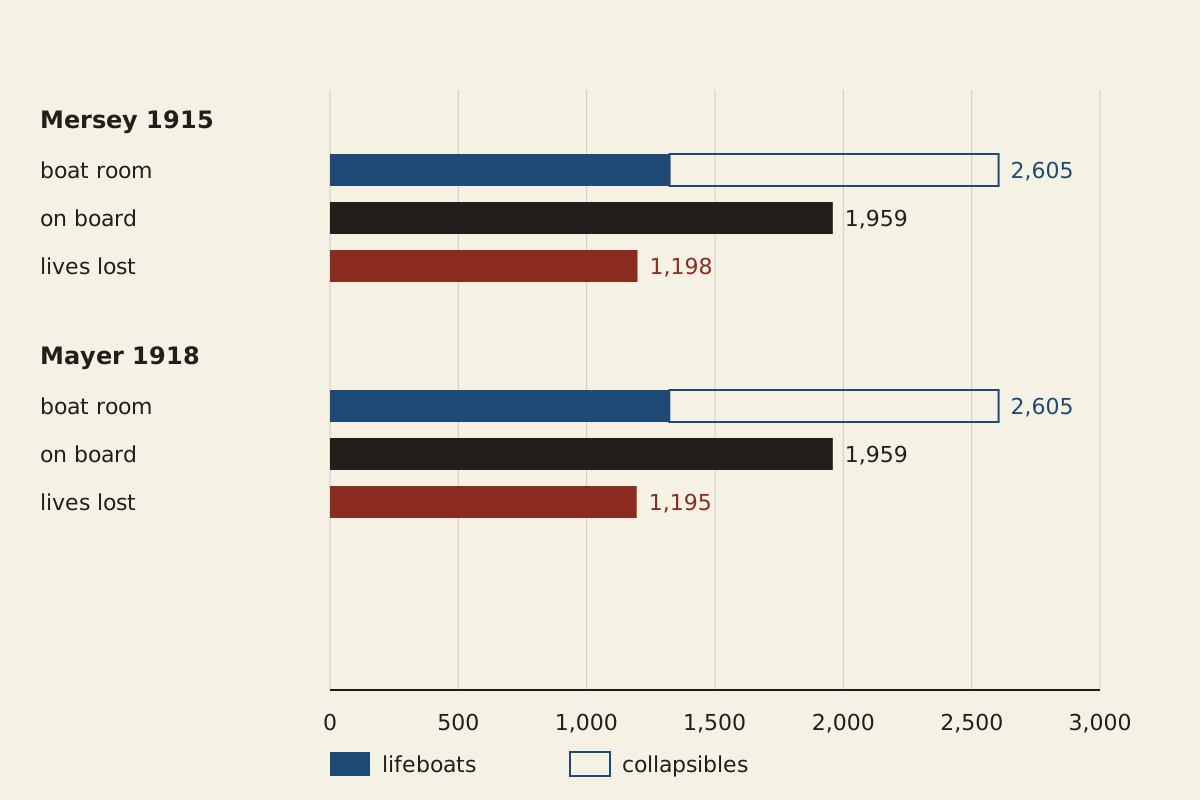
Figure: From the Surviving Record, CC BY 4.0
Full credit line for reuse
"Lusitania: boat room, people on board and lives lost, by document" by From the Surviving Record, CC BY 4.0. Source: https://fromthesurvivingrecord.com/shipwrecks/lusitania/ — License: https://creativecommons.org/licenses/by/4.0/
Data: Report of a Formal Investigation into the foundering of the Lusitania, Cd. 8022 (HMSO, 1915), retrieved 2026-11-01, public domain; The Lusitania, 251 F. 715, Federal Reporter vol. 251 (1918), retrieved 2026-11-01, public domain
| Count | Mersey report | 1918 opinion |
|---|---|---|
| Lifeboats under davits (room for) | 22 (1,323) | 22 (1,322) |
| Collapsible boats (room for) | 26 (1,282) | 26 (1,283) |
| All boats (room for) | 48 (2,605) | 48 (2,605) |
| People on board | 1,959 | 1,959 |
| Lives lost | 1,198 | 1,195 |
Table: from the boat and passenger pages of each document; each row of the file below gives the page.
Download the table (CSV, lusitania-boats.csv) (file notes: sources and license) Data: Report of a Formal Investigation into the foundering of the Lusitania, Cd. 8022 (HMSO, 1915), retrieved 2026-11-01, public domain; The Lusitania, 251 F. 715, Federal Reporter vol. 251 (1918), retrieved 2026-11-01, public domain
The 1918 court went further into the mechanism. The ship “was built so as to float with two compartments open to the sea,” it wrote, and her side coal bunkers counted as compartments. With two boiler rooms and a bunker flooding, “the damage done by one torpedo was enough to sink the ship.”
From what was known of the German torpedoes then in use, the court thought each would rupture the outer hull for 30 to 40 feet lengthwise and 10 to 15 feet vertically. The senior third engineer testified that within a few seconds the steam pressure fell from 190 to 50 pounds.
Mersey heard complaints about the launching and about leaking boats and judged them “ill-founded.” Passengers who tried to help launch the boats did “more harm than good,” in his view, and he concluded that the launching “was carried out as well as the short time, the moving ship and the serious list would allow.”
Claimants in New York argued that open portholes had hastened the sinking. The court found that some dining-room ports on D deck were open, but they were 23 to 30 feet above the water. It held that they had “a very trifling influence, if any.”
Captain Turner's choices
William Thomas Turner had been with Cunard since 1883 and a commander since 1903, the inquiry records, and Mersey wrote that he gave his evidence “truthfully and well.” Mersey heard the Admiralty's advice to him in closed session and declined to set it out in detail. He did write, “It is certain that in some respects Captain Turner did not follow the advice given to him.”
Before she sailed, a notice from the Imperial German Embassy, dated April 22, ran in five New York papers on May 1, by the 1918 court's account, warning that travelers in the war zone on British ships “do so at their own risk.” Turner saw it, or “something of the kind,” the court found. Mersey wrote that the threats “were not regarded as serious by the people intended to be affected by them.”
The 1918 opinion prints the advice the court had. A notice of April 15, 1915, said, “Ships should give prominent headlands a wide berth.” A memo of April 16 described zigzagging, “altering the course at short and irregular intervals.” The court summed up the advice as five points: wide berth to headlands, a mid-channel course, high speed, zigzagging, and arrival in port at dawn.
On the evening of May 6 the ship received two Admiralty messages, the second ending “Submarines off Fastnet,” and the next morning she passed the Fastnet so far out that it was not in sight. The court gave the distance as about 25 miles by Cunard's figure or about 18½ by the claimants' calculation, and called either one a wide berth.
At 11.25 a.m. on May 7, by the court's account, Turner received word of submarines 20 miles south of Coningbeg light vessel, ahead of him. He chose to work in toward the shore rather than hold his distance off. Whether he was negligent in not following the advice to the letter, and in the course he took, the court called “the only debatable question of fact in the case.”
Speed was the other question. In November 1914, the inquiry records, Cunard closed six of the ship's boilers to save coal and labor, which cut her attainable speed from 24½ to 21 knots. Mersey called that reduction “of no significance,” and the 1918 court called it “quite immaterial.”
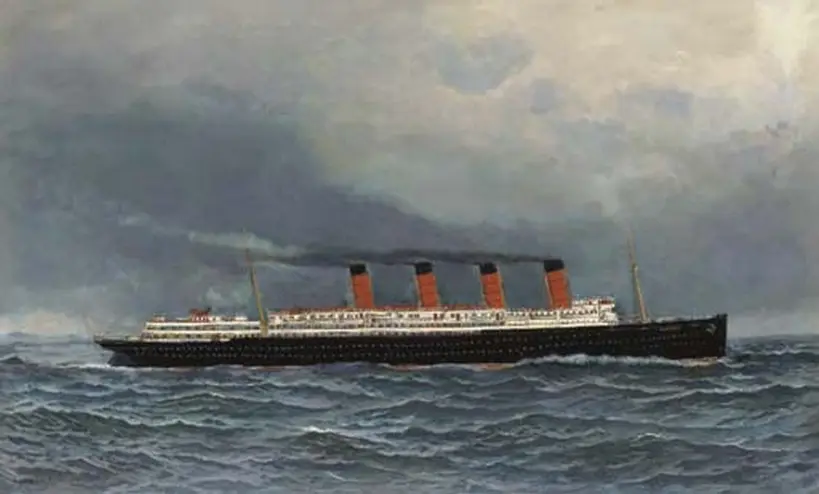
“The R.M.S. Lusitania under full steam” by Antonio Jacobsen, Public Domain Mark
Full credit
"The R.M.S. Lusitania under full steam" by Antonio Jacobsen — https://commons.wikimedia.org/wiki/File:Antonio_Jacobsen_-_The_R.M.S._Lusitania_under_full_steam_-_1908.png — Public domain (Antonio Jacobsen died in 1921: life plus 70 years ended in 1991 in the EU, and in the US a work by an author dead that long is public domain whether or not it was published; faithful reproduction of a flat painting)
What did the two courts decide?
The 1915 inquiry, held before Lord Mersey and four assessors, sat six times in June and July, heard 36 witnesses, and answered 21 questions put by the Board of Trade. It found that the loss was due to “torpedoes fired by a submarine of German nationality,” and that the act was done with the intention of “destroying the lives of the people on board,” not merely of sinking the ship. Asked whether the submarine could be identified, it answered, “It was not identified.” No blame was put on the captain or on Cunard.
Both courts found that the ship was not armed. Mersey called the German government's claims of masked guns, trained gunners and Canadian troops on board “baseless inventions,” and the 1918 court found that “the proof is absolute that she was not and never had been armed.”
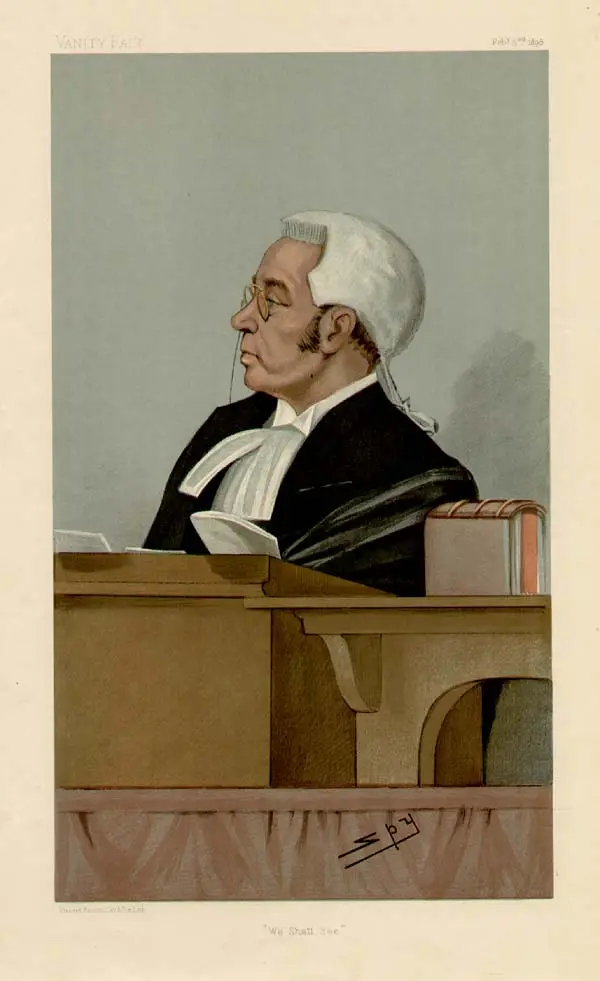
“Judges No. 51: Mr Justice J. C. Bigham, "We Shall…” by Leslie Ward ("Spy"), Public Domain Mark
Full credit
"Judges No. 51: Mr Justice J. C. Bigham, "We Shall See"" by Leslie Ward ("Spy") — https://commons.wikimedia.org/wiki/File:John_Charles_Bigham,_Vanity_Fair,_1898-02-03.jpg — Public domain (Leslie Ward died in 1922, so life plus 70 years has ended in the UK and EU; published in Vanity Fair in 1898, before 1931, for the US; faithful reproduction of a flat print)
Three years later, on August 23, 1918, a federal court in New York ruled on Cunard's petition to limit its liability for the suits brought after the sinking. The judge found the captain had not been negligent and added a second ground: even if negligence were shown, it could not be the proximate cause, the cause the law holds responsible, when an independent illegal act came between. Here, he held, that act was the submarine commander's. The petition was granted and the claims dismissed.
The two courts ended in the same place. “The whole blame for the cruel destruction of life in this catastrophe must rest solely with those who plotted and with those who committed the crime,” Mersey wrote, and the 1918 opinion quoted those words near its close. Not every official inquiry leaves its central count in doubt; decades later, the Silver Bridge collapse was traced to a flaw in one eyebar.
What could the second blow have been?
The 1918 court found the evidence of a second explosion “overwhelming,” though some witnesses heard only one. What caused it is where the records stop short of a fix. Setting a court's record beside the stories told about a ship is also the method of the entry on the Mary Celeste.
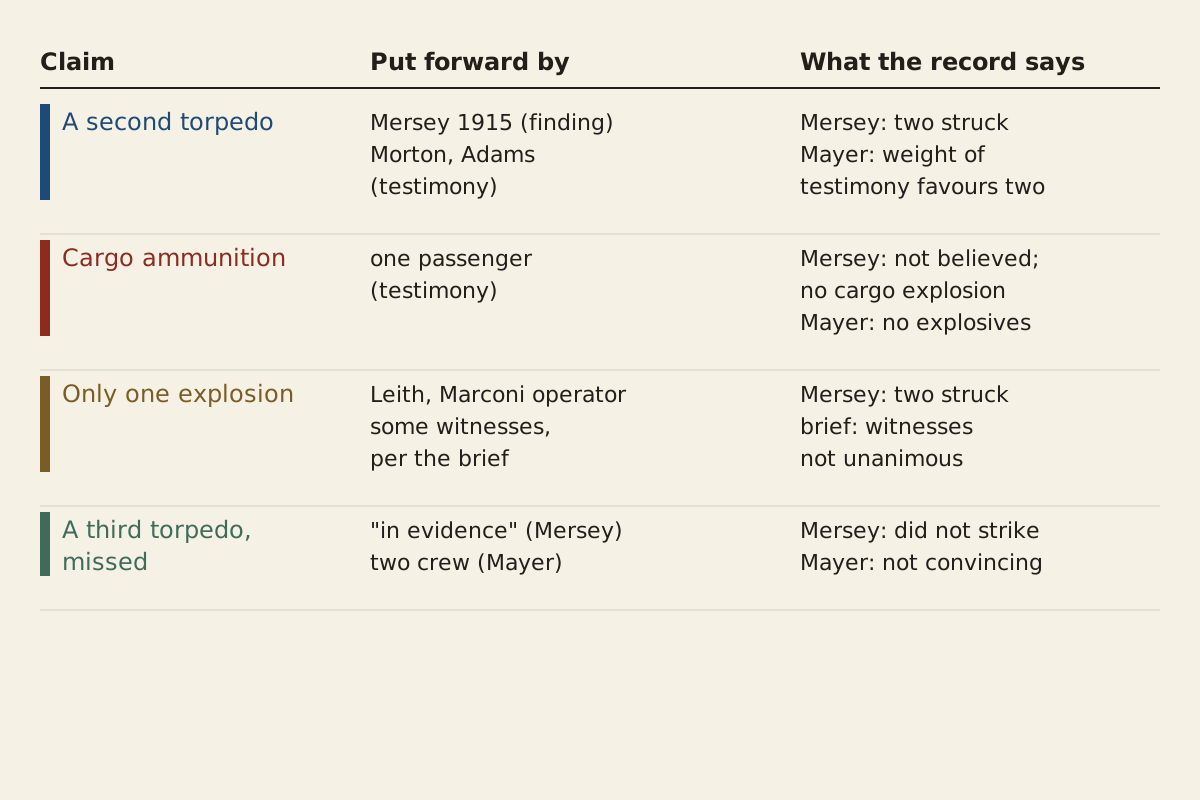
Figure: From the Surviving Record, CC BY 4.0
Full credit line for reuse
"Lusitania: claims about the second blow" by From the Surviving Record, CC BY 4.0. Source: https://fromthesurvivingrecord.com/shipwrecks/lusitania/ — License: https://creativecommons.org/licenses/by/4.0/
Data: Report of a Formal Investigation into the foundering of the Lusitania, Cd. 8022 (HMSO, 1915), retrieved 2026-11-01, public domain; The Lusitania, 251 F. 715, Federal Reporter vol. 251 (1918), retrieved 2026-11-01, public domain; Brief on the Facts for the Petitioner, Cunard Steamship Co., U.S. District Court S.D.N.Y. (1918), retrieved 2026-11-01, public domain in the US
| Claim | Put forward by | What the record says |
|---|---|---|
| A second torpedo | Mersey's court (finding); Morton and Adams (testimony) | Mersey: two struck. The 1918 court: the weight of testimony favors two. |
| Ammunition in the cargo exploded | One passenger (testimony) | Mersey did not believe him and found no explosion of cargo; the 1918 court found no explosives on board. |
| Only one explosion | Leith, the wireless operator; some witnesses, per Cunard's brief | Mersey found two torpedoes; the brief calls the witnesses “by no means unanimous.” |
| A third torpedo that missed | Evidence before Mersey; two crew members in 1918 | Mersey: it did not strike. The 1918 court: not convincing. |
Table: the same claims as the chart, from the pages listed in the file below.
Download the table (CSV, lusitania-torpedo-accounts.csv) (file notes: sources and license) Data: Report of a Formal Investigation into the foundering of the Lusitania, Cd. 8022 (HMSO, 1915), retrieved 2026-11-01, public domain; The Lusitania, 251 F. 715, Federal Reporter vol. 251 (1918), retrieved 2026-11-01, public domain; Brief on the Facts for the Petitioner, Cunard Steamship Co., U.S. District Court S.D.N.Y. (1918), retrieved 2026-11-01, public domain in the US
The cargo claim came from one passenger, who said the blast sounded “similar to the rattling of a maxim gun.” Mersey wrote, “I did not believe this gentleman,” and noted that the man had threatened Cunard with evidence that would not be “to the credit either of your Company or of the Admiralty.” The report lists about 5,000 cases of cartridges, stowed well forward and about 50 yards from where the torpedoes struck. The 1918 opinion counts 4,200 cases of safety cartridges and says none could be set off by fire or impact; the sources disagree on the number of cases.
The 1918 court reached two torpedoes by elimination. “As there were no explosives on board, it is difficult to account for the second explosion, except on the theory that it was caused by a second torpedo,” the judge wrote. One passenger, quoted in Cunard's brief, put the second hit “about thirty seconds after the first.”
By dead reckoning, the two-torpedo finding rests on testimony and on ruling out the cargo, not on a record from the submarine. Both courts saw the attack only from the ship's side, and no document here records how many torpedoes were fired from the other.
The last good decision
By dead reckoning, the first candidate for the last good decision is the turn toward land at 12.40 and the long bearing at 1.50. What was known: a message at 11.25 placed submarines ahead, the Admiralty's April notice said to give headlands a wide berth, and the captain was unsure of his position. The alternatives argued in 1918 were a quicker bearing or a course farther off. The limit is that the submarine's position was known to no one on board; the 1918 opinion says a captain is not bound “to guess the exact location of a hidden and puzzling danger.”
By dead reckoning, the second candidate is the cut to 18 knots. The Admiralty's advice, as the 1918 court summarized it, favored high speed, while the captain was timing his arrival at the Liverpool bar for a tide he could cross without stopping. The limit is that the 1918 court called the planning “proper and good judgment,” and, answering the charges about speed and zigzagging together, held it “impossible to determine” whether the ship would have escaped.
The inquiry's view was that the captain “exercised his judgment for the best,” and that is the inquiry's verdict, not this page's. By dead reckoning, neither candidate can be judged on the surviving record. The Admiralty evidence Mersey heard in closed session is not printed, and no German record is among the sources here.
Still missing:
- What the second blow was. Mersey found a second torpedo and the 1918 court favored two, both by weighing testimony and ruling out the cargo; no document on file records it from the attacker's side.
- What the submarine's own war diary says. It is not among the records on file, and neither court names the submarine.
- How far off the Old Head the bearing would have put her. Each document has the bearing under way at the strike; how a ship's position was reckoned between fixes is the subject of dead reckoning.
Cite this page
From the Surviving Record. “RMS Lusitania: Witnesses Disagree on a Second Explosion.” First published 2026-11-01. https://fromthesurvivingrecord.com/shipwrecks/lusitania/ (accessed add the date you read it).
Sources
- Board of Trade, Shipping Casualties (Loss of the Steamship "Lusitania"): Report of a Formal Investigation into the circumstances attending the foundering on 7th May, 1915, of the British Steamship "Lusitania," of Liverpool, Lord Mersey, Wreck Commissioner (London: HMSO, 1915), Cd. 8022. archive.org/details/shippingcasualti00grea_0 Read: full report, with the annex and the court's answers to the 21 questions.
- The Lusitania (Petition of Cunard S.S. Co.), 251 F. 715 (D.C.S.D.N.Y. 1918), opinion of District Judge Mayer, August 23, 1918, in The Federal Reporter, vol. 251 (St. Paul: West Publishing), pp. 715–737. archive.org/details/gov.uscourts.f1.251 Read: full text of the opinion (pp. 715–737).
- In the Matter of the Petition of the Cunard Steamship Company, Limited, as Owners of the Steamship "Lusitania," for Limitation of Its Liability: Brief on the Facts for the Petitioner (U.S. District Court, Southern District of New York, 1918), Lord, Day & Lord, proctors for petitioner. archive.org/details/cu31924017205208 Read: pages 9–16 of the brief on the facts (course, precautions, the torpedoing).
- Who's Who, 1920 (London: A. & C. Black, 1920), entry “Mersey, 1st Viscount.” archive.org/details/whos-who_1920 Read: the entry for Lord Mersey.
Spotted an error? Write to contact@fromthesurvivingrecord.com (the link fills in this page's title as the subject). Changes are logged in the corrections log and at the foot of the entry; the evidence levels page explains how sources are weighed.
Related entries
-
Shipwrecks & Seafaring
Dead Reckoning: Why Bowditch Advised Shorter Log-Line Knots
How dead reckoning worked: Bowditch's 1802 manual timed a log line knotted every 51 feet with a half-minute glass, then advised shorter knots. Figures and CSV.
Picture credit
Illustration: From the Surviving Record. Generated schematic image — not a photograph or historical record. © From the Surviving Record, all rights reserved.
-
Shipwrecks & Seafaring
Mary Celeste: Conan Doyle's 1884 Story Called Her 'Marie'
The Mary Celeste was found with no one aboard in 1872, her boat gone, per testimony Fay printed. Conan Doyle's 1884 story called her Marie and kept her boats.
Picture credit
"Brigantine Amazon entering Marseilles, November 1861" by Unknown painter — https://commons.wikimedia.org/wiki/File:Mary_Celeste_as_Amazon_in_1861.jpg — Public domain (US and EU: painting dated 1861 by its inscription; painter unknown, so the author is presumed to have died more than 70 years ago (presumed, per the site's rule for anonymous works of the 1860s and earlier); a faithful photograph of a flat artwork adds no new rights)