Mary Celeste: Conan Doyle's 1884 Story Called Her 'Marie'
Published Last substantive revision
How to read this page: each point is marked as a cross-checked fix, a single record (“according to”), or inference (“by dead reckoning”).
TL;DR: When sailors from the Dei Gratia boarded the Mary Celeste in December 1872, she was afloat with no one aboard and her one boat gone, according to the court testimony printed in Charles Edey Fay's 1942 history. The name “Marie Celeste” and the boats still hanging in their davits appear in Arthur Conan Doyle's 1884 short story “J. Habakuk Jephson's Statement,” a work of fiction, and not in the testimony Fay printed.
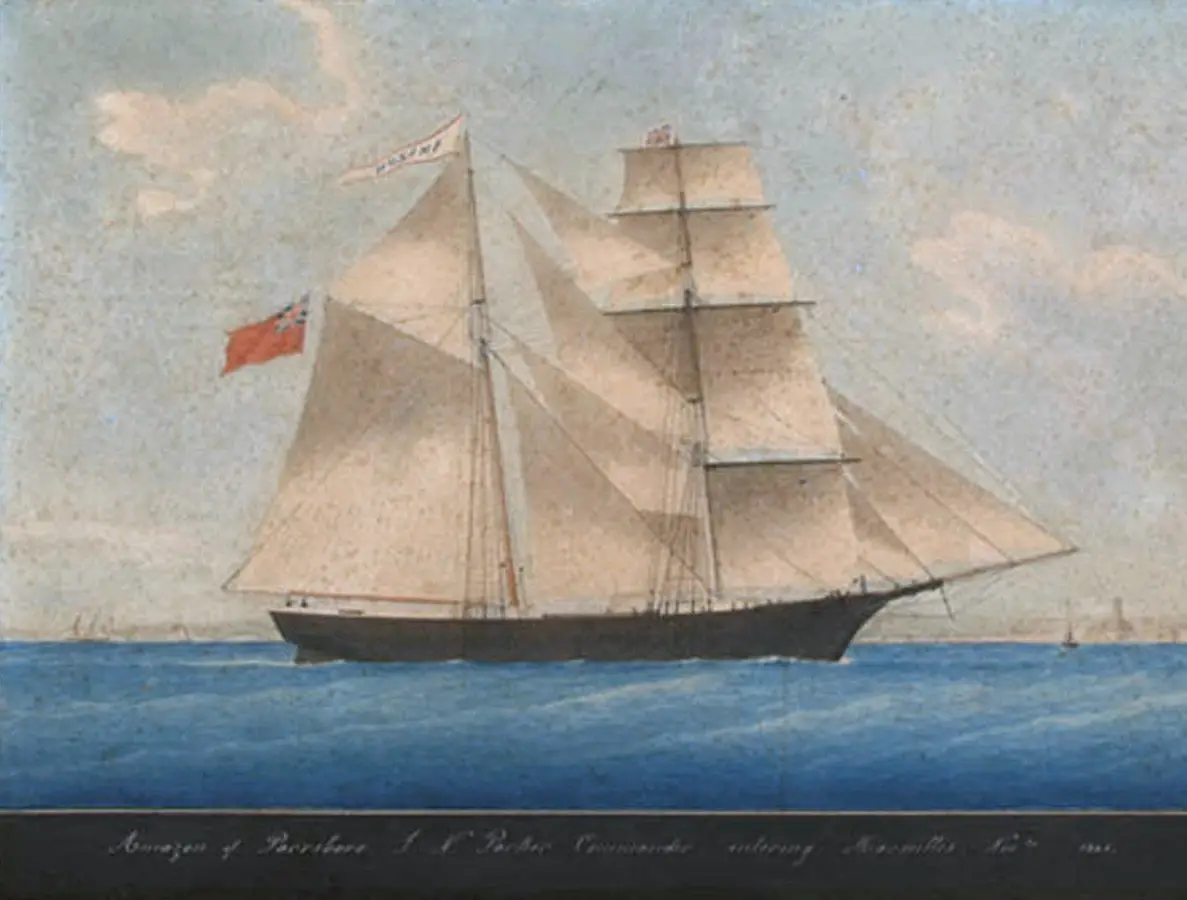
“Brigantine Amazon entering Marseilles, November 1861” by Unknown painter, Public domain
Full credit
"Brigantine Amazon entering Marseilles, November 1861" by Unknown painter — https://commons.wikimedia.org/wiki/File:Mary_Celeste_as_Amazon_in_1861.jpg — Public domain (US and EU: painting dated 1861 by its inscription; painter unknown, so the author is presumed to have died more than 70 years ago (presumed, per the site's rule for anonymous works of the 1860s and earlier); a faithful photograph of a flat artwork adds no new rights)
What did the boarding party find?
Sailors from the Dei Gratia boarded the Mary Celeste in December 1872 and found nobody aboard, according to Fay (1942). Fay drew on the salvage court's testimony and the American consul's letters at Gibraltar; the originals could not be read for this page.
In Fay's account, the Dei Gratia's men sighted her on the afternoon of 4 December, which the ship's log dated 5 December because sea days then began at noon. The Dei Gratia's log gave the position as 38° 20′ N, 17° 15′ W. The first mate, Oliver Deveau, and the second mate, John Wright, rowed across and found no one. Her one boat, which had been carried across the main hatch, was missing.
The rest of the scene, by Fay's account of the testimony, was untidy rather than strange. There was about three and a half feet of water in the hold, two sails had blown away, and the compass was broken. The captain's chronometer, sextant and the ship's register were gone. The cargo, 1,700 barrels of alcohol, was in the hold, and there were six months' provisions in the storeroom.
Illustration: From the Surviving Record. Generated schematic image — not a photograph or historical record. © From the Surviving Record, all rights reserved.
Deveau and two seamen then sailed her to Gibraltar, some six hundred miles, according to Fay. By his account she was not towed. The Vice-Admiralty Court there later awarded the salvors £1,700, which Fay reckons at about a fifth of the ship and cargo's value.
The first printed account of the find on file is a column from the Boston Post of 24 February 1873, reprinted by The New York Times two days later. It reports the case as a crime: pirates, it says, were “now believed” to have seized the ship and murdered the captain, his wife, child and officers. It also has her “safely towed into Gibraltar” and mentions “spots of blood on the blade of a sword.”
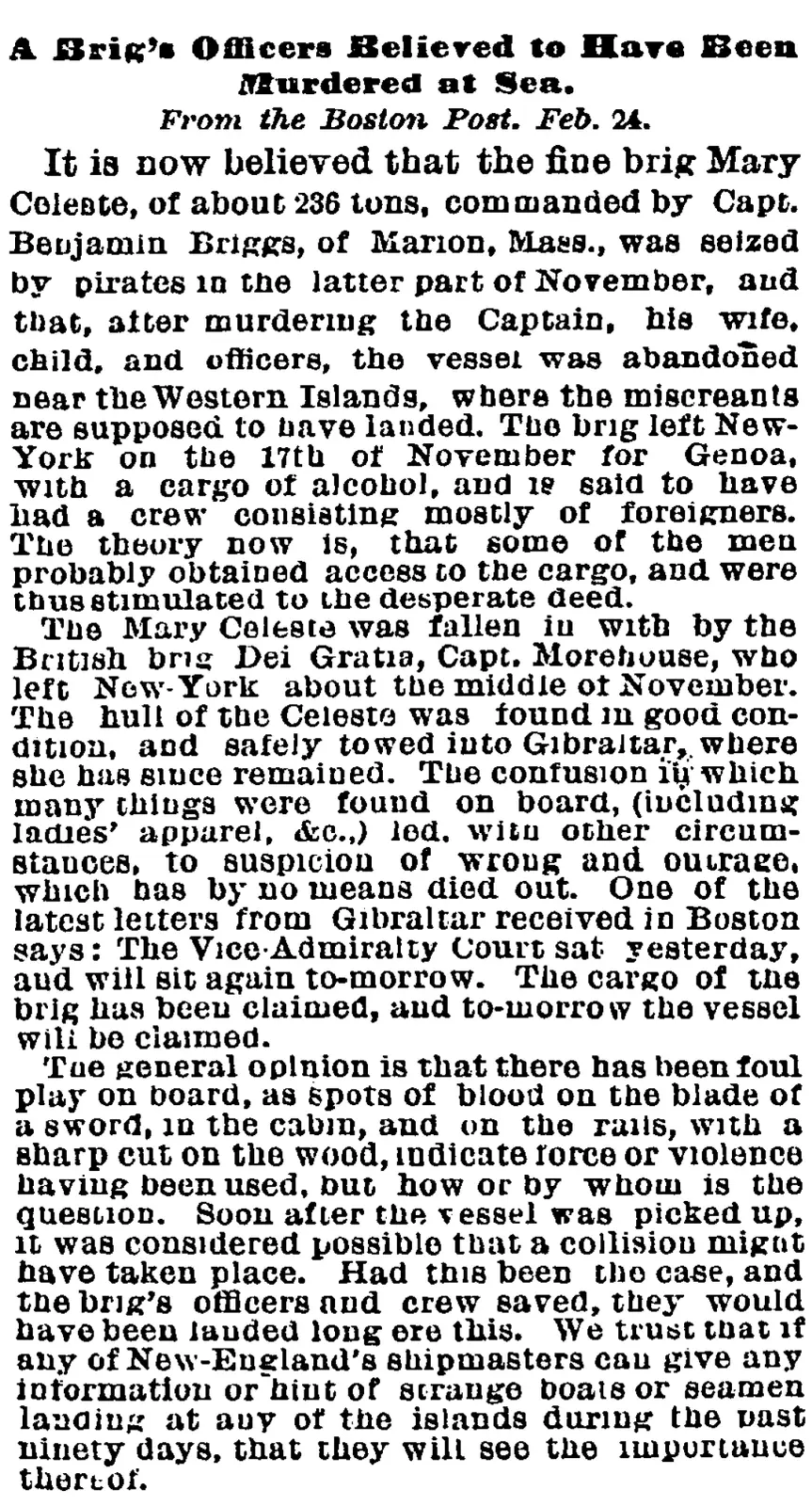
“A Brig's Officers Believed to Have Been Murdered at Sea…” by The New York Times, from the Boston Post, Public domain
Full credit
"A Brig's Officers Believed to Have Been Murdered at Sea (The New York Times, 26 February 1873)" by The New York Times, from the Boston Post — https://commons.wikimedia.org/wiki/File:Mary_Celeste_NYTimes_1873February26.png — Public domain (US: published 1873, before 1931; EU: unsigned newspaper item, anonymous work published in 1873, more than 70 years ago)
A chemist's report for the court, as printed in Fay (1942), found no blood on the sword or on the stained deck. The piracy theory was a newspaper's theory, printed while the case was still in court.
Fix: the ship was bound from New York for Genoa with a cargo of alcohol, under Captain Benjamin Briggs, and was met by the Dei Gratia under Captain Morehouse. The New York Times item of 26 February 1873 and the record printed in Fay (1942) agree on all four points. They differ on the sailing date: the 1873 item has her leaving New York on 17 November, while Fay (1942), from the shipping registers and a letter Sarah Briggs wrote off Staten Island, gives 7 November.
What does Doyle's story say?
“J. Habakuk Jephson's Statement” appeared, unsigned, at the front of the London monthly The Cornhill Magazine for January 1884. It opens like a news report. A narrator quotes a Gibraltar Gazette article and a Boston telegram about a derelict brigantine, then says he was aboard her and alone survived.
None of the framing is real. The narrator, Joseph Habakuk Jephson, is a character, and the Gibraltar Gazette article, whose date he gives from memory, is part of the fiction. The rest of the story is a plot: a fellow passenger arranges the deaths of most of those aboard. Like much fiction of its time, it relies on the racial attitudes of the 1880s, and its account of the crew is not repeated here.
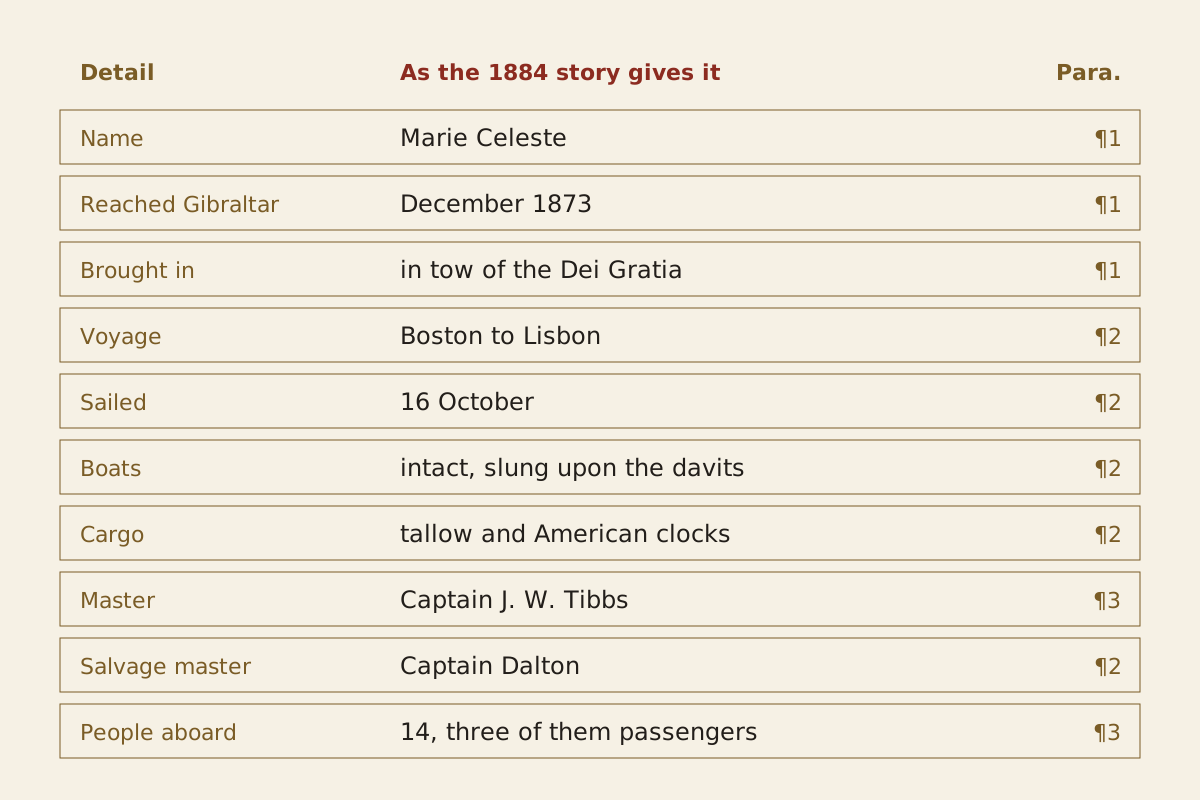
Figure: From the Surviving Record, CC BY 4.0
Full credit line for reuse
"The Mary Celeste as the 1884 story describes her" by From the Surviving Record, CC BY 4.0. Source: https://fromthesurvivingrecord.com/shipwrecks/mary-celeste/ — License: https://creativecommons.org/licenses/by/4.0/
Data: [Arthur Conan Doyle], "J. Habakuk Jephson's Statement," The Cornhill Magazine, new series, vol. 2, no. 7 (London: Smith, Elder, January 1884), pp. 1-32, retrieved 2026-11-01, public domain
The opening pages give the ship a full set of particulars. These are the ones that can be set beside a record:
| Detail | As the 1884 story gives it | Paragraph |
|---|---|---|
| Name | Marie Celeste | 1 |
| Reached Gibraltar | December 1873 | 1 |
| Brought in | in tow of the Dei Gratia | 1 |
| Voyage | Boston to Lisbon, sailing 16 October | 2 |
| Boats | “intact, and slung upon the davits” | 2 |
| Cargo | “tallow and American clocks” | 2 |
| Master | Captain J. W. Tibbs | 3 |
| Master of the Dei Gratia | Captain Dalton | 2 |
| People aboard | 14, three of them passengers | 3 |
Download the table (CSV, mary-celeste-doyle-1884-story-details.csv) (file notes: sources and license) Data: [Arthur Conan Doyle], "J. Habakuk Jephson's Statement," The Cornhill Magazine, new series, vol. 2, no. 7 (London: Smith, Elder, January 1884), pp. 1-32, retrieved 2026-11-01, public domain
The story's sign of a calm sea comes from the same invented newspaper. It says “a bobbin of silk was found standing upon the sewing-machine,” as proof that the weather had been mild. As printed in Fay (1942), the boarding party described broken gear, water in the hold and sails blown away.
Fay (1942) credits Doyle with two points, the salvage ship's name (Dei Gratia) and a roughly right position: the story's longitude, 17° 15′ W, is the one in the Dei Gratia's log. Beyond these, he calls the story “wholly inaccurate.”
Fix: the ship was found and brought into Gibraltar months before the December 1873 that the story gives. The New York Times reported her there on 26 February 1873, and the testimony printed in Fay (1942) dates the boarding to 4 December 1872.
Where did the name 'Marie Celeste' come from?
The story's spelling is the plainest change. The ship's American registers name her Mary Celeste from 1868 on, according to Fay (1942), who adds that she had been built as the Amazon at Spencer's Island, Nova Scotia, in 1861. The painting at the top of this page carries that first name, “Amazon of Parrsboro,” with the date November 1861.
Fay also traced how the new spelling took hold. He found one use of “Marie Celeste” before Doyle, an entry in Lloyd's List of 25 March 1873, but holds Doyle's story responsible for the change from “Mary” to “Marie.” Writers after 1884, Fay says, kept it “with the tenacity of the familiar barnacle.”
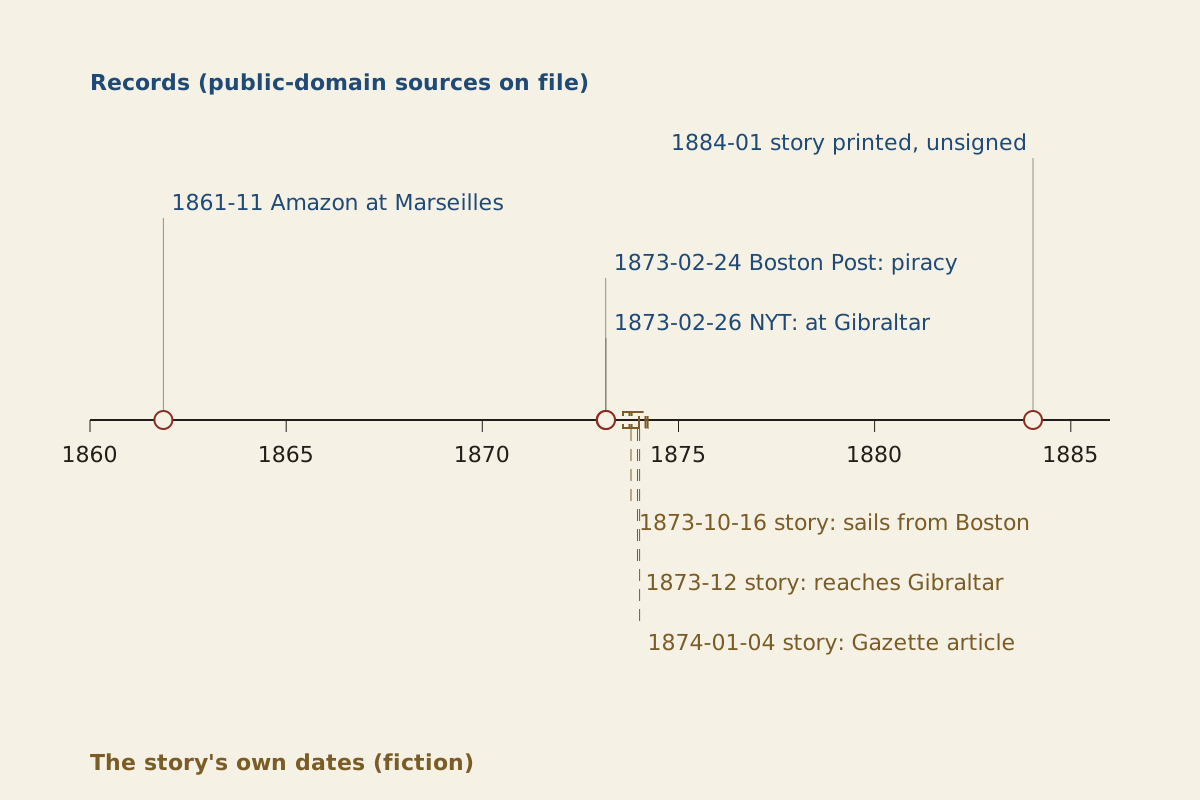
Figure: From the Surviving Record, CC BY 4.0
Full credit line for reuse
"Mary Celeste: record dates and the story's dates" by From the Surviving Record, CC BY 4.0. Source: https://fromthesurvivingrecord.com/shipwrecks/mary-celeste/ — License: https://creativecommons.org/licenses/by/4.0/
Data: Unsigned ship portrait of the brigantine Amazon, inscribed "Amazon of Parrsboro. J.N. Parker, Commander, entering Marseilles, Nov'b'r 1861", retrieved 2026-11-01, public domain; "A Brig's Officers Believed to Have Been Murdered at Sea," The New York Times, 26 February 1873, p. 2, from the Boston Post, 24 February 1873, retrieved 2026-11-01, public domain; [Arthur Conan Doyle], "J. Habakuk Jephson's Statement," The Cornhill Magazine, new series, vol. 2, no. 7 (London: Smith, Elder, January 1884), pp. 1-32, retrieved 2026-11-01, public domain
Download the table (CSV, mary-celeste-timeline-dates.csv) (file notes: sources and license) Data: Unsigned ship portrait of the brigantine Amazon, inscribed "Amazon of Parrsboro. J.N. Parker, Commander, entering Marseilles, Nov'b'r 1861", retrieved 2026-11-01, public domain; "A Brig's Officers Believed to Have Been Murdered at Sea," The New York Times, 26 February 1873, p. 2, from the Boston Post, 24 February 1873, retrieved 2026-11-01, public domain; [Arthur Conan Doyle], "J. Habakuk Jephson's Statement," The Cornhill Magazine, new series, vol. 2, no. 7 (London: Smith, Elder, January 1884), pp. 1-32, retrieved 2026-11-01, public domain
The story was soon read at Gibraltar. As printed in Fay (1942), the American consul there, Horatio J. Sprague, wrote to Washington on 12 January 1884 that it was full of errors about the date, the voyage, the destination and the crew. He added that she had carried no passengers beyond the master's wife and child.
By dead reckoning, then, the legend grew from two sources and not one. The crime story, the tow and the blood were in print in February 1873, nearly eleven years before the story appeared. The boats on their davits and the passengers arrived with the story in 1884, and so did the spelling Marie that stuck; the one earlier use Fay found did not take hold. Neither strand came from the testimony.
Legend vs. record
| Legend | Record |
|---|---|
| The ship was called the Marie Celeste. | Her registers name her Mary Celeste, according to Fay (1942); Doyle's 1884 story uses Marie throughout. |
| Her boats were still hanging in their davits. | That is the 1884 story's wording; the testimony as printed in Fay (1942) has her one boat missing. |
| She was brought into Gibraltar in December 1873. | That is the story's date; The New York Times had her at Gibraltar by 26 February 1873. |
| She was towed into Gibraltar. | The 1873 press item and the story both say so; as printed in Fay (1942), three men from the Dei Gratia sailed her in. |
| Blood on a sword showed that murder was done. | The 1873 press item reported “spots of blood”; a chemist's report for the court, as printed in Fay (1942), found none. |
| She carried passengers. | The story has three; Consul Sprague in 1884, as printed in Fay (1942), says none besides the master's wife and child. |
FAQ
Was the Mary Celeste ever found?
Yes. The Dei Gratia found her afloat on 4 December 1872, as printed in Fay (1942), and three of its men sailed her to Gibraltar. She went back into trade. Fay records that she was wrecked on a reef near Miragoane, Haiti, on 3 January 1885, with all seven aboard saved.
Did Conan Doyle write about the Mary Celeste?
He did. “J. Habakuk Jephson's Statement” appeared without an author's name in The Cornhill Magazine for January 1884, and later in Doyle's collection The Captain of the Polestar and Other Tales. It is fiction, and it calls the ship Marie Celeste.
What happened to the crew of the Mary Celeste?
No one knows. As printed in Fay (1942), ten people sailed: Captain Briggs, his wife, their two-year-old daughter and seven crew, and none was found. The 1873 piracy theory and Doyle's plot are both stories; the sources on file do not settle why a ship still afloat was left. The last entry on her log slate, as Fay prints it, puts her off Santa Maria in the Azores at 8 a.m. on 25 November 1872.
Was there food on the table of the Mary Celeste?
Not according to the testimony as printed in Fay (1942): there was nothing to eat or drink on the cabin table and no cooked food in the galley. Fay lists the warm-meal story among later errors. It is not in the 1884 story or the 1873 press item on file.
Still missing:
- Why the crew left a ship that was still afloat. None of the ten who sailed in her, as Fay counts them, was found to say, and the court's own papers could not be read for this page. The same question runs the other way in Franklin Expedition: Two Notes on One Page, 11 Months Apart, where the ships were found long after their crews' last note.
- What her last position can and cannot tell. The 8 a.m. bearing on her log slate, as Fay prints it, is the last fixed point her own crew left; what they did after it is reckoning. How sailors of the time kept that reckoning is set out in Dead Reckoning: Why Bowditch Advised Shorter Log-Line Knots.
- How a court record and a popular story drift apart. Another shipwreck set against its inquiry is RMS Lusitania: Witnesses Disagree on a Second Explosion, and a story that outran its record on land is Cardiff Giant: By White's Account, Its Stone Was Gypsum.
Cite this page
From the Surviving Record. “Mary Celeste: Conan Doyle's 1884 Story Called Her 'Marie'.” First published 2026-11-01. https://fromthesurvivingrecord.com/shipwrecks/mary-celeste/ (accessed add the date you read it).
Sources
- [Arthur Conan Doyle], “J. Habakuk Jephson's Statement,” The Cornhill Magazine, new series, vol. 2, no. 7 (London: Smith, Elder, January 1884), pp. 1–32 (published unsigned). archive.org/details/sim_cornhill-magazine_1884-01_49_7 Read: full text of the story.
- “A Brig's Officers Believed to Have Been Murdered at Sea,” The New York Times, 26 February 1873, p. 2, reprinted from the Boston Post of 24 February 1873; Wikimedia Commons file page. commons.wikimedia.org/wiki/File:Mary_Celeste_NYTimes_1873February26.png Read: full text of the item.
- Unsigned ship portrait, Brigantine Amazon Entering Marseilles, inscribed “Amazon of Parrsboro. J.N. Parker, Commander, entering Marseilles, Nov'b'r 1861”; Wikimedia Commons file page. commons.wikimedia.org/wiki/File:Mary_Celeste_as_Amazon_in_1861.jpg Read: the painting and its inscription.
- Arthur Conan Doyle, “J. Habakuk Jephson's Statement,” in The Captain of the Polestar and Other Tales (London: Longmans, Green, 1890); Wikisource and Project Gutenberg eBook #294. en.wikisource.org/wiki/The_Captain_of_the_Polestar_and_Other_Tales/J._Habakuk_Jephson%27s_Statement Read: full text of the story.
- Charles Edey Fay, Mary Celeste: The Odyssey of an Abandoned Ship (Salem, Mass.: Peabody Museum, 1942). archive.org/details/marycelesteodyss00fayc Read: paraphrased only (non-commercial terms).


Spotted an error? Write to contact@fromthesurvivingrecord.com (the link fills in this page's title as the subject). Changes are logged in the corrections log and at the foot of the entry; the evidence levels page explains how sources are weighed.
Related entries
-
Shipwrecks & Seafaring
RMS Lusitania: Witnesses Disagree on a Second Explosion
How the Lusitania sank on May 7, 1915: the British inquiry found two torpedoes and 1,198 lives lost; a 1918 U.S. court said about 18 minutes. Timeline, CSV.
Picture credit
"The "Lusitania's" first appearance in New York Harbor, Sept. 13, 1907" by Unknown photographer — https://commons.wikimedia.org/wiki/File:The_%22Lusitania%27s%22_first_appearance_in_New_York_Harbor,_Sept._13,_1907._LCCN2002721293.jpg — Public domain (US: a 1907 photographic print entered with the U.S. Copyright Office (Library of Congress record notes H100466), published before 1931; EU: no photographer is named and the print was made public in 1907, so the 70-year term for anonymous works has ended); modified: cropped: the typed title line and the sky above it at the top, and the print edges on all four sides, removed; ship, harbor and waterfront untouched
-
Shipwrecks & Seafaring
Dead Reckoning: Why Bowditch Advised Shorter Log-Line Knots
How dead reckoning worked: Bowditch's 1802 manual timed a log line knotted every 51 feet with a half-minute glass, then advised shorter knots. Figures and CSV.
Picture credit
Illustration: From the Surviving Record. Generated schematic image — not a photograph or historical record. © From the Surviving Record, all rights reserved.