Cardiff Giant: By White's Account, Its Stone Was Gypsum
Published Last substantive revision
How to read this page: each point is marked as a cross-checked fix, a single record (“according to”), or inference (“by dead reckoning”).
TL;DR: The Cardiff Giant, dug up on a farm near Cardiff, New York, on October 16, 1869, was a carved figure by Andrew D. White's account, and he recorded that an acid test on a piece said to come from it showed soft gypsum, not the hard local limestone it resembled. White also records that he called it a hoax on his first visit, that admission receipts in those first weeks were “very large,” and that Professor Marsh of Yale called it “a most decided humbug” in a letter printed on November 30, 1869.
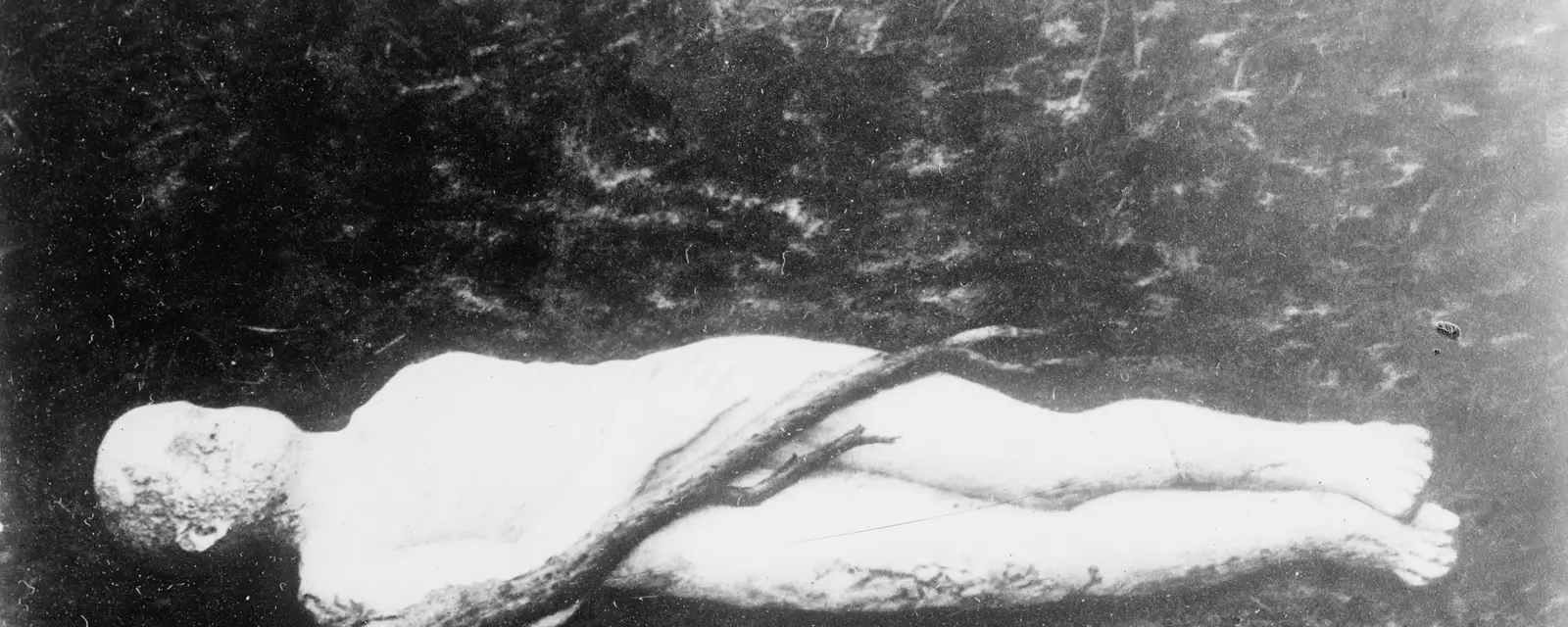
“Cardiff Giant” by Bain News Service, Public Domain Mark
Full credit
"Cardiff Giant" by Bain News Service — https://commons.wikimedia.org/wiki/File:Cardiff_Giant_LCCN2014693762.jpg — Public domain (US: copy negative of a photograph marked as copyrighted in the 1860s, issued by Bain without a copyright notice, public domain in the United States either way; EU: the photograph names only a copyright claimant, C. O. Gott, whose dates are unknown, and was made in the 1860s, so the author is presumed to have died more than 70 years ago (presumed)); modified: cropped to remove the torn negative edge, the hand-lettered title at top left, the negative number at the right edge and a hand-written copyright line at lower right; the figure itself is not cut
How was the Cardiff Giant found?
On October 16, 1869, a giant stone figure was dug up on a farm near Cardiff, New York. Andrew D. White drove down from Syracuse to see it, by the account in his Autobiography (1905). The roads, he wrote, were crowded with buggies, carriages, omnibuses and farm wagons.
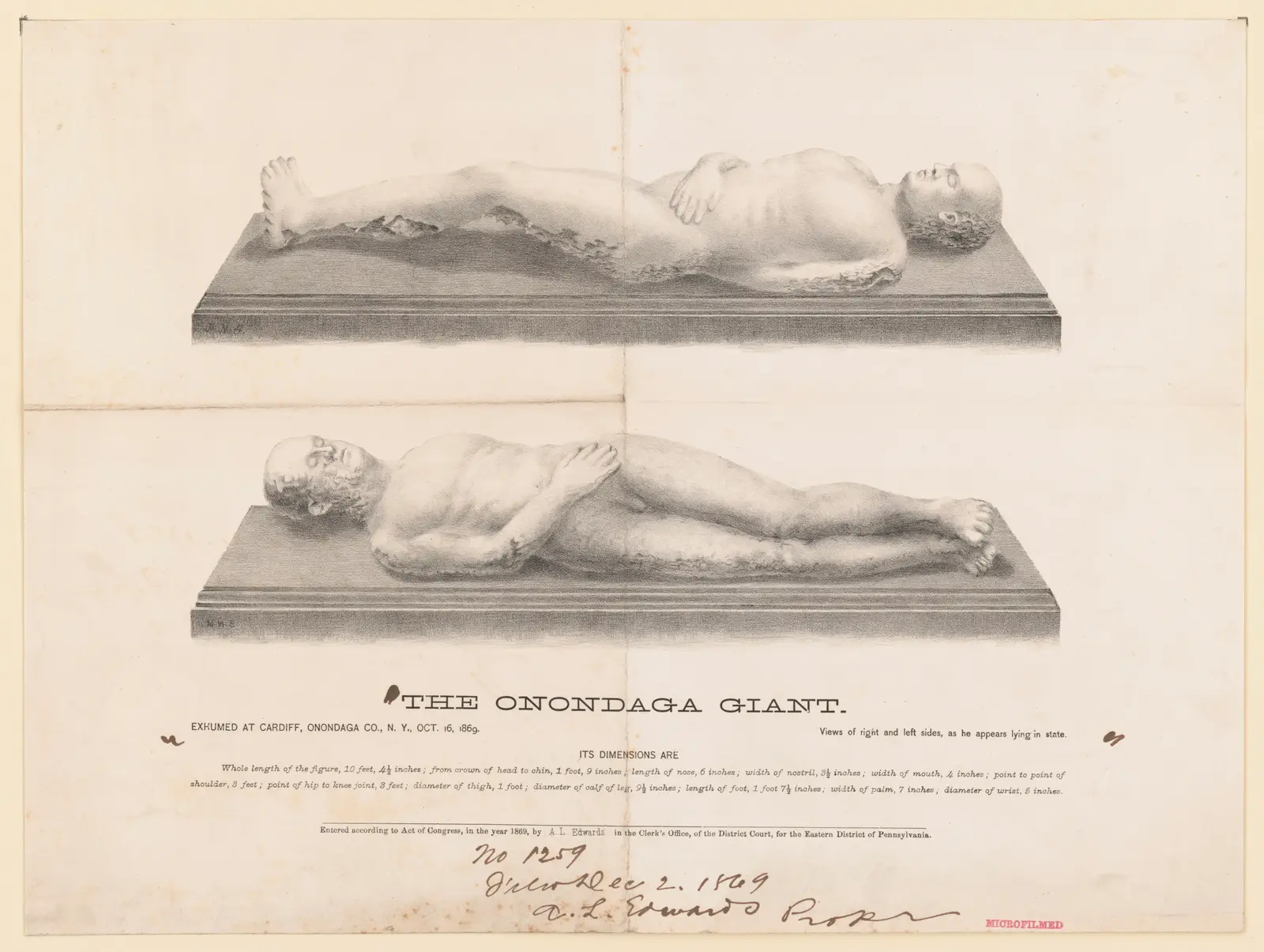
Fix: the find is dated October 16, 1869, in a note in White's account and in the caption of a print registered in 1869, The Onondaga Giant, which reads “Exhumed at Cardiff, Onondaga Co., N.Y., Oct. 16, 1869.”
By his own account, White had been away in another state for some weeks, and back in Syracuse he joked about the find to a deacon and former county judge, who told him it was “no laughing matter.” The next morning White and his brother drove to the Newell farm, where the gathering “seemed like a county fair.” In a tent, a crowd pressed for admission to see a figure lying in a pit, “perhaps five feet below the surface.”
“The Onondaga Giant” by A. L. Edwards, Public domain
Full credit
"The Onondaga Giant" by A. L. Edwards — https://commons.wikimedia.org/wiki/File:The_Onondaga_giant_LCCN2003666806.jpg — Public domain (US: registered and published in 1869, before 1931; EU: artist unknown, work made in 1869, so the author is presumed to have died more than 70 years ago (presumed))
White was told that the farmer had found the figure while digging a well. Asked his opinion, White answered that the whole matter was “undoubtedly a hoax.” There was no reason for the farmer to dig a well on that spot, he said: a good spring and a stream already served the house and barn. The figure itself looked to him like “a modern performance of a low order.”
Nor could it be a fossilized man, White argued, and on that point “all scientific observers of any note agreed.” To one who had seen much sculpture, he wrote, the carver had plainly seen casts, engravings or photographs of famous sculpture. The drawn-up limbs reminded White, vaguely, of Michelangelo's “Night and Morning.” With no pedestal, White reasoned, the figure was meant as neither an idol nor a monument, and its tiny imitation pores showed it was meant to pass as a petrified human being.
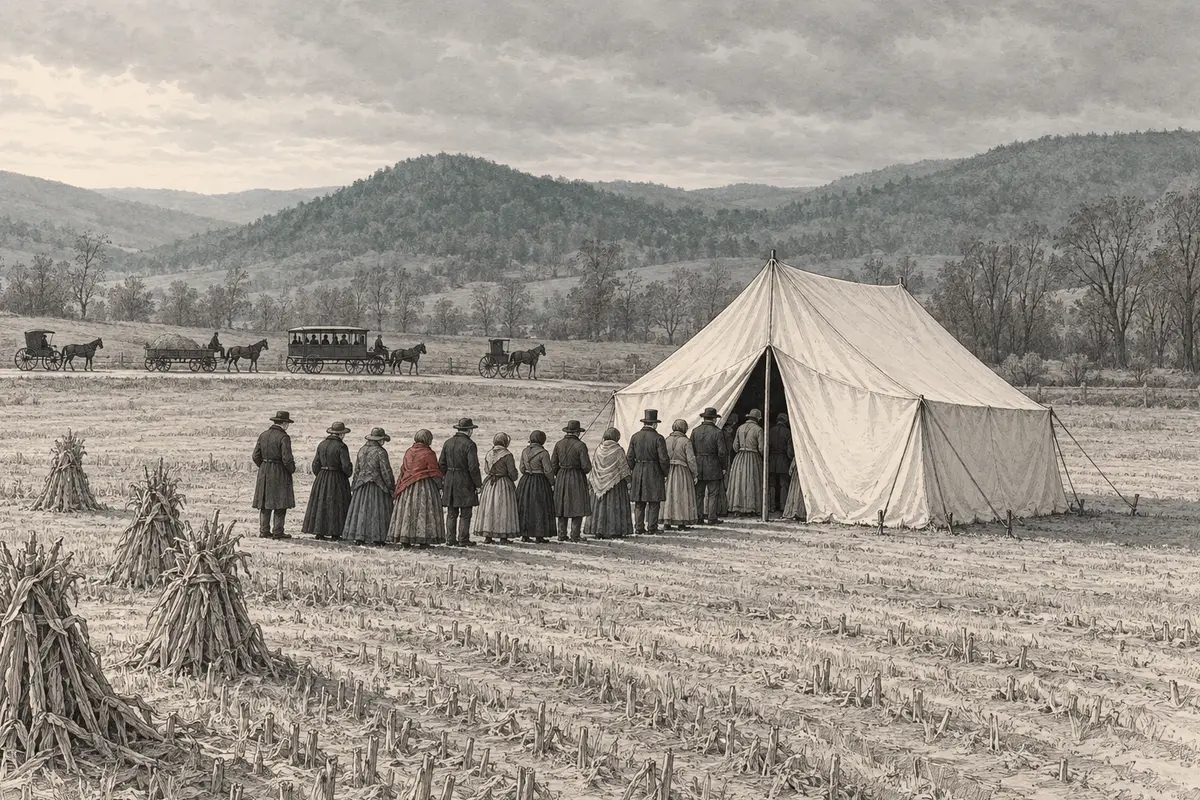
Illustration: From the Surviving Record. Generated schematic image — not a photograph or historical record. © From the Surviving Record, all rights reserved.
How big was the Cardiff Giant?
According to the 1869 print, the figure's whole length was 10 feet 4½ inches, or 3.162 meters. That is about 1.7 times the height of a man 6 feet tall. The print also gives 3 feet from shoulder to shoulder, 1 foot 9 inches from the crown of the head to the chin, and 1 foot 7½ inches for the foot.
White gives no measurements. He calls the figure “enormous” and describes it as nude, with “the limbs contracted as if in agony” and tiny punctures over its surface, “like pores.”
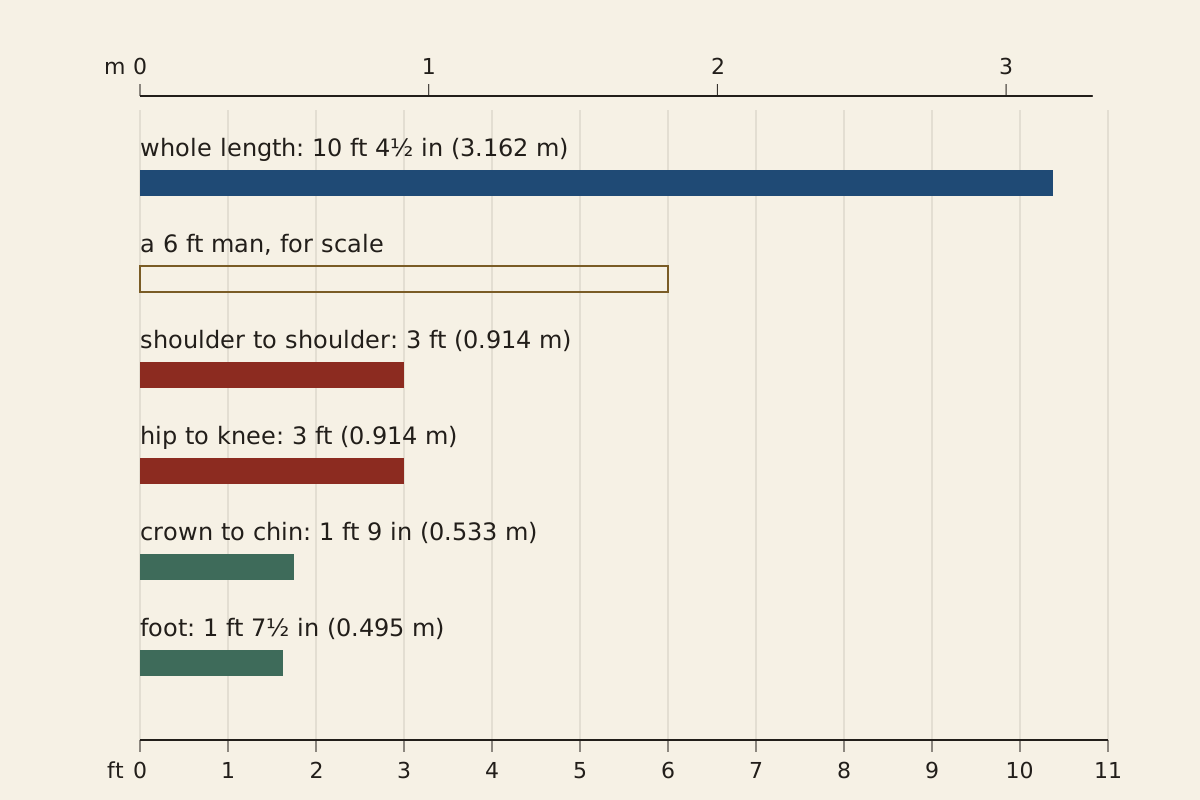
Figure: From the Surviving Record, CC BY 4.0
Full credit line for reuse
"Cardiff Giant measurements as printed in 1869" by From the Surviving Record, CC BY 4.0. Source: https://fromthesurvivingrecord.com/hoaxes/cardiff-giant/ — License: https://creativecommons.org/licenses/by/4.0/
Data: "The Onondaga Giant", print entered in 1869 by A. L. Edwards (Library of Congress pga.06018), retrieved 2026-11-01, public domain
| Measurement, per the 1869 print | Feet and inches | Meters |
|---|---|---|
| Whole length | 10 ft 4½ in | 3.162 |
| Shoulder to shoulder | 3 ft | 0.914 |
| Hip to knee | 3 ft | 0.914 |
| Crown of head to chin | 1 ft 9 in | 0.533 |
| Foot | 1 ft 7½ in | 0.495 |
Download the table (CSV, cardiff-giant-dimensions.csv) (file notes: sources and license) Data: "The Onondaga Giant", print entered in 1869 by A. L. Edwards (Library of Congress pga.06018), retrieved 2026-11-01, public domain
Each meter value is worked out twice, once from feet and inches and once from total inches, and the two results agree to the millimeter.
Why did visitors believe the Cardiff Giant was real?
White lists the arguments people used against a hoax. The farmer was thought unable to plan such a fraud or to pay for it. His family would swear they had never seen the figure, and nobody, it was said, could have buried so much stone unnoticed. Last, water running beneath it seemed to have cut deep grooves in its underside.
That last point puzzled White too. Onondaga gray limestone was hard enough to be used for canal locks, and if the figure was made of it, as it appeared, wear like that “would require centuries,” he wrote. Within a week, he notes, stories spread that the neighboring Indians had old traditions of giants in the hills. Others found in the figure a confirmation of the Bible verse “There were giants in those days.”
As White's party left the tent on a second visit, he recalls, the pastor of one of the largest churches in Syracuse spoke of “a fossilized human being.” Dr. Boynton, a local lecturer on science, praised it instead as a work of art left by Jesuit missionaries some two hundred years before.
A week or two after his first visit, by White's account, a deputation of state regents came to see the figure, with James Hall, the New York State geologist, among them. White met them at their hotel the evening before and urged caution, warning that a mistake could hurt “the proper standing of scientific men and methods in the State.” On October 23, 1869, Hall wrote in a letter to the Syracuse papers that it was “the most remarkable object brought to light in this country.” He did not call it a petrified man, White notes, though White counted him “perhaps the most eminent American paleontologist” of the day.
White's own timing and his note disagree here. His first visit came after the dig on October 16, so regents arriving a week or more later could not have seen the figure before October 24, the day after the date of Hall's letter. The record on file does not settle which is wrong.
“Such was the rush to see the figure that the admission receipts were very large,” White wrote. Men from the surrounding region formed a joint-stock company to buy the figure. They hired a showman, “Colonel” Wood, to exhibit it.
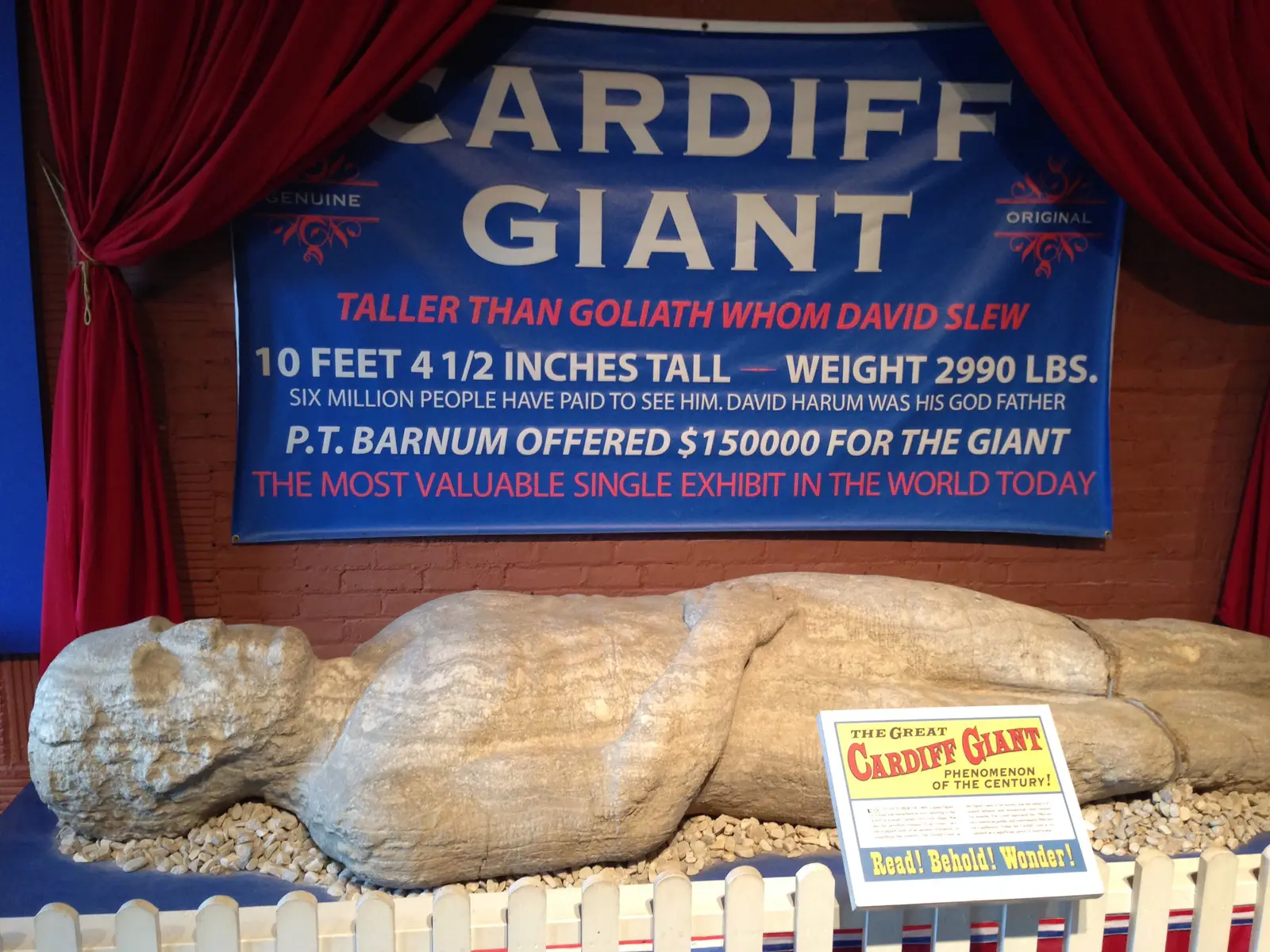
"The Cardiff Giant" by Martin Lewison — https://commons.wikimedia.org/wiki/File:The_Cardiff_Giant_(8923364469).jpg — CC BY-SA 2.0 (https://creativecommons.org/licenses/by-sa/2.0/)
What did White's acid test show?
Soon afterward, White writes, the figure was raised from its pit and shown in Syracuse and other cities, New York among them. One day, he recalls, one of the valley's “cool-headed skeptics,” an old schoolmate of White's, brought him what he said was a piece of the giant.
The stone was soft enough to mark with a fingernail. When White tested it with an acid, he wrote, it proved to be “not hard carbonate of lime, but a soft, friable sulphate of lime,” a form of gypsum that “must have been brought from some other part of the country.” Friable means it crumbles easily. Carbonate of lime was what made the hard local limestone that White had expected.
For White, the test cleared up the puzzle of the grooves at once: the stone was not the hard limestone whose wear would take centuries. White does not say when the test took place. Nor does he say whether he published the result.
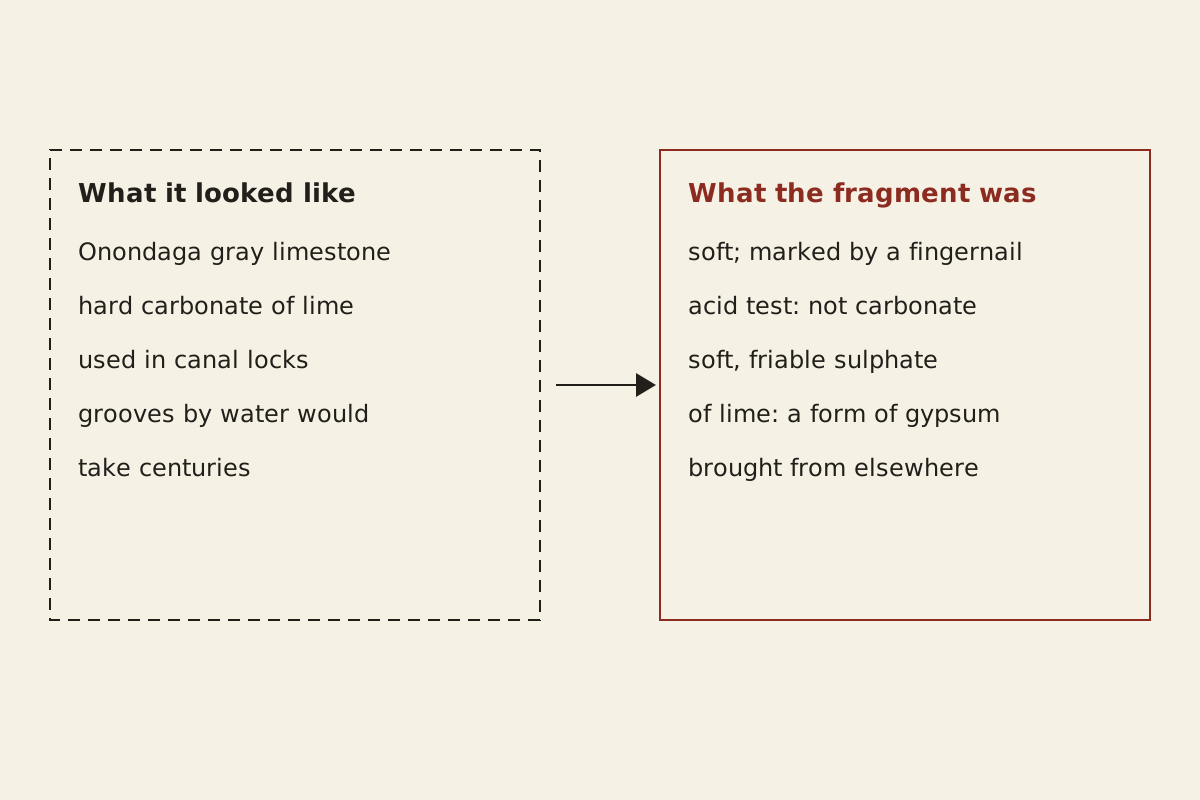
Figure: From the Surviving Record, CC BY 4.0
Full credit line for reuse
"Expected stone and tested fragment" by From the Surviving Record, CC BY 4.0. Source: https://fromthesurvivingrecord.com/hoaxes/cardiff-giant/ — License: https://creativecommons.org/licenses/by/4.0/
Data: Andrew Dickson White, Autobiography of Andrew Dickson White, vol. 2 (1905), ch. 56, retrieved 2026-11-01, public domain
| Point, in White's terms | What it looked like | What the fragment was |
|---|---|---|
| Stone | Onondaga gray limestone | a form of gypsum, brought from elsewhere |
| Hardness | hard, used in canal locks | soft, marked by a fingernail |
| Acid test | carbonate of lime expected | not carbonate; sulphate of lime |
Who doubted the Cardiff Giant, and when?
Professor Marsh of Yale, “one of the most eminent of living paleontologists” in White's words, examined the figure. As quoted by Andrew D. White, citing the Syracuse Daily Journal of November 30, 1869, Marsh wrote that it was “of very recent origin, and a most decided humbug.” Its tool marks and polished surfaces were “still quite perfect,” he argued, so it “must have been very recently buried.”
That letter appeared 45 days after the dig. The doubts White records before it carry no date, and he does not say any of them was printed: his own verdict on his first visit, “an undercurrent of skepticism among the harder heads in the valley,” and the state's leading sculptor, who called the figure nothing more than a poor piece of carving.
Doubt was “not well received,” White wrote, because many “very good people” had bought shares. According to White, a pamphlet, The American Goliath, admitted only letters and articles that favored the giant and left Marsh's out. A writer signing himself “X” in the Syracuse Journal insisted that “the operations of water as testified and interpreted by science cannot create falsehood.” White cites that letter from its reprint in a Fort Dodge pamphlet of 1870, The Cardiff Giant Humbug.
| Date | Newspaper, as White cites it | What it printed |
|---|---|---|
| Oct 23, 1869 | Syracuse papers (title not given) | Hall's letter, dated that day: “the most remarkable object brought to light in this country” |
| 1869, day not given | a leading daily of the region, quoted in The American Goliath | “ninety-nine out of every hundred persons” who saw it thought it “not made by mortal hands” |
| not given | Syracuse daily papers | a pastor's theory of “a trained sculptor” from “that French colony” |
| Nov 30, 1869 | Syracuse Daily Journal | Marsh's letter: “a most decided humbug” |
| not given | Syracuse Journal | a letter signed “X” defending the giant |
| Aug 2, 1889 | The Times, London | a “petrified man” found near Bathurst, Australia, a later fraud |
| Jan 4, 1898 | Ithaca Daily Journal | Hull's “Final Statement” |
Table: every newspaper cited in White's chapter, with his note numbers in the CSV.
Download the table (CSV, cardiff-giant-press-per-white.csv) (file notes: sources and license) Data: Andrew Dickson White, Autobiography of Andrew Dickson White, vol. 2 (1905), ch. 56, retrieved 2026-11-01, public domain
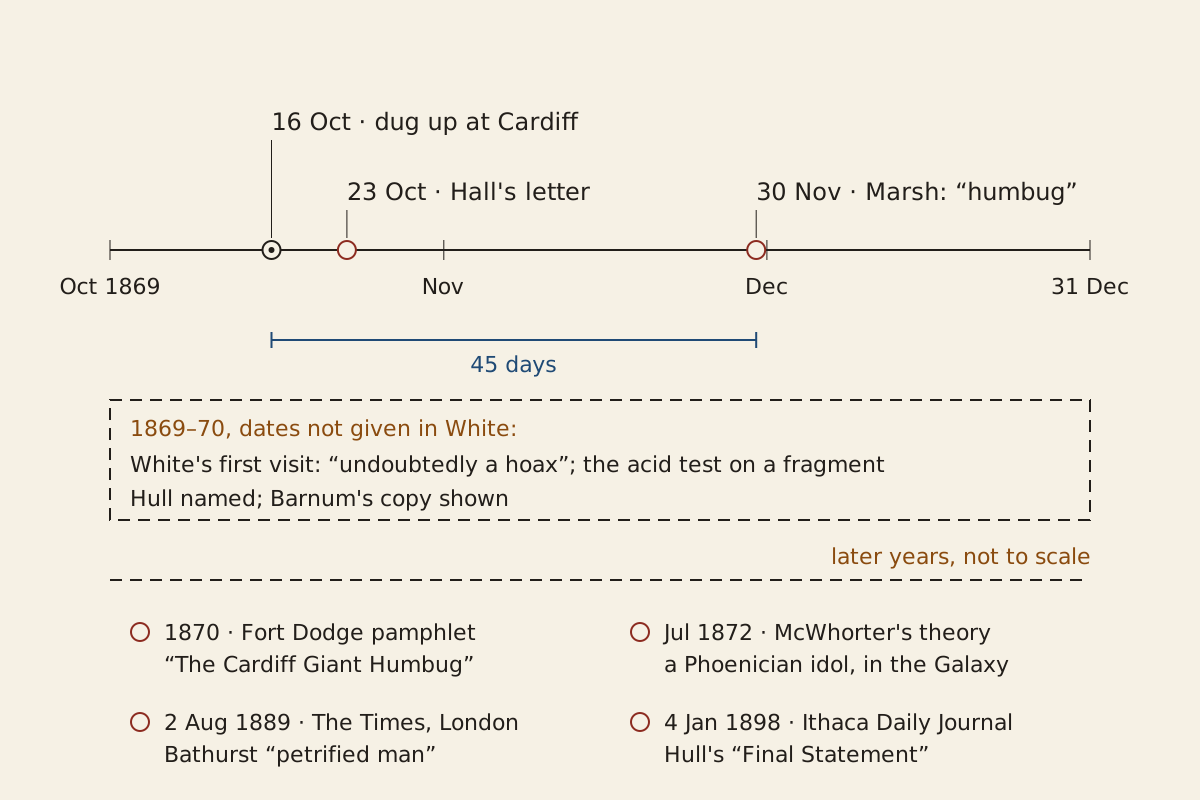
Figure: From the Surviving Record, CC BY 4.0
Full credit line for reuse
"Cardiff Giant: dated records cited by White" by From the Surviving Record, CC BY 4.0. Source: https://fromthesurvivingrecord.com/hoaxes/cardiff-giant/ — License: https://creativecommons.org/licenses/by/4.0/
Data: Andrew Dickson White, Autobiography of Andrew Dickson White, vol. 2 (1905), ch. 56, retrieved 2026-11-01, public domain; "The Onondaga Giant", print entered in 1869 by A. L. Edwards (Library of Congress pga.06018), retrieved 2026-11-01, public domain
How was the giant made, and who made it?
Suspicion turned to money. According to White, Newell, the farmer, had sent “several thousand dollars” of admission fees to a man named Hull, who turned out to be his brother-in-law. Farmers visiting from a distance recognized Hull as the man they had seen with a wagon carrying “an enormous box,” which he called tobacco-cutting machinery. No such box had passed the toll-gates between Cardiff and Syracuse.
Affidavits from Iowa and Illinois, as White reports them, traced the rest. The figure began as a block of gypsum at Fort Dodge, Iowa, hauled by wagon to the railway at Boone, about 45 miles away; when the wagon broke down, part of the block was cut off. In Chicago a German stone-carver gave it its final shape, drawing up the legs to fit the shorter block. Its underside was grooved to look worn by age, and its surface pitted with a mallet faced with steel needles.
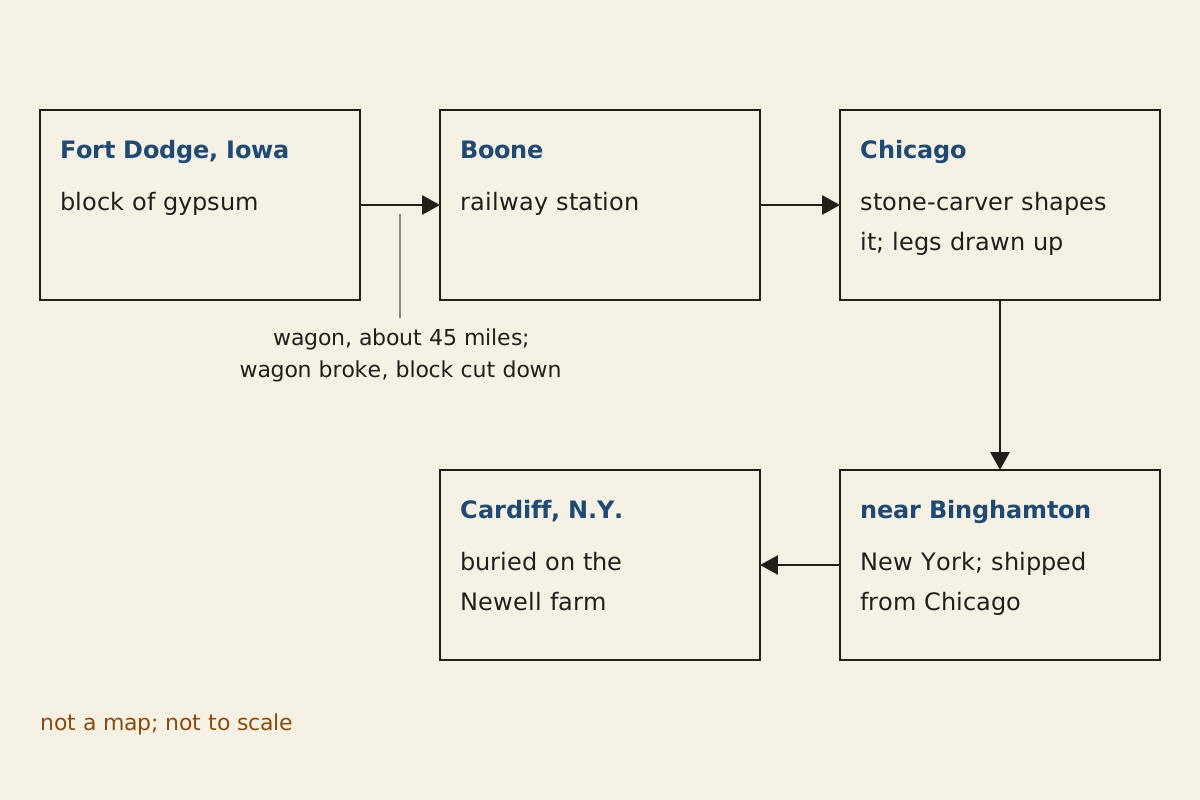
Figure: From the Surviving Record, CC BY 4.0
Full credit line for reuse
"How the gypsum figure reached Cardiff" by From the Surviving Record, CC BY 4.0. Source: https://fromthesurvivingrecord.com/hoaxes/cardiff-giant/ — License: https://creativecommons.org/licenses/by/4.0/
Data: Andrew Dickson White, Autobiography of Andrew Dickson White, vol. 2 (1905), ch. 56, retrieved 2026-11-01, public domain
By the same affidavits, the figure was then stained to look old, shipped to a place near Binghamton, New York, and buried at Cardiff. It was further stated, White adds, that Hull had sent the farmer's family away on a short trip while the figure was brought in and buried. That answered one of the arguments for the giant: in this telling, the family could swear they had seen nothing of it until it was dug up.
Hull then admitted the swindle, White writes. The idea, he said, came from an argument in Iowa with a Methodist revivalist about the giants in the Bible, and White adds that Hull took pleasure in getting even with the Rev. Mr. Turk of Ackley, Iowa, who had out-argued him.
In White's telling, Barnum, “King of Showmen,” had tried to buy the figure before the affidavits came in, and failed. He had a copy made instead and exhibited it as “the Cardiff Giant” too, and “thenceforward the credit of the discovery waned,” in White's words. In 1898, aged 76 by White's account, Hull gave the press a “Final Statement,” printed in the Ithaca Daily Journal on January 4, confirming what he had said before.
Elated by his success, White writes, Hull soon had a second “petrified man” made of clay baked in a furnace, with human bones inside and “a tail and legs of the ape type,” and had it buried and dug up in Colorado. Marsh, by then Hull's “old enemy,” ended that one “by a few minutes of scientific observation.” Others copied the idea, White notes, with a cement figure in Michigan in 1876 and a “petrified man” near Bathurst, Australia, in 1889.
Even Hull's confession did not end every belief. In 1872, White records, Alexander McWhorter, a former resident graduate of the Yale divinity school, argued in the Galaxy that the giant was a Phoenician idol.
At New Haven, by Andrew D. White's account, a professor at the Yale Medical School, also named White, studied the pores through lenses that “magnified forty-five diameters” and, though “not fully decided,” leaned toward an ancient origin. Some ten years after the find, the Autobiography adds, a Hebrew instructor in the theology school at the University of Halle, Dr. Schlottmann, still believed it was a Phoenician statue bearing an inscription.
By dead reckoning, the doubts in White's account had three handicaps. White's own early verdict went to those who asked, and his account does not say it was printed; the first printed charge of fraud on file came 45 days in; and a pamphlet issued on the giant's behalf left it out. White's own explanation was a “joy in believing” and “vested interests.” The record on file holds no visitor counts, so whether the crowds thinned after Marsh's letter cannot be measured.
A similar question, why early doubts did not end a fake sooner, runs through the Donation of Constantine and Charles Ponzi's postal coupon scheme.
The last good decision
By dead reckoning, the first candidate for the last good decision is Hall's letter of October 23, 1869. What could be known then: White had warned the visiting state regents, on the evening before their visit, that a mistake could damage the standing of science in the state. Withholding judgment in print was open to Hall. The limit is that Hall stopped short of calling it a petrified man, and the record cannot show how many visitors his praise brought in.
A second candidate is White's acid test. A fragment had shown soft gypsum, which removed the strongest argument for great age, and publishing that result at once was an open action. The limit is that the fragment came on a schoolmate's word, and White gives no date for the test and says nothing of what he did with the result, so it cannot be placed before or after Marsh's letter.
A third candidate sits with the compilers of The American Goliath, once Marsh's verdict was in print on November 30, 1869. If the pamphlet went to press after that, including it was open to them; by White's account they left it out. The limit is that White does not name the compilers or give the pamphlet's month. On the surviving record, doubt and paid admission ran side by side, and none of these points can be shown to have stopped the show.
Still missing:
- Who first said “There's a sucker born every minute,” and about what. None of the sources on file ties the line to the Cardiff Giant or to Barnum's copy.
- How much money the giant made. White gives only the “several thousand dollars” sent to Hull and a rumor he does not vouch for; no ledger is on file.
- How far a popular story can drift from its record. Another entry follows a ship whose popular story owes much to an 1884 short story and to newspaper reports, set against what the record shows: the Mary Celeste.
Cite this page
From the Surviving Record. “Cardiff Giant: By White's Account, Its Stone Was Gypsum.” First published 2026-11-01. https://fromthesurvivingrecord.com/hoaxes/cardiff-giant/ (accessed add the date you read it).
Sources
- Andrew Dickson White, Autobiography of Andrew Dickson White, vol. 2 (1905), ch. 56, “The Cardiff Giant: A Chapter in the History of Human Folly, 1869–1870,” with notes 18–35. Project Gutenberg eBook #1370. www.gutenberg.org/ebooks/1370 Read: full text of the chapter and its notes.
- The Onondaga Giant, print entered according to Act of Congress in 1869 by A. L. Edwards, Clerk's Office of the District Court for the Eastern District of Pennsylvania; Library of Congress, Prints and Photographs Division, pga.06018. Wikimedia Commons file page. commons.wikimedia.org/wiki/File:The_Onondaga_giant_LCCN2003666806.jpg Read: printed caption, measurements and registration line on the print.

Spotted an error? Write to contact@fromthesurvivingrecord.com (the link fills in this page's title as the subject). Changes are logged in the corrections log and at the foot of the entry; the evidence levels page explains how sources are weighed.
Related entries
-
Hoaxes & Forgeries
Donation of Constantine: Written Centuries After Constantine
The Catholic Encyclopedia dated the Donation of Constantine to 750–850 in 1909, long after Constantine died in 337, and Valla's treatise against it to 1440.
Picture credit
"Portrait of Lorenzo Valla (Laurentius Valla)" by Theodor de Bry and Johann Theodor de Bry — https://commons.wikimedia.org/wiki/File:Portret_van_Lorenzo_Valla_Laurentius_Valla_(titel_op_object),_RP-P-1909-4359.jpg — CC0 1.0 (https://creativecommons.org/publicdomain/zero/1.0/)
-
Hoaxes & Forgeries
Charles Ponzi: A Coupon Trade the Supreme Court Called False
In 1924 the U.S. Supreme Court called Charles Ponzi's postal-coupon trade a “false tale.” His $150-for-$100 promise and the 1920 run, from the Court's record.
Picture credit
Illustration: From the Surviving Record. Generated schematic image — not a photograph or historical record. © From the Surviving Record, all rights reserved.