Donation of Constantine: Written Centuries After Constantine
Published Last substantive revision
How to read this page: each point is marked as a cross-checked fix, a single record (“according to”), or inference (“by dead reckoning”).
TL;DR: The Donation of Constantine is a document in which the emperor Constantine, who died in 337, appears to give Pope Sylvester I and his successors the city of Rome and the provinces of Italy and “the western regions”; the Catholic Encyclopedia of 1909 dated the forgery to between 750 and 850. Lorenzo Valla took it apart in a treatise that the same encyclopedia and his 1922 translator, Christopher B. Coleman, both date to 1440; by Coleman's account, Nicholas of Cusa had covered part of the same ground some seven years earlier.
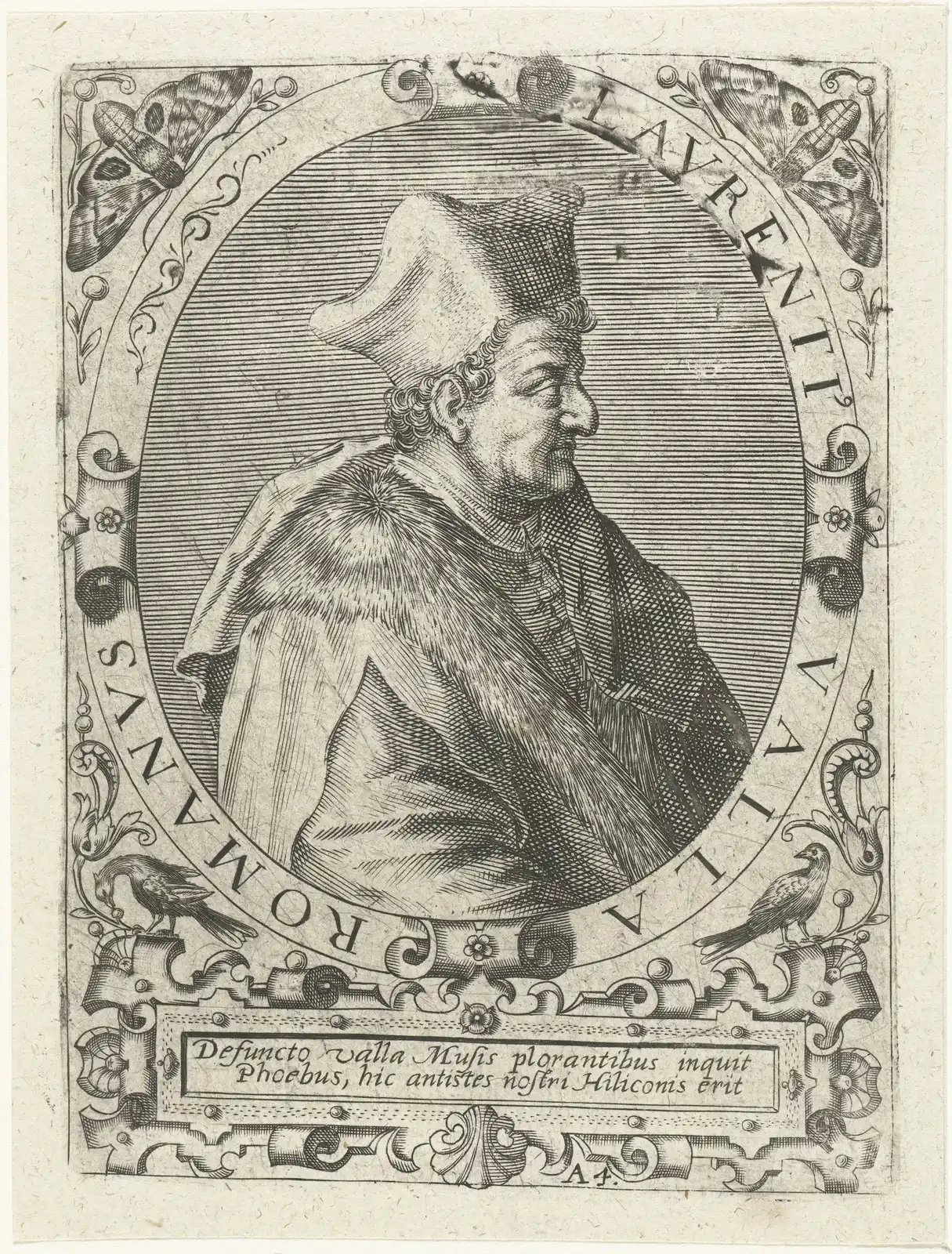
"Portrait of Lorenzo Valla (Laurentius Valla)" by Theodor de Bry and Johann Theodor de Bry — https://commons.wikimedia.org/wiki/File:Portret_van_Lorenzo_Valla_Laurentius_Valla_(titel_op_object),_RP-P-1909-4359.jpg — CC0 1.0 (https://creativecommons.org/publicdomain/zero/1.0/)
What does the Donation of Constantine claim?
Constantine died in 337; the deed in which he hands the pope Rome and Italy was written centuries later. The Catholic Encyclopedia's 1909 article, by J. P. Kirsch, calls it “without doubt a forgery, fabricated somewhere between the years 750 and 850.” Christopher B. Coleman, who translated Lorenzo Valla's attack on it in 1922, dated it “probably not long after the middle of the eighth century.” The same encyclopedia's 1908 article on the emperor puts his death in May 337.
In its oldest known manuscript, Kirsch notes, the document is titled Constitutum domini Constantini imperatoris, the decree of the lord emperor Constantine (this site's translation). Constantine tells in it how Pope Sylvester I baptized him and cured him of leprosy. He then rewards the Roman church with rank, property and the emblems of an emperor, and in Coleman's summary grants Sylvester “Rome, all of Italy, and the western provinces, to remain forever under the control of the Roman See.” Last, he says he will move his rule to Byzantium, so that no earthly emperor stands in the way of the church.
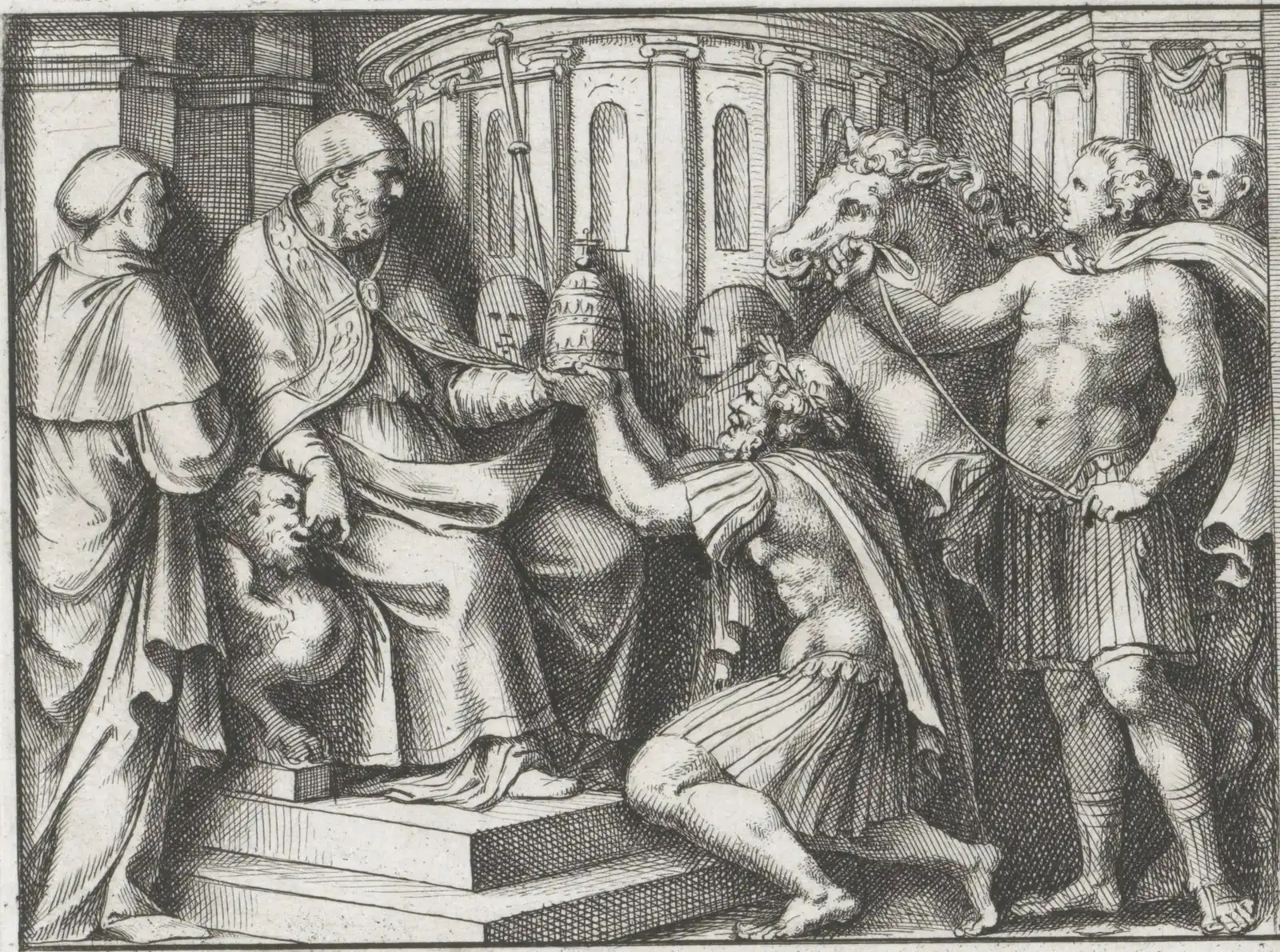
“Keizer Constantijn overhandigt Rome aan paus Silvester I (Donatio Constantini)” by Pietro Santi Bartoli, after Raphael, CC0
Full credit
"Keizer Constantijn overhandigt Rome aan paus Silvester I (Donatio Constantini)" by Pietro Santi Bartoli, after Raphael — https://commons.wikimedia.org/wiki/File:Keizer_Constantijn_overhandigt_Rome_aan_paus_Silvester_I_en_het_Seleucidische_oordeel_Donatio_Constantini_Seleucus_filio_ob_adulterium_utriusq_oculi_paena_daninato_populi_precib_(titel_op_object)_Voorstellingen_door_Ra,_RP-P-OB-34.099.jpg — CC0 1.0 (https://creativecommons.org/publicdomain/zero/1.0/); modified: cropped to the left-hand scene (the Donatio Constantini) with its framing line; the right-hand scene, the engraved lettering below, pencilled collection numbers and the blank paper margin are removed; the scene itself is not cut
From the ninth century to the fifteenth, Coleman writes, the deed was “almost universally accepted as genuine.” He counts “no less than ten Popes” who cited it. Collections of church law, he adds, made it widely known. The Pseudo-Isidorian Decretals, a ninth-century collection of church documents, took it in, and Gratian's Decretum, the textbook of church law that Valla used, later carried part of it.
What did the deed hand over?
The text Valla worked from is the shorter one in Gratian's Decretum, which Coleman reprints with an English translation. It lists the grants clause by clause. First comes rank: the pope is to have “the supremacy as well over the four principal seats, Alexandria, Antioch, Jerusalem, and Constantinople, as also over all the churches of God in the whole earth.”
Property and dress follow. The deed gives estates in Judea, Greece, Asia, Thrace, Africa and Italy to pay for lamps in the churches of Peter and Paul, and hands the pope the Lateran palace, the imperial crown, a tiara, the purple mantle, sceptres and standards. The Roman clergy are to be “made patricians and consuls.” Constantine even says that, “holding the bridle of his horse,” he “performed for him the duty of groom.”
Then comes the land. Constantine hands over “the city of Rome, and all the provinces, places and cities of Italy and the western regions,” and he announces that a new capital “should be built in our name” in “the province of Byzantia.” Valla would make much of that last clause.
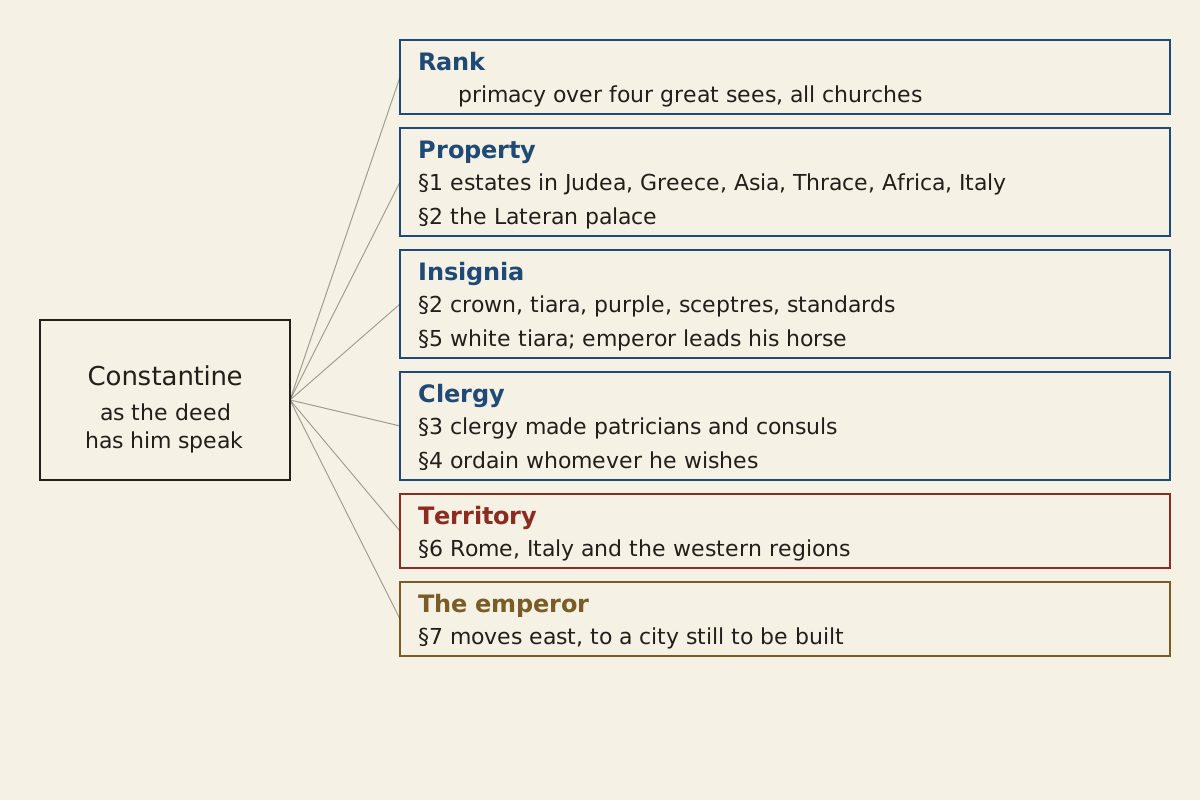
Figure: From the Surviving Record, CC BY 4.0
Full credit line for reuse
"What the Donation of Constantine grants" by From the Surviving Record, CC BY 4.0. Source: https://fromthesurvivingrecord.com/hoaxes/donation-of-constantine/ — License: https://creativecommons.org/licenses/by/4.0/
Data: Constitutum Constantini, as given in Gratian's Decretum, Part I, Dist. XCVI, chs. XIII-XIV, translated in Christopher B. Coleman, The Treatise of Lorenzo Valla on the Donation of Constantine (Yale University Press, 1922), retrieved 2026-11-01, public domain
| Section | What the deed grants | To whom |
|---|---|---|
| opening | supremacy over the four principal sees and all churches | the pontiff at the head of the Roman church |
| 1 | landed estates for the lights of the churches of Peter and Paul, east and west | the churches of the apostles Peter and Paul, administered by Sylvester and his successors |
| 2 | the imperial Lateran palace | Sylvester and all his successors |
| 2 | crown, tiara, shoulder-band, purple mantle, scarlet tunic, sceptres and standards | Sylvester and all his successors |
| 3 | the rank and dress of the senate for the Roman clergy | the clergy of the Roman church |
| 4 | freedom to ordain whomever he wishes | Sylvester and his successors |
| 5 | a white tiara for processions; the emperor leads the pope's horse | Sylvester and his successors |
| 6 | the city of Rome and the provinces of Italy and the western regions | Sylvester and his successors |
| 7 | the emperor moves his rule east, to a city still to be built | the emperor himself |
Download the table (CSV, donation-of-constantine-grants.csv) (file notes: sources and license) Data: Constitutum Constantini, as given in Gratian's Decretum, Part I, Dist. XCVI, chs. XIII-XIV, translated in Christopher B. Coleman, The Treatise of Lorenzo Valla on the Donation of Constantine (Yale University Press, 1922), retrieved 2026-11-01, public domain; Christopher B. Coleman, The Treatise of Lorenzo Valla on the Donation of Constantine (Yale University Press, 1922), retrieved 2026-11-01, public domain; J. P. Kirsch, "Donation of Constantine", The Catholic Encyclopedia, vol. 5 (1909), retrieved 2026-11-01, public domain
How far “the western regions” reached is read in two ways. Coleman's note says the writer meant the Italian peninsula, with Lombardy, Venetia, Istria and nearby islands, and that Valla followed the wider reading of his own day. Kirsch (1909) reports that some of the scholars who place the forgery at Rome limit the phrase to Italy, but that most of them take it to mean the whole former Western Empire. On this point the sources disagree.
When was it written?
Kirsch's 1909 window runs from 750 to 850. Most investigators, he writes, take the pontificate of Stephen II (752–757) as the earliest possible date and the deed's entry into the False Decretals, about 840–850, as the latest. Within those limits, he adds, “nearly every student of this intricate question maintains his own distinct view.”
Coleman, writing 13 years later, narrowed it. The deed's Latin, he argued, uses words in ways typical of the papal chancery, the office that drafted papal letters, under Stephen II and Paul I. His note on one of them, retro, says it was used at Rome in the late eighth century to mean “still” or “again.” He named the reign of Paul I, from 757 to 767, as “the most probable time.”
On the place, the two sources part ways. Coleman's reading points to the papal chancery in Rome. Kirsch notes that the deed first turns up in Frankish collections and in Frankish writers, and he calls the view that it was made in the Frankish Empire “rightly tenable” against the majority who place it at Rome. Even the oldest copy is numbered differently: a ninth-century Paris manuscript, Latin 2777 in Kirsch and Latin 2778 in Coleman.
The False Decretals get slightly different dates too: about 847 to 853 in Coleman, 847 to 852 in Kirsch. Measured from Constantine's death in 337, Kirsch's window opens 413 years later and closes 513 years later, and Coleman's decade falls 420 to 430 years after it. Each interval is a subtraction of the years as the sources give them, checked two ways.
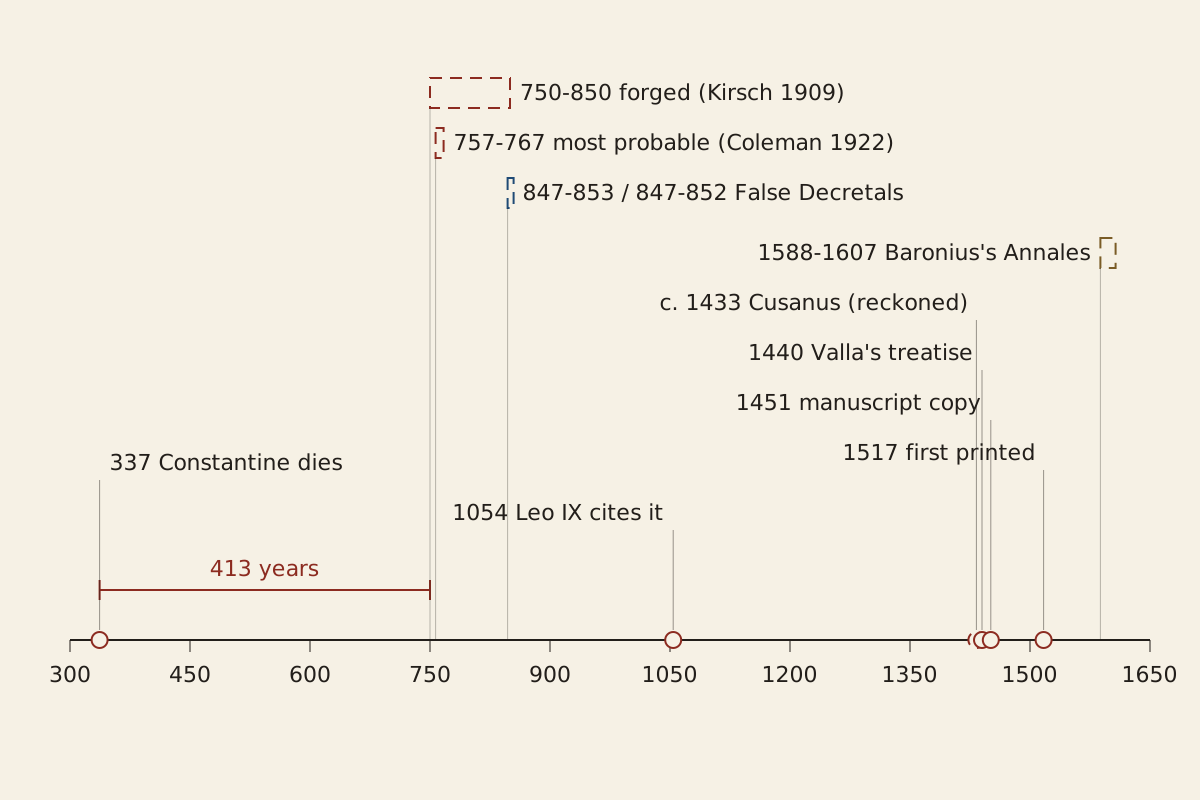
Figure: From the Surviving Record, CC BY 4.0
Full credit line for reuse
"Donation of Constantine: dated points, 337 to 1607" by From the Surviving Record, CC BY 4.0. Source: https://fromthesurvivingrecord.com/hoaxes/donation-of-constantine/ — License: https://creativecommons.org/licenses/by/4.0/
Data: C. Herbermann and G. Grupp, "Constantine the Great", The Catholic Encyclopedia, vol. 4 (1908), retrieved 2026-11-01, public domain; J. P. Kirsch, "Donation of Constantine", The Catholic Encyclopedia, vol. 5 (1909), retrieved 2026-11-01, public domain; Christopher B. Coleman, The Treatise of Lorenzo Valla on the Donation of Constantine (Yale University Press, 1922), retrieved 2026-11-01, public domain; J. B. Peterson, "Venerable Cesare Baronius", The Catholic Encyclopedia, vol. 2 (1907), retrieved 2026-11-01, public domain in the US
Download the table (CSV, donation-of-constantine-timeline.csv) (file notes: sources and license) Data: C. Herbermann and G. Grupp, "Constantine the Great", The Catholic Encyclopedia, vol. 4 (1908), retrieved 2026-11-01, public domain; J. P. Kirsch, "Donation of Constantine", The Catholic Encyclopedia, vol. 5 (1909), retrieved 2026-11-01, public domain; Christopher B. Coleman, The Treatise of Lorenzo Valla on the Donation of Constantine (Yale University Press, 1922), retrieved 2026-11-01, public domain; J. B. Peterson, "Venerable Cesare Baronius", The Catholic Encyclopedia, vol. 2 (1907), retrieved 2026-11-01, public domain in the US
At Rome, Kirsch adds, no pope relied on the deed in an official act until Leo IX, in a letter of 1054. That was 717 years after Constantine's death.
How did Lorenzo Valla take it apart?
Lorenzo Valla's treatise against the deed is dated to 1440 by Coleman (1922), partly from events the treatise itself mentions, and Kirsch's 1909 article gives the same year.
Coleman adds the setting. Valla was then secretary to Alfonso, king of Aragon, Sicily and Naples, and the treatise “may well be considered as part of the campaign which that king was conducting against Pope Eugenius IV.” Valla knew the risk. “How they will rage against me,” he writes near the start, because he was writing against “the supreme pontiff.”
His sharpest point is about a city. The deed lists Constantinople among the four great sees, yet at the time of the grant, Valla writes, it was “not yet a patriarchate, nor a see, nor a Christian city, nor named Constantinople, nor founded, nor planned!” The deed itself says the new capital is still to be built. “Who then does not see that the man who wrote the ‘privilege’ lived long after the time of Constantine,” Valla asks, and he closes with an old proverb: “Liars need good memories.”
The rest of his case reads the words. Valla could not remember reading of any Roman satrap, the deed's word for a high official, and he argued that Roman decrees came from the Senate, as the letters S.C. and S.P.Q.R. on old stones and coins show. Coleman's note backs him: the word was applied to high officials at Rome only in the middle of the eighth century. Clergy “made patricians and consuls” also struck Valla as wrong, since consuls are made but patricians are born, and Coleman notes that the old office of consul had disappeared during the German invasions.
The date line fails as well. It names Constantine and Gallicanus as consuls, which Valla found strange, and Coleman's note puts it bluntly: “the date is impossible; no such consulship as this is known.” Valla adds a point from coins. He owned many gold coins of Constantine's with Latin inscriptions, he writes, yet no one had seen a coin of a pope ruling Rome.
| Point | What the deed says | Valla's objection | Coleman's 1922 note |
|---|---|---|---|
| satraps | “together with all our satraps, and the whole senate” | Roman decrees came from the Senate; Valla recalled no Roman satrap in his reading | the word was used for high officials at Rome only from the mid-eighth century |
| Constantinople as a patriarchal see | “the four principal seats, Alexandria, Antioch, Jerusalem, and Constantinople” | the city was not yet founded, named or planned; the deed says it is still to be built | no dating note |
| the province of Byzantia | “in the province of Byzantia … a city should be built” | Byzantium was a town, not a province, and Thrace lies north, not east | no dating note |
| phrygium (tiara) | “the tiara and also the shoulder-band” | no one called the tiara phrygium in Latin, and the writer leaves the word unexplained | no dating note |
| clergy made patricians and consuls | “that they be made patricians and consuls” | consuls are made, but patricians are born | the consul's office had disappeared during the German invasions |
| the date line | Constantine and Gallicanus named as consuls | an odd shared consulship, and a leper would not take the office | no such consulship is known |
| retro (still) | “now and in all times still to come” | not raised by Valla | Roman usage of the late eighth century |
Download the table (CSV, donation-of-constantine-anachronisms.csv) (file notes: sources and license) Data: Lorenzo Valla, Discourse on the Forgery of the Alleged Donation of Constantine (1440), translated in Christopher B. Coleman, The Treatise of Lorenzo Valla on the Donation of Constantine (Yale University Press, 1922), retrieved 2026-11-01, public domain; Constitutum Constantini, as given in Gratian's Decretum, Part I, Dist. XCVI, chs. XIII-XIV, translated in Christopher B. Coleman, The Treatise of Lorenzo Valla on the Donation of Constantine (Yale University Press, 1922), retrieved 2026-11-01, public domain; Christopher B. Coleman, The Treatise of Lorenzo Valla on the Donation of Constantine (Yale University Press, 1922), retrieved 2026-11-01, public domain; J. P. Kirsch, "Donation of Constantine", The Catholic Encyclopedia, vol. 5 (1909), retrieved 2026-11-01, public domain
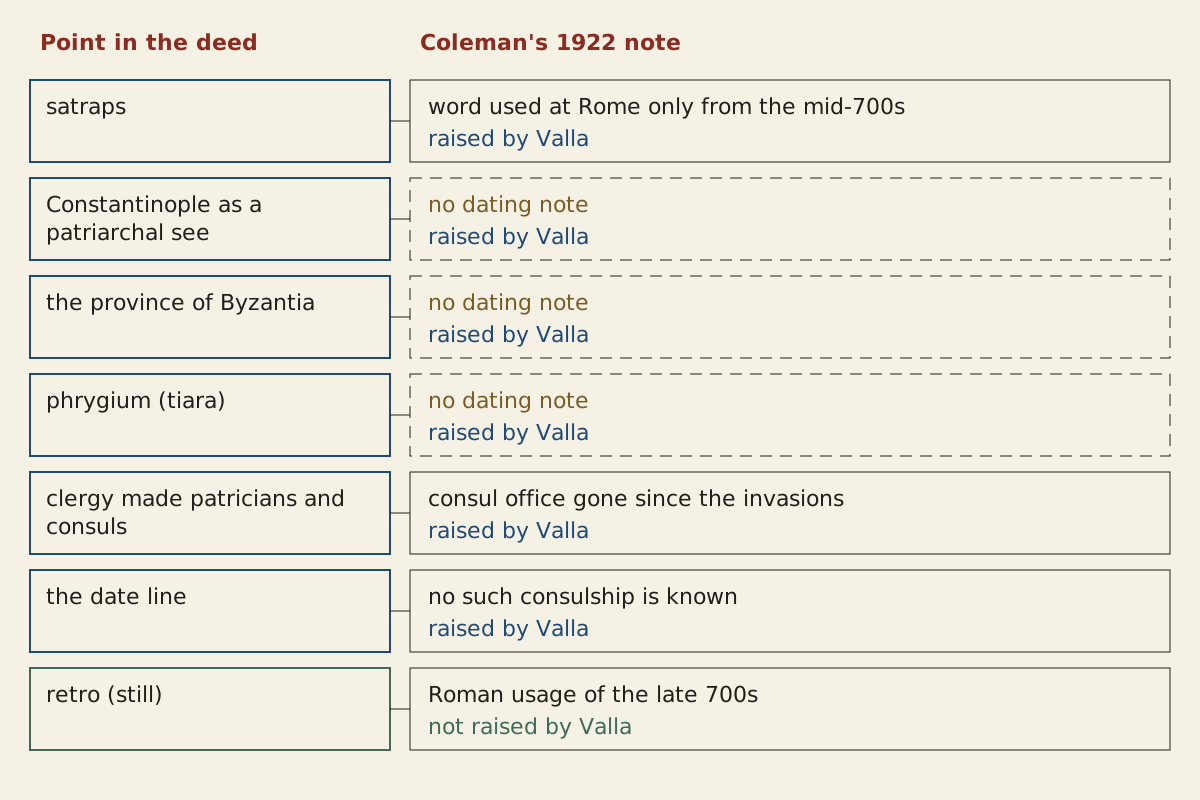
Figure: From the Surviving Record, CC BY 4.0
Full credit line for reuse
"Valla's points against the Donation, with Coleman's 1922 notes" by From the Surviving Record, CC BY 4.0. Source: https://fromthesurvivingrecord.com/hoaxes/donation-of-constantine/ — License: https://creativecommons.org/licenses/by/4.0/
Data: Lorenzo Valla, Discourse on the Forgery of the Alleged Donation of Constantine (1440), translated in Christopher B. Coleman, The Treatise of Lorenzo Valla on the Donation of Constantine (Yale University Press, 1922), retrieved 2026-11-01, public domain; Christopher B. Coleman, The Treatise of Lorenzo Valla on the Donation of Constantine (Yale University Press, 1922), retrieved 2026-11-01, public domain
Not every argument holds up. Coleman calls one of Valla's claims, about how Eusebius describes Constantine's faith, “slightly overdrawn.” Still, he credits Valla with using, effectively and for the first time, “the method of studying the usage of words in the variations of their meaning and application.”
Why did the doubts take so long to win?
Coleman (1922) and Kirsch (1909) both put Nicholas of Cusa ahead of Valla in questioning the deed.
Only Coleman says how much earlier. Cusanus, he writes, “some seven years earlier in his De concordantia catholica covered part of the same ground even better than Valla did, and anticipated some of his arguments.” Kirsch says Cusa called the deed a dictamen apocryphum, an apocryphal composition (this site's translation). In England, according to Kirsch, Reginald Pecock, bishop of Chichester from 1450 to 1457, reached a similar conclusion “independently of both his predecessors.”

Illustration: From the Surviving Record. Generated schematic image — not a photograph or historical record. © From the Surviving Record, all rights reserved.
Before the fifteenth century, Kirsch writes, no one doubted that the deed was genuine. The popes' medieval opponents never denied its validity; they argued instead that the legal conclusions drawn from it rested on false readings. Even after Valla, “the majority of canonists and jurists” kept quoting it as authentic through the sixteenth century.
Valla's case also reached print slowly. The only complete manuscript Coleman could find is dated December 7, 1451, and the first printed edition, by Ulrich von Hutten, came out in 1517, 77 years after Valla wrote. Once the forgery was known, Coleman adds, the reaction against it, “as in Luther's case, contributed powerfully to the revolt from Rome.” According to Kirsch (1909), the cardinal Cesare Baronius admitted it was a forgery in his Annales Ecclesiastici, under the year 324; the encyclopedia's 1907 article on Baronius dates those twelve volumes from 1588 to 1607.
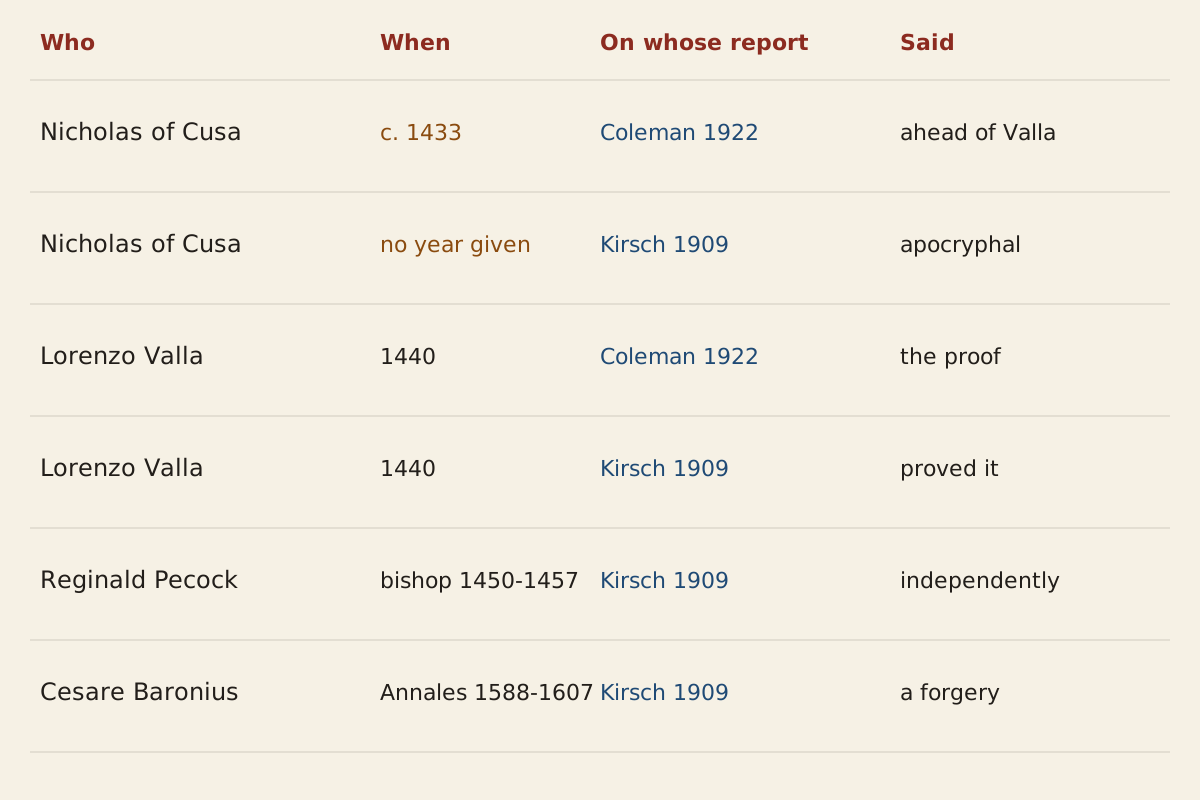
Figure: From the Surviving Record, CC BY 4.0
Full credit line for reuse
"Who doubted the Donation of Constantine" by From the Surviving Record, CC BY 4.0. Source: https://fromthesurvivingrecord.com/hoaxes/donation-of-constantine/ — License: https://creativecommons.org/licenses/by/4.0/
Data: Christopher B. Coleman, The Treatise of Lorenzo Valla on the Donation of Constantine (Yale University Press, 1922), retrieved 2026-11-01, public domain; J. P. Kirsch, "Donation of Constantine", The Catholic Encyclopedia, vol. 5 (1909), retrieved 2026-11-01, public domain; J. B. Peterson, "Venerable Cesare Baronius", The Catholic Encyclopedia, vol. 2 (1907), retrieved 2026-11-01, public domain in the US
Download the table (CSV, donation-of-constantine-doubters.csv) (file notes: sources and license) Data: Christopher B. Coleman, The Treatise of Lorenzo Valla on the Donation of Constantine (Yale University Press, 1922), retrieved 2026-11-01, public domain; J. P. Kirsch, "Donation of Constantine", The Catholic Encyclopedia, vol. 5 (1909), retrieved 2026-11-01, public domain; J. B. Peterson, "Venerable Cesare Baronius", The Catholic Encyclopedia, vol. 2 (1907), retrieved 2026-11-01, public domain in the US
By dead reckoning, three points in this record help explain the slow end, though neither source weighs them. Valla's case circulated only in manuscript for 77 years. It was written for a king at war with the pope, so a reader could set it aside as a partisan tract. And for centuries the argument over the deed had been about what it meant, not whether it was genuine.
Two other entries follow a fake that kept working after people doubted it: the Cardiff Giant, called a hoax within days of being dug up, and Charles Ponzi's postal coupon scheme. Valla settled that Constantine did not issue the deed. Who did is still open, and Kirsch wrote in 1909 that “the last word of historical research in this matter still remains to be said.”
Still missing:
- Who wrote the deed, and where. Kirsch (1909) says the authorship “is still wrapped in obscurity,” and he and Coleman disagree on whether it came from Rome or from Frankish lands. Book counts written down centuries after the event raise a similar problem in Library of Alexandria: No Source on File Names Its Last Day.
- What Cusanus actually wrote. De concordantia catholica is not among the sources read for this page, so his arguments are known here only through Coleman's and Kirsch's summaries.
- Whether close reading can settle every question like this one. It showed the deed was later than Constantine, but two centuries of reading a 1598 list have not settled which play one title named: Love's Labour's Won: A Shakespeare Title Listed in 1598.
Cite this page
From the Surviving Record. “Donation of Constantine: Written Centuries After Constantine.” First published 2026-11-01. https://fromthesurvivingrecord.com/hoaxes/donation-of-constantine/ (accessed add the date you read it).
Sources
- Constitutum Constantini (the Donation of Constantine), as given in Gratian's Decretum, Part I, Dist. XCVI, chs. XIII–XIV, Latin text with English translation in Christopher B. Coleman, The Treatise of Lorenzo Valla on the Donation of Constantine (New Haven: Yale University Press, 1922). www.gutenberg.org/ebooks/70092 Read: full English translation of the text as given in Gratian.
- Lorenzo Valla, Discourse on the Forgery of the Alleged Donation of Constantine (1440), translated by Christopher B. Coleman in The Treatise of Lorenzo Valla on the Donation of Constantine (New Haven: Yale University Press, 1922). www.gutenberg.org/ebooks/70092 Read: the English translation: the opening and the passages cited on this page.
- Christopher B. Coleman, “Introductory” and notes, in The Treatise of Lorenzo Valla on the Donation of Constantine (New Haven: Yale University Press, 1922). www.gutenberg.org/ebooks/70092 Read: the introduction in full; the notes cited on this page.
- J. P. Kirsch, “Donation of Constantine,” in The Catholic Encyclopedia, vol. 5 (New York: Robert Appleton Company, 1909). www.newadvent.org/cathen/05118a.htm Read: full article.
- Charles Herbermann and Georg Grupp, “Constantine the Great,” in The Catholic Encyclopedia, vol. 4 (New York: Robert Appleton Company, 1908). www.newadvent.org/cathen/04295c.htm Read: the passage on his death.
- John Bertram Peterson, “Venerable Cesare Baronius,” in The Catholic Encyclopedia, vol. 2 (New York: Robert Appleton Company, 1907). www.newadvent.org/cathen/02304b.htm Read: the passages on the Annales.
Spotted an error? Write to contact@fromthesurvivingrecord.com (the link fills in this page's title as the subject). Changes are logged in the corrections log and at the foot of the entry; the evidence levels page explains how sources are weighed.
Related entries
-
Hoaxes & Forgeries
Cardiff Giant: By White's Account, Its Stone Was Gypsum
The Cardiff Giant was dug up on October 16, 1869. Andrew D. White recorded that a piece said to be from it was gypsum. Who doubted it, and when, with CSV data.
Picture credit
"Cardiff Giant" by Bain News Service — https://commons.wikimedia.org/wiki/File:Cardiff_Giant_LCCN2014693762.jpg — Public domain (US: copy negative of a photograph marked as copyrighted in the 1860s, issued by Bain without a copyright notice, public domain in the United States either way; EU: the photograph names only a copyright claimant, C. O. Gott, whose dates are unknown, and was made in the 1860s, so the author is presumed to have died more than 70 years ago (presumed)); modified: cropped to remove the torn negative edge, the hand-lettered title at top left, the negative number at the right edge and a hand-written copyright line at lower right; the figure itself is not cut
-

Hoaxes & Forgeries
Charles Ponzi: A Coupon Trade the Supreme Court Called False
In 1924 the U.S. Supreme Court called Charles Ponzi's postal-coupon trade a “false tale.” His $150-for-$100 promise and the 1920 run, from the Court's record.
Picture credit
Illustration: From the Surviving Record. Generated schematic image — not a photograph or historical record. © From the Surviving Record, all rights reserved.