Charles Ponzi: A Coupon Trade the Supreme Court Called False
Published Last substantive revision
How to read this page: each point is marked as a cross-checked fix, a single record (“according to”), or inference (“by dead reckoning”).
TL;DR: In a 1924 bankruptcy case, the Supreme Court of the United States called Charles Ponzi's claim that he profited by buying and selling international postal coupons a “false tale,” and it noted his written promise to pay $150 for every $100 lent within ninety days. The Court found that he made no investments of any kind and took in $9,582,000 within eight months, and it ruled that six lenders repaid in the August 1920 rush had received unlawful preferences that his bankruptcy trustee could recover.
“Don't Be Ponzied” by Washington Mutual Savings Bank, in The Town Crier…, Public domain
Full credit
"Don't Be Ponzied" by Washington Mutual Savings Bank, in The Town Crier (Seattle), 25 September 1920 — https://commons.wikimedia.org/wiki/File:Don%27t_Be_Ponzied.jpg — Public domain (published in The Town Crier, Seattle, 25 September 1920, before 1931, for the US; an unsigned company advertisement with no named author, so the EU term of 70 years from publication ended in 1990)
What did Ponzi tell his lenders?
In 1924, the U.S. Supreme Court called Charles Ponzi's postal-coupon trade a “false tale.” The words come from Cunningham v. Brown, decided on April 28, 1924, nearly four years after his business in Boston collapsed. Chief Justice Taft wrote for the Court.
According to the opinion, Ponzi began in December 1919 “with a capital of $150,” borrowing money on his own promissory notes. A promissory note is a written promise to repay a set sum by a set date. He did not offer to invest for his lenders, the Court says; he borrowed “on his credit only.”
What he told them, in the Supreme Court's words, was a false tale: that “on his own account he was engaged in buying international postal coupons in foreign countries” and selling them in other countries at a profit of 100 percent. He said the gaps between currency exchange rates after the war made this possible, and he offered to let others share in it.
The terms fit on one line. “By a written promise in ninety days to pay them $150 for every $100 loaned, he induced thousands to lend him,” the opinion says. In practice he paid his ninety-day notes in full after forty-five days, and he let it be known that anyone who brought in a note before forty-five days would get back 100 percent of the loan.
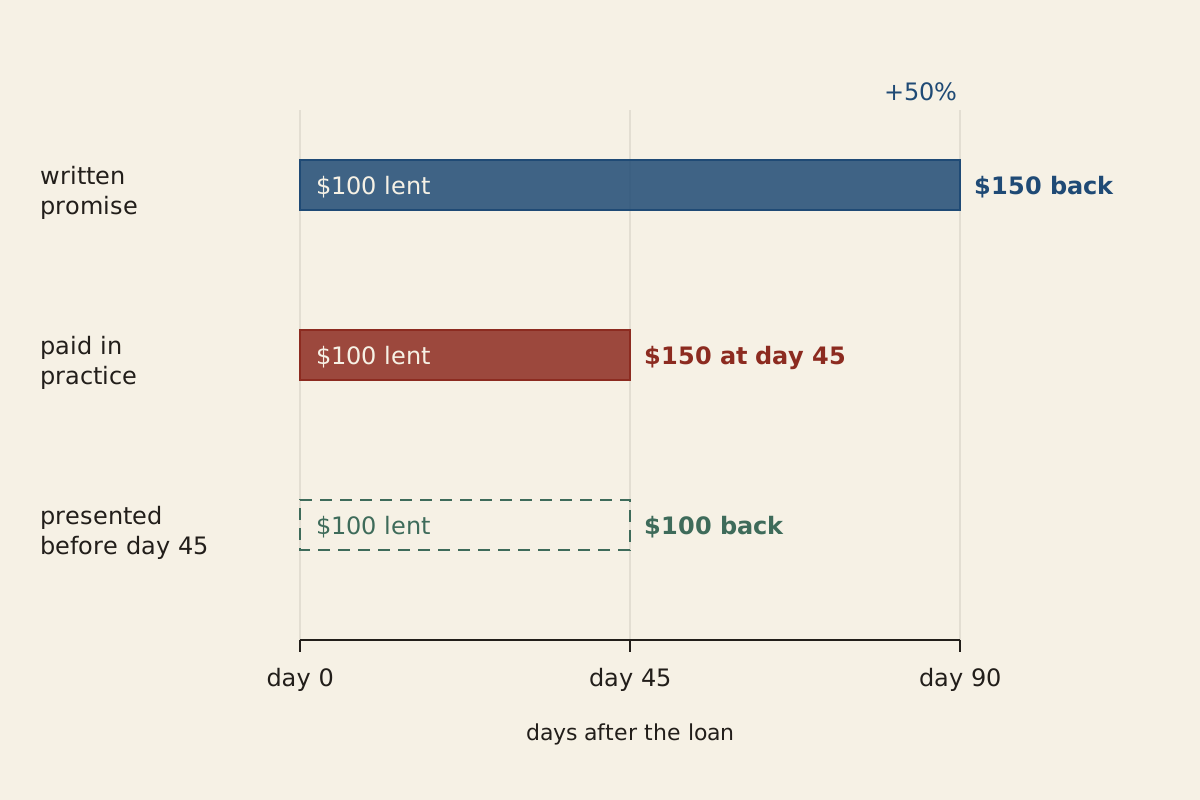
Figure: From the Surviving Record, CC BY 4.0
Full credit line for reuse
"Ponzi's 90-day promise and his 45-day practice" by From the Surviving Record, CC BY 4.0. Source: https://fromthesurvivingrecord.com/hoaxes/charles-ponzi/ — License: https://creativecommons.org/licenses/by/4.0/
Data: Cunningham v. Brown, 265 U.S. 1 (1924), opinion of the Court, U.S. Reports via govinfo.gov, retrieved 2026-11-01, public domain (U.S. court opinion)
By dead reckoning, a 50 percent gain in 90 days works out to about 203 percent a year as simple interest, and about 406 percent if a note was paid at 45 days. These are this page's own arithmetic, not the Court's, and they are given only to show the size of the promise.
What was an international reply coupon?
Postal coupons of the kind Ponzi named did exist. A Belgian coupon, dated 1907 on the file page of a collector's scan, states its use on the back in four languages; the English paragraph reads: “This coupon can be exchanged for a postage stamp of the value of 25 centimes or the equivalent of that sum in countries which have adopted the arrangement.” The front repeats the offer in French and Dutch under the heading Coupon-réponse international, or international reply coupon.
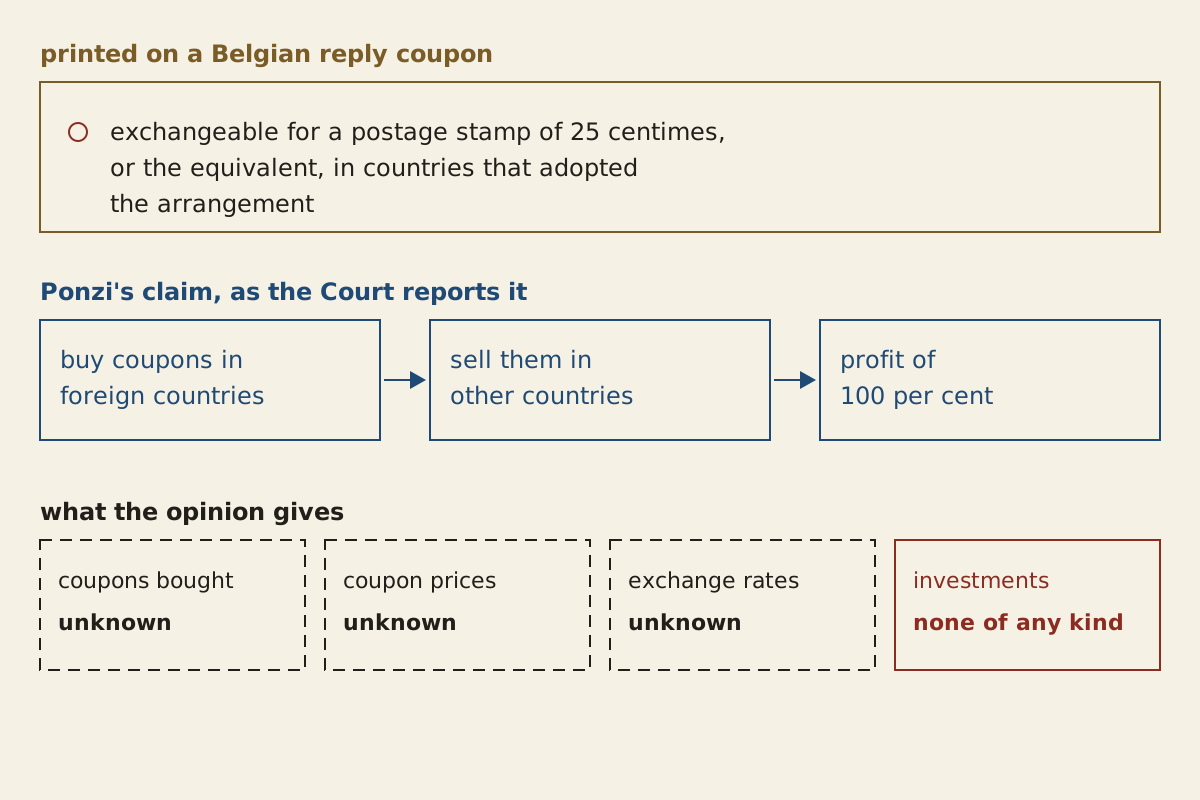
Figure: From the Surviving Record, CC BY 4.0
Full credit line for reuse
"The coupon, the claim, and what the opinion gives" by From the Surviving Record, CC BY 4.0. Source: https://fromthesurvivingrecord.com/hoaxes/charles-ponzi/ — License: https://creativecommons.org/licenses/by/4.0/
Data: Cunningham v. Brown, 265 U.S. 1 (1924), opinion of the Court, U.S. Reports via govinfo.gov, retrieved 2026-11-01, public domain (U.S. court opinion); Belgian international reply coupon, dated 1907 on its Wikimedia Commons file page, English text printed on the reverse (short quotation), retrieved 2026-11-01
The opinion does not say whether Ponzi ever bought a coupon. It says something wider: “He made no investments of any kind, so that all the money he had at any time was solely the result of loans by his dupes.” The Court gives no count of coupons, no coupon prices and no exchange rates. This page therefore does not try to work out what a coupon trade could have earned.
Where did the money come from?
Ponzi's lenders paid in $9,582,000 “within eight months,” and he gave them notes for $14,374,000, according to the opinion. The notes come to almost exactly one and a half times the cash, which matches the promise of $150 for every $100.
Each loan cost him more than the promise. The opinion says he paid the people who sold his notes a commission of 10 percent, so “every loan paid in full with the profit would cost him 60 per cent.” By July 1, 1920, he was taking in “about one million dollars a week.”
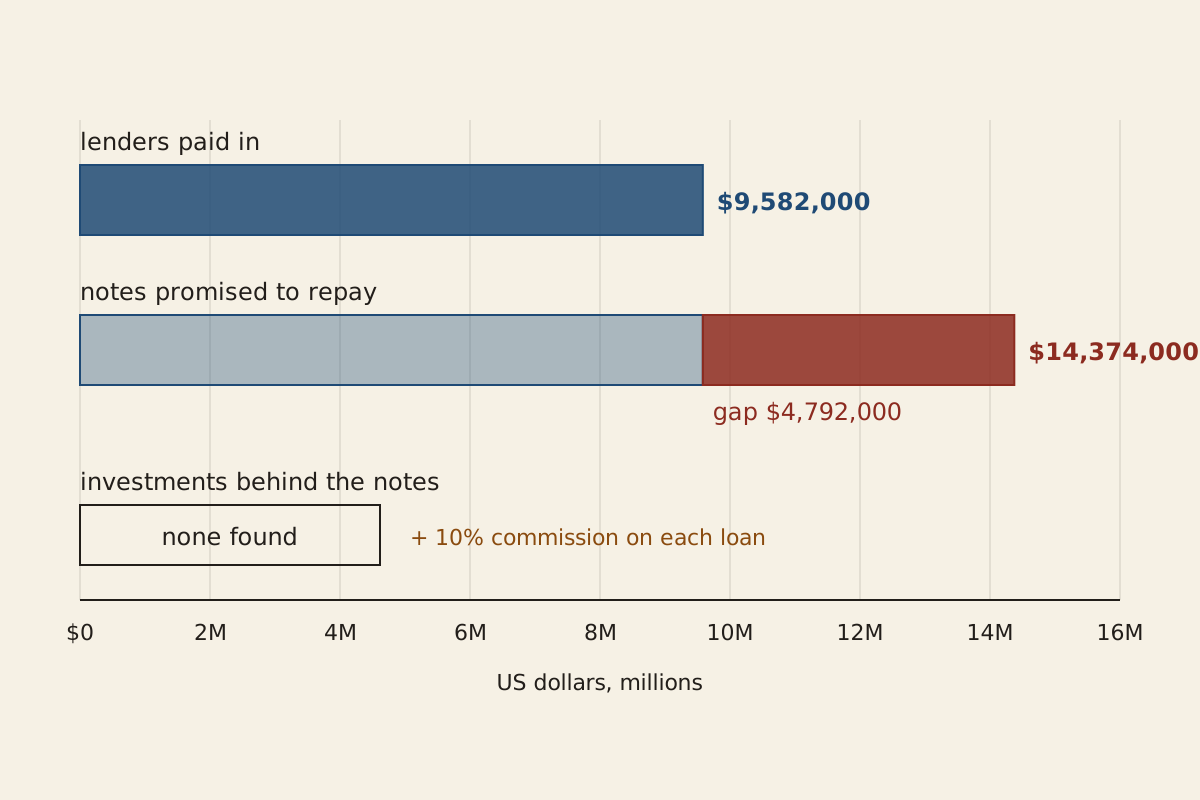
Figure: From the Surviving Record, CC BY 4.0
Full credit line for reuse
"Money taken in against the notes issued" by From the Surviving Record, CC BY 4.0. Source: https://fromthesurvivingrecord.com/hoaxes/charles-ponzi/ — License: https://creativecommons.org/licenses/by/4.0/
Data: Cunningham v. Brown, 265 U.S. 1 (1924), opinion of the Court, U.S. Reports via govinfo.gov, retrieved 2026-11-01, public domain (U.S. court opinion)
The Court summed up the business in one line: “He was always insolvent and became daily more so, the more his business succeeded.” Insolvent means owing more than one owns. By the Court's account, all the money he had came from loans. By dead reckoning, the extra $50 on any note paid in full could only come out of other lenders' money.
By dead reckoning, the early payments did more than keep lenders calm. The opinion says the 45-day payouts “stimulated their avidity,” and Ponzi's secretary testified that from as early as April anyone unwilling to wait could take the money back at the amount lent. A doubtful lender could leave quietly, so private doubt did not have to become a public run.
The Court found “no evidence of any general attempt” by holders of unmatured notes to get paid before the run that began after the investigation. The opinion does not say what lenders believed before the run. The same question, why early doubt failed to stop a fake, runs through the entries on the Cardiff Giant and the Donation of Constantine.
What happened in the summer of 1920?
On July 26, 1920, Ponzi stopped selling notes “because of an investigation by public authority,” the opinion says, without naming the authority. He kept paying. Notes that had not yet run forty-five days were paid back at the amount lent, and notes that had were paid in full.
The report of the investigation set off a run on his Boston office. On Monday, August 2, the run became “a wild scramble,” when “a Boston newspaper, most widely circulated, declared Ponzi to be hopelessly insolvent,” with an account by one of his recent employees. The Court does not name the paper. Ponzi moved money from his other banks in Boston and New England into the Hanover Trust Company, his main bank.
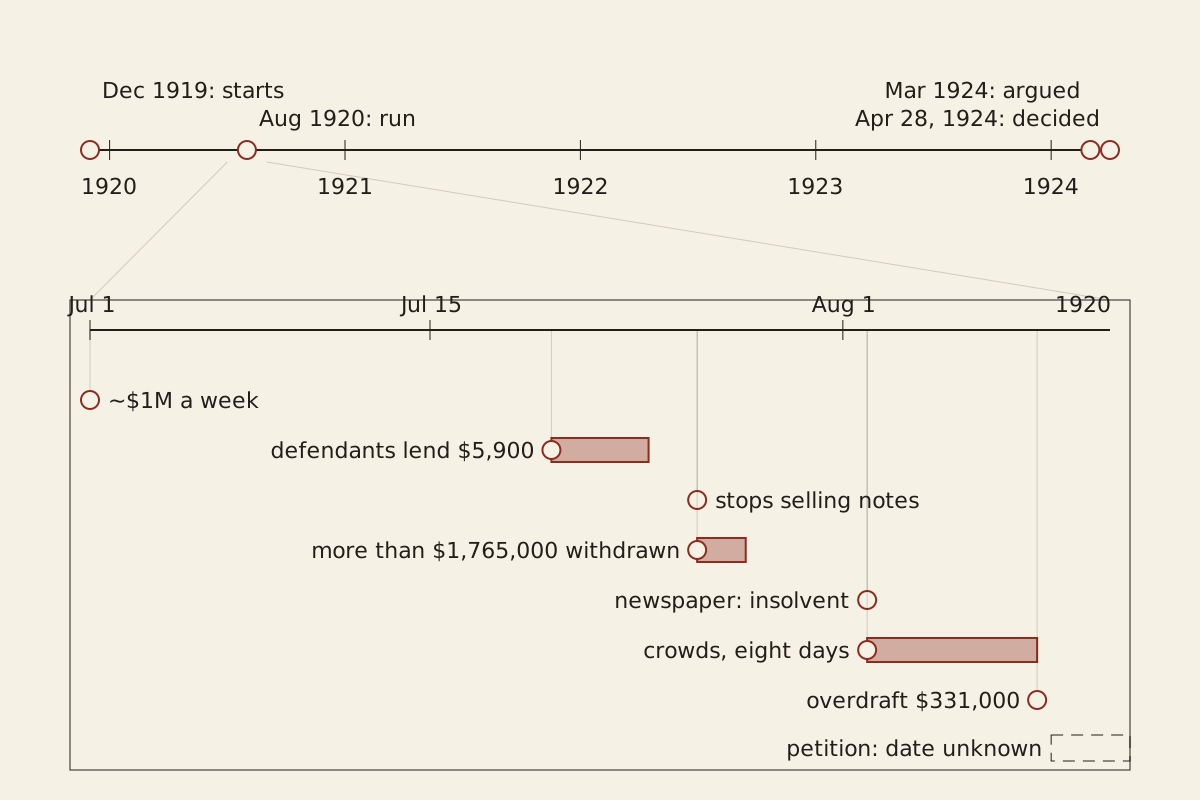
Figure: From the Surviving Record, CC BY 4.0
Full credit line for reuse
"Dated events in the Supreme Court opinion, 1919 to 1924" by From the Surviving Record, CC BY 4.0. Source: https://fromthesurvivingrecord.com/hoaxes/charles-ponzi/ — License: https://creativecommons.org/licenses/by/4.0/
Data: Cunningham v. Brown, 265 U.S. 1 (1924), opinion of the Court, U.S. Reports via govinfo.gov, retrieved 2026-11-01, public domain (U.S. court opinion)
| Date | Event, per the Supreme Court |
|---|---|
| December 1919 | Ponzi starts borrowing on his notes, with $150 in capital |
| By April 1920 | Lenders can take their money back at the amount lent before 45 days (his secretary's testimony) |
| By July 1, 1920 | About $1 million a week coming in |
| July 20–24, 1920 | Six lenders, later the defendants, lend him $5,900 in seven payments |
| July 26, 1920 | Stops selling notes because of an investigation; keeps paying |
| July 26–28, 1920 | More than $1,765,000 withdrawn from his Hanover accounts |
| August 2, 1920 | A Boston newspaper calls him hopelessly insolvent; the run becomes a scramble |
| August 2–9, 1920 | Crowds around the Hanover bank, “for eight days” |
| August 9, 1920 | The account ends $331,000 overdrawn; the bankruptcy petition follows |
| March 12, 1924 | Case argued in the Supreme Court |
| April 28, 1924 | Case decided; the lower courts reversed |
Download the table (CSV, charles-ponzi-court-findings.csv) (file notes: sources and license) Data: Cunningham v. Brown, 265 U.S. 1 (1924), opinion of the Court, U.S. Reports via govinfo.gov, retrieved 2026-11-01, public domain (U.S. court opinion)
Why did crowds fill the Hanover bank?
“The neighborhood of the Hanover Bank was crowded with people trying to get their money and for eight days they struggled,” the Court wrote. It gave the reason: “Because they feared that they would be left only with claims against the insolvent debtor.”
The bank figures show how fast the money moved. The balance in Ponzi's Hanover accounts was $334,000 at the opening of business on July 19 and $871,000 at the close on July 24. Withdrawals of $572,000 on July 26, $288,000 on July 27 and $905,000 on July 28 add up to $1,765,000, which the Court gives as “more than $1,765,000.”
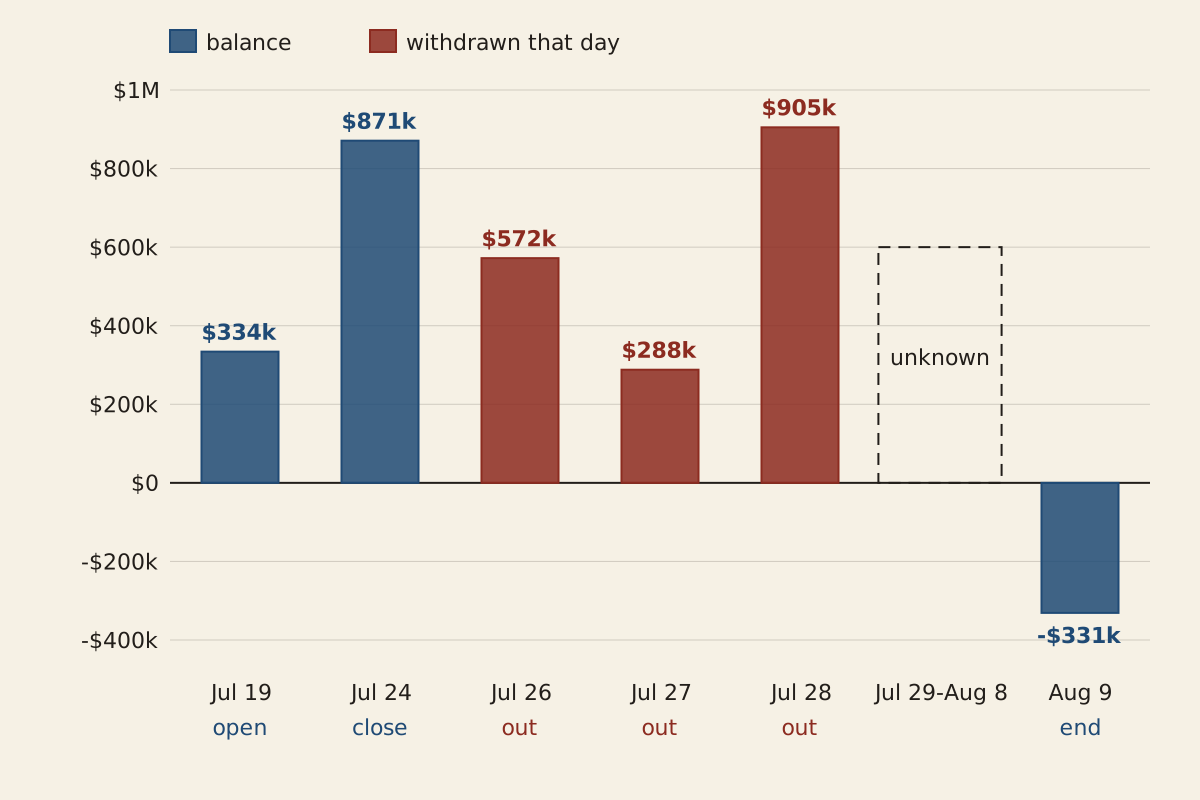
Figure: From the Surviving Record, CC BY 4.0
Full credit line for reuse
"Ponzi's Hanover Trust Company accounts, July 19 to August 9, 1920" by From the Surviving Record, CC BY 4.0. Source: https://fromthesurvivingrecord.com/hoaxes/charles-ponzi/ — License: https://creativecommons.org/licenses/by/4.0/
Data: Cunningham v. Brown, 265 U.S. 1 (1924), opinion of the Court, U.S. Reports via govinfo.gov, retrieved 2026-11-01, public domain (U.S. court opinion)
New deposits from other banks kept the account open until August 9, when it ended in an overdraft of $331,000. The petition in bankruptcy was then filed. Between July 19 and August 10, withdrawals totaled $6,692,000. At the end, the opinion says, there were five hundred people “to whom he gave checks in compliance with his promise” who were turned away “merely because there were no more funds.”
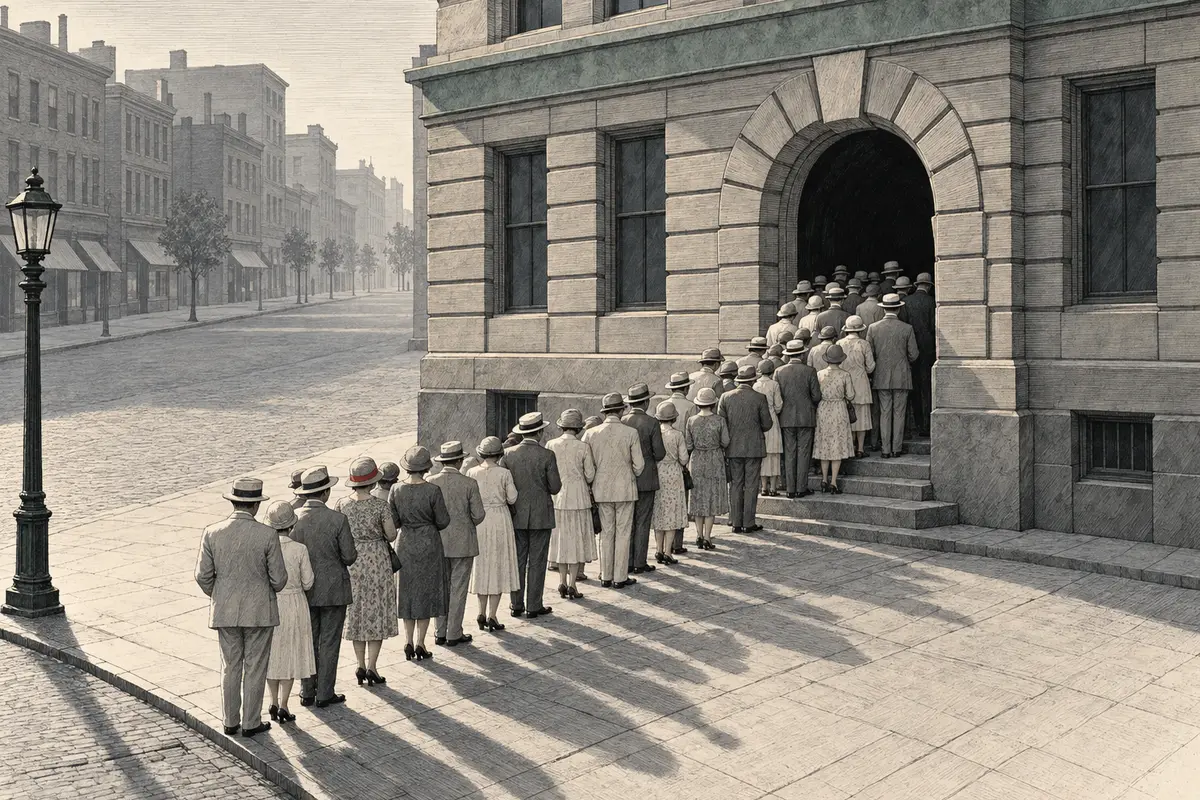
Illustration: From the Surviving Record. Generated schematic image — not a photograph or historical record. © From the Surviving Record, all rights reserved.
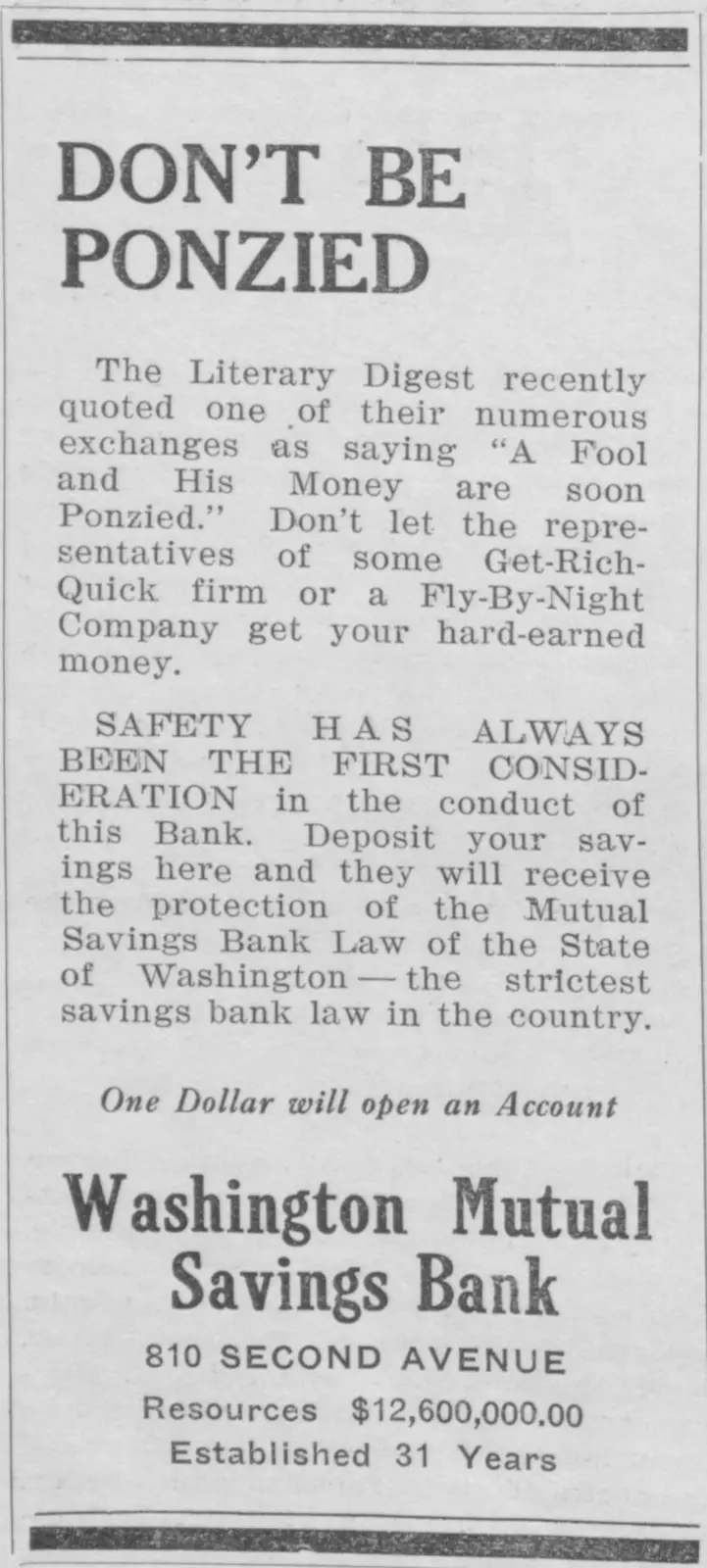
The claims later filed against the bankrupt estate were for the money lent, not for the 150 percent he had promised, the opinion notes. By September 25, 1920, his name had become a verb in a Seattle bank's newspaper advertisement headed “Don't Be Ponzied,” which quoted a line it said the Literary Digest had picked up from another paper: “A Fool and His Money are soon Ponzied.”
What did the Supreme Court decide?
The case was about who keeps money paid out during a collapse. Ponzi's trustees in bankruptcy, the officers who gather a bankrupt's property for all the creditors, sued six lenders he had repaid within four months before the petition. Those six, by the opinion's list, had lent him $5,900 between July 20 and July 24, and one of them, Brown, had been a minor. By 1924 all the original trustees had died or resigned, and Cunningham, substituted for the last of them, was the sole trustee.
The District Court and the Court of Appeals saw the repayments as the lenders rescinding, or undoing, loans made through fraud and simply taking back their own money. Both courts dismissed the suits. The District Court also found that when these lenders were paid, on and after August 2, they had reason to believe Ponzi was insolvent.
The Supreme Court disagreed with the lower courts for two reasons. First, the lenders had not undone anything: they “merely took advantage of his agreement to pay his unmatured notes at par of the actual loan.” Second, a claim to their own money would fail anyway, because they could not trace it. All they had deposited had been withdrawn by the end of July 28, days before they were paid.
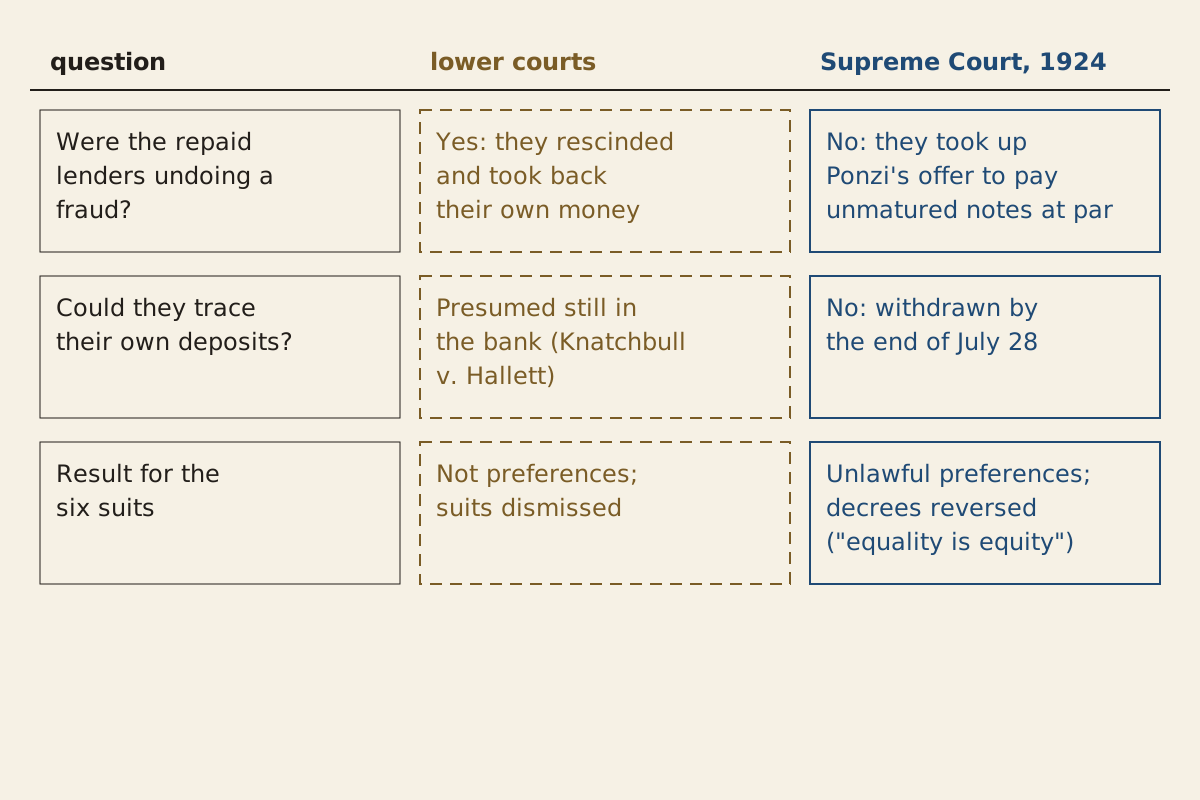
Figure: From the Surviving Record, CC BY 4.0
Full credit line for reuse
"The lower courts and the Supreme Court on the same three questions" by From the Surviving Record, CC BY 4.0. Source: https://fromthesurvivingrecord.com/hoaxes/charles-ponzi/ — License: https://creativecommons.org/licenses/by/4.0/
Data: Cunningham v. Brown, 265 U.S. 1 (1924), opinion of the Court, U.S. Reports via govinfo.gov, retrieved 2026-11-01, public domain (U.S. court opinion)
| Question | Lower courts | Supreme Court, 1924 |
|---|---|---|
| Were the repaid lenders undoing a fraud? | Yes: they rescinded and took back their own money | No: they took up Ponzi's offer to pay unmatured notes at par |
| Could they trace their own deposits? | Presumed still in the bank, under the rule in Knatchbull v. Hallett | No: withdrawn by the end of July 28 |
| Result for the six suits | Not preferences; suits dismissed | Unlawful preferences; decrees reversed |
The Court also held that an old English rule from Clayton's Case (1816) “has no application.” Under that rule, in a mixed fund owed to several defrauded people, the first money paid out counts against the first money paid in. Ponzi had drawn the July 26 to 28 money out before these lenders showed any sign of wanting it back, and at that point, the Court said, he could legally withdraw it.
To presume that Ponzi had kept these lenders' deposits apart from everyone else's would be, in the Court's phrase, “carrying the fiction to a fantastic conclusion.” After August 2, the Court said, his lenders “were all of one class,” all trying to save themselves from his insolvency. A payment that let one creditor recover a larger share of the debt than others in the same class was a preference, and when the creditor had reasonable cause to see that, the bankruptcy law let the trustee take it back.
“It is a case the circumstances of which call strongly for the principle that equality is equity,” Taft wrote. The minor stood in the same place as the others. The decrees were reversed. This is a reading of a 1924 decision, not legal advice about any present-day case.
The last good decision
By dead reckoning, the first candidate for the last good decision lies with the investigation that made Ponzi stop selling notes on July 26. The opinion records two facts that sat in his own business, not only in hindsight: he “made no investments of any kind,” and all his money came from loans. An examination of his accounts earlier in 1920 could have found no investments behind the money coming in, which by July 1 was about a million dollars a week. The limit is large: the opinion does not say when the investigation began, who ran it or what it could see, and no state record is among the sources on file.
A second candidate is Ponzi's own choice after July 26 to keep paying notes and to pull his money into one bank to meet the run. Had he stopped all payments at once, no lender would have been paid ahead of the rest, the equality the Court called for nearly four years later. The opinion does not record his reasons, and it gives no total loss to measure either choice against.
On the record read here, neither candidate can be shown to have changed how much the lenders lost in all.
Still missing:
- How many coupons Ponzi ever bought. The opinion gives no figure, and no coupon account is on file.
- How much his lenders lost in all. The opinion gives what came in ($9,582,000) and what left one bank between July 19 and August 10 ($6,692,000), but no final loss.
- What one kind of record can prove. This page rests on a single court opinion; another entry weighs what two royal payment records can and cannot show about a play no one can now read: Cardenio.
Cite this page
From the Surviving Record. “Charles Ponzi: A Coupon Trade the Supreme Court Called False.” First published 2026-11-01. https://fromthesurvivingrecord.com/hoaxes/charles-ponzi/ (accessed add the date you read it).
Sources
- Cunningham, Trustee of Ponzi, v. Brown et al., 265 U.S. 1 (argued March 12, 1924; decided April 28, 1924), opinion of the Court by Chief Justice Taft. United States Reports, vol. 265, pp. 1–14. www.govinfo.gov/content/pkg/USREPORTS-265/pdf/USREPORTS-265-1.pdf Read: full text of the case: syllabus, arguments of counsel and the opinion.
- International reply coupon, Belgium (Coupon-réponse international), front and back, dated 1907 and called the “Roma” type by the uploader. Wikimedia Commons file page. commons.wikimedia.org/wiki/File:IRC1907-1930Belgium.jpg Read: printed text on the front and back of the coupon.
- Washington Mutual Savings Bank, advertisement “Don't Be Ponzied,” The Town Crier (Seattle), vol. 15, no. 39, September 25, 1920, p. 16; Seattle Public Library. Wikimedia Commons file page. commons.wikimedia.org/wiki/File:Don%27t_Be_Ponzied.jpg Read: full text of the advertisement.


Spotted an error? Write to contact@fromthesurvivingrecord.com (the link fills in this page's title as the subject). Changes are logged in the corrections log and at the foot of the entry; the evidence levels page explains how sources are weighed.
Related entries
-
Hoaxes & Forgeries
Cardiff Giant: By White's Account, Its Stone Was Gypsum
The Cardiff Giant was dug up on October 16, 1869. Andrew D. White recorded that a piece said to be from it was gypsum. Who doubted it, and when, with CSV data.
Picture credit
"Cardiff Giant" by Bain News Service — https://commons.wikimedia.org/wiki/File:Cardiff_Giant_LCCN2014693762.jpg — Public domain (US: copy negative of a photograph marked as copyrighted in the 1860s, issued by Bain without a copyright notice, public domain in the United States either way; EU: the photograph names only a copyright claimant, C. O. Gott, whose dates are unknown, and was made in the 1860s, so the author is presumed to have died more than 70 years ago (presumed)); modified: cropped to remove the torn negative edge, the hand-lettered title at top left, the negative number at the right edge and a hand-written copyright line at lower right; the figure itself is not cut
-
Hoaxes & Forgeries
Donation of Constantine: Written Centuries After Constantine
The Catholic Encyclopedia dated the Donation of Constantine to 750–850 in 1909, long after Constantine died in 337, and Valla's treatise against it to 1440.
Picture credit
"Portrait of Lorenzo Valla (Laurentius Valla)" by Theodor de Bry and Johann Theodor de Bry — https://commons.wikimedia.org/wiki/File:Portret_van_Lorenzo_Valla_Laurentius_Valla_(titel_op_object),_RP-P-1909-4359.jpg — CC0 1.0 (https://creativecommons.org/publicdomain/zero/1.0/)