Cardenio: A Lost Play Known From Two 1613 Court Payments
Published Last substantive revision
How to read this page: each point is marked as a cross-checked fix, a single record (“according to”), or inference (“by dead reckoning”).
TL;DR: Cardenio is a lost play that turns up in two royal payment entries of 1613, as E. K. Chambers printed them in 1930: they pay Shakespeare's company, the King's Men, for a play the clerks spelled “Cardenno” and “Cardenna.” No text of it is known, and the only record on file that names an author is Humphrey Moseley's register entry of 1653, which Chambers prints as crediting “Mr. Fletcher. & Shakespeare.”
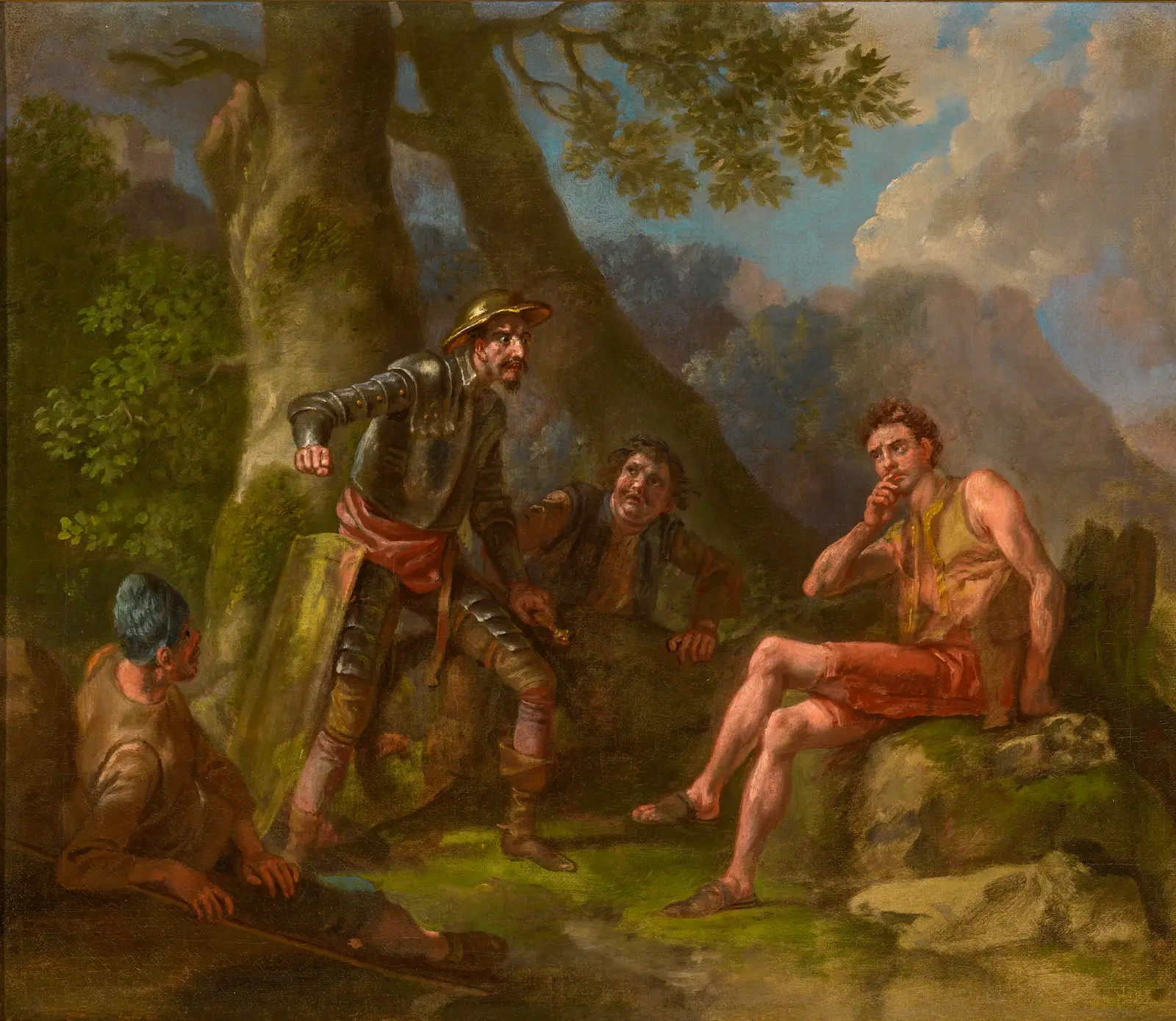
"Don Quixote Disputing with the Mad Cardenio" by Francis Hayman — https://commons.wikimedia.org/wiki/File:Don_Quixote_Disputing_with_the_Mad_Cardenio_-_Francis_Hayman_-_5_1963_4.jpg — CC0 1.0 (https://creativecommons.org/publicdomain/zero/1.0/)
What do the 1613 court accounts record?
The royal accounts record £6 13s 4d paid to Shakespeare's company, on a warrant of 9 July 1613, for Cardenna. According to the entry, the play was presented “before the Duke of Savoyes Embassadour on the viijth daye of June, 1613.” The money went to John Heminges, a member of the company by Chambers's account, “for himself and the rest of his fellowes his Majesties servauntes and Players.”
An earlier entry, under a warrant dated at Whitehall on 20 May 1613, pays Heminges for “sixe severall playes.” The fourth is “Cardenno,” listed between “the Alcumist” and “The Hotspur.” The entry gives no dates, only that all six were “played within the tyme of this Accompte.” It pays forty pounds, and twenty more “by waye of his Majesties rewarde.”
A separate entry under a warrant of the same date pays Heminges for fourteen plays presented before the Lady Elizabeth and the Prince Palatine, among them The Tempest and The Winters Tale. The six-play entry that names Cardenno does not say who was in the audience.
Both entries come from what Chambers labels the Chamber Account, and both are read here as he printed them in 1930. He notes that he took his court payments from his own earlier book, The Elizabethan Stage. Two entries in one series, read through one printed copy, count here as one source, so neither date is marked as a fix.
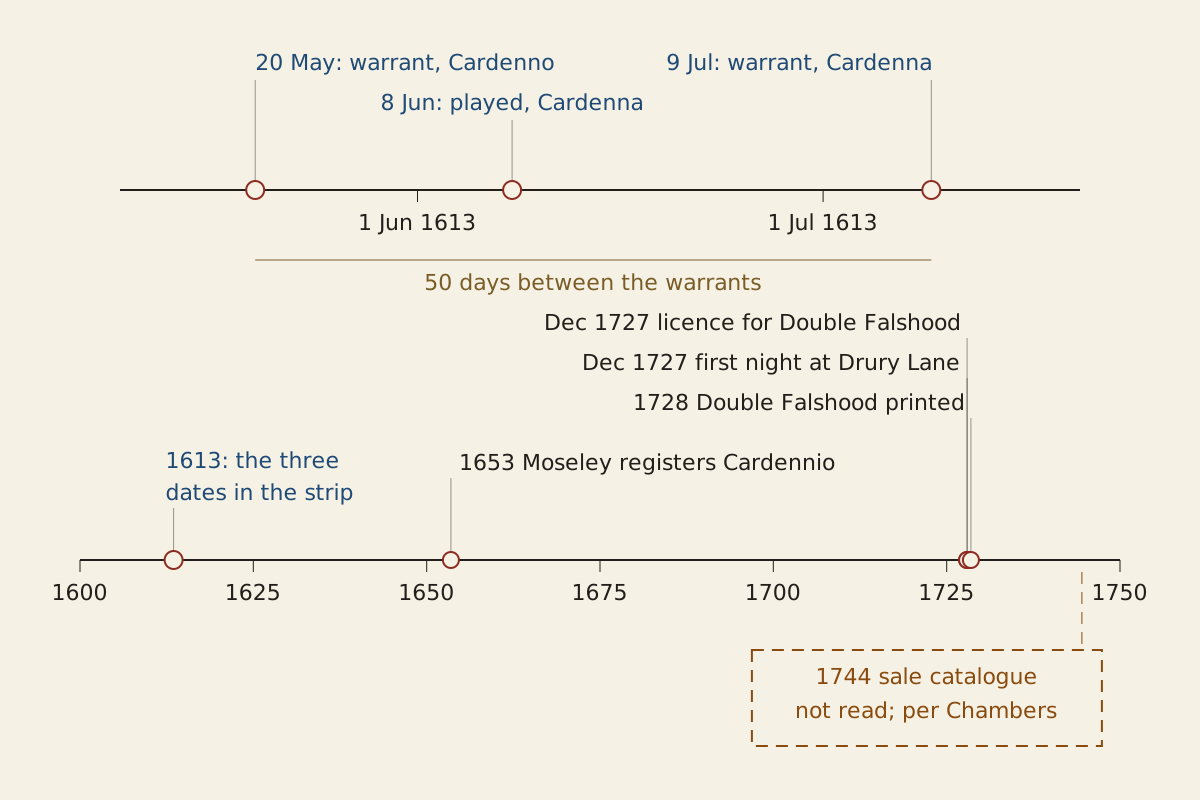
Figure: From the Surviving Record, CC BY 4.0
Full credit line for reuse
"Records that name Cardenio, 1613 to 1744" by From the Surviving Record, CC BY 4.0. Source: https://fromthesurvivingrecord.com/vanished-texts/cardenio/ — License: https://creativecommons.org/licenses/by/4.0/
Data: Chamber Account entries of 1613, as printed in E. K. Chambers, William Shakespeare: A Study of Facts and Problems, vol. 2 (Oxford, 1930), retrieved 2026-11-01, public domain; Stationers' Register entry of 1653, as printed in E. K. Chambers, William Shakespeare: A Study of Facts and Problems, vol. 1 (Oxford, 1930), retrieved 2026-11-01, public domain; Lewis Theobald, Double Falshood; or, The Distrest Lovers (London, 1728), retrieved 2026-11-01, public domain; E. K. Chambers, William Shakespeare: A Study of Facts and Problems, vol. 1 (Oxford, 1930), retrieved 2026-11-01, public domain
The two warrants are dated 50 days apart. The May entry pays £40 for six plays. That works out to £6 13s 4d a play, exactly the sum the July entry pays for Cardenna alone.
By dead reckoning, the May entry puts one showing of Cardenno no later than 20 May 1613, the date of its warrant. How much earlier is not in the entry. Chambers himself dated that showing to the winter of 1612–13, and the second to 8 June 1613.
| Date | Record | Name as printed |
|---|---|---|
| 20 May 1613 | Warrant for six plays paid to John Heminges | Cardenno |
| 8 June 1613 | Play given before the Duke of Savoy's ambassador (date from the July warrant) | Cardenna |
| 9 July 1613 | Warrant paying Heminges for that performance | Cardenna |
| 9 September 1653 | Stationers' Register entry by Humphrey Moseley | The History of Cardennio |
| 5 December 1727 | Royal licence for Theobald to print Double Falshood | not named |
| 13 December 1727 | Double Falshood first staged at Drury Lane (per Chambers) | not named |
| 1728 | Double Falshood printed with Theobald's preface | not named |
| 23 October 1744 | Sale catalogue of Theobald's books (not read; per Chambers) | not named |
Download the table (CSV, cardenio-records.csv) (file notes: sources and license) Data: Chamber Account entries of 1613, as printed in E. K. Chambers, William Shakespeare: A Study of Facts and Problems, vol. 2 (Oxford, 1930), retrieved 2026-11-01, public domain; Stationers' Register entry of 1653, as printed in E. K. Chambers, William Shakespeare: A Study of Facts and Problems, vol. 1 (Oxford, 1930), retrieved 2026-11-01, public domain; Lewis Theobald, Double Falshood; or, The Distrest Lovers (London, 1728), retrieved 2026-11-01, public domain; E. K. Chambers, William Shakespeare: A Study of Facts and Problems, vol. 1 (Oxford, 1930), retrieved 2026-11-01, public domain
What does each record prove?
Cardenio is a paper survivor: no copy of the play is known, but other documents that name it keep its title and its dates. Here those documents are two payments and a register entry, and each one proves less than the story usually built on it.
The payments show that a play by that name was presented by the King's players in 1613. They name no author and preserve no lines. The 1653 entry names authors but no performance. Double Falshood names Shakespeare and has a full text, but no character in it is called Cardenio.
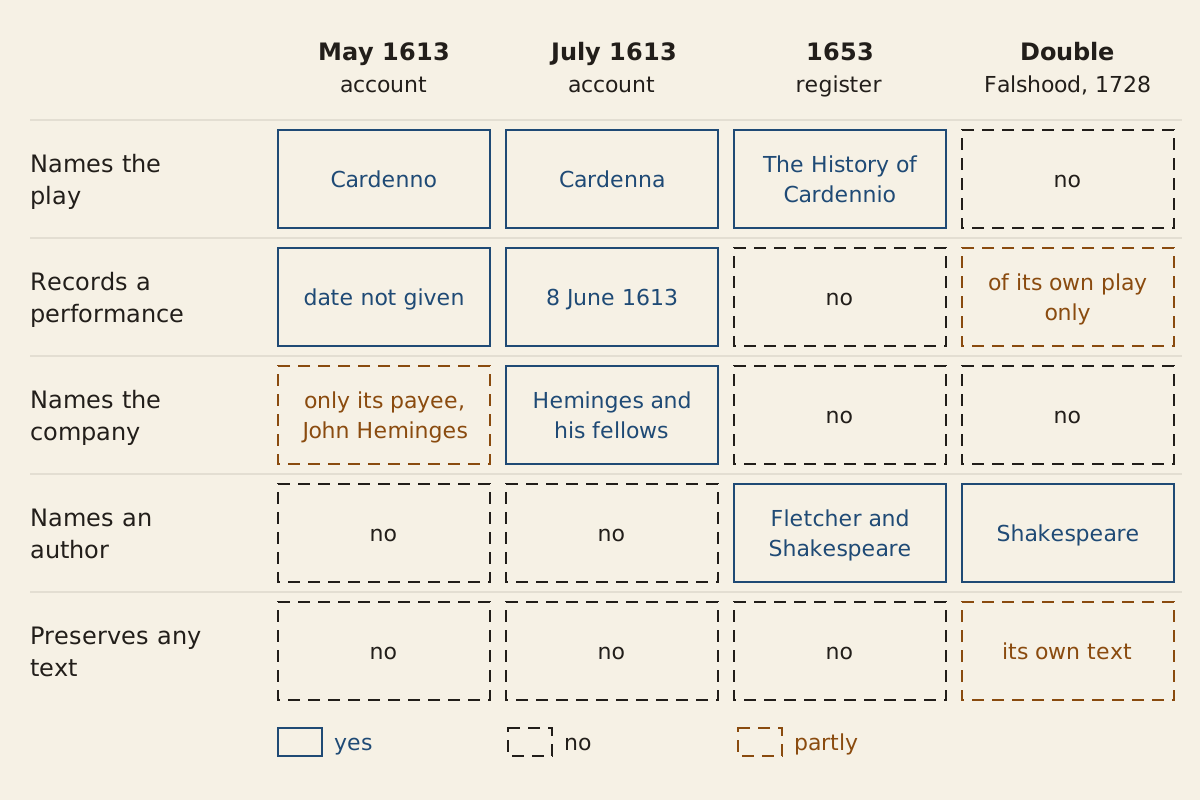
Figure: From the Surviving Record, CC BY 4.0
Full credit line for reuse
"What each record on Cardenio shows" by From the Surviving Record, CC BY 4.0. Source: https://fromthesurvivingrecord.com/vanished-texts/cardenio/ — License: https://creativecommons.org/licenses/by/4.0/
Data: Chamber Account entries of 1613, as printed in E. K. Chambers, William Shakespeare: A Study of Facts and Problems, vol. 2 (Oxford, 1930), retrieved 2026-11-01, public domain; Stationers' Register entry of 1653, as printed in E. K. Chambers, William Shakespeare: A Study of Facts and Problems, vol. 1 (Oxford, 1930), retrieved 2026-11-01, public domain; Lewis Theobald, Double Falshood; or, The Distrest Lovers (London, 1728), retrieved 2026-11-01, public domain; E. K. Chambers, William Shakespeare: A Study of Facts and Problems, vol. 1 (Oxford, 1930), retrieved 2026-11-01, public domain
| Question | May 1613 entry | July 1613 entry | 1653 register entry | Double Falshood, 1728 |
|---|---|---|---|---|
| Names the play | yes, as Cardenno | yes, as Cardenna | yes, as The History of Cardennio | no; its lovers are Julio and Leonora |
| Records a performance | yes, date not given | yes, 8 June 1613 | no | of its own play only |
| Names the company | only its payee, John Heminges | yes, Heminges and his fellows, the King's players | no | no |
| Names an author | no | no | yes, Fletcher and Shakespeare | yes, Shakespeare |
| Preserves any text | no | no | no | its own text; said to rest on old manuscripts |
Download the table (CSV, cardenio-proof-matrix.csv) (file notes: sources and license) Data: Chamber Account entries of 1613, as printed in E. K. Chambers, William Shakespeare: A Study of Facts and Problems, vol. 2 (Oxford, 1930), retrieved 2026-11-01, public domain; Stationers' Register entry of 1653, as printed in E. K. Chambers, William Shakespeare: A Study of Facts and Problems, vol. 1 (Oxford, 1930), retrieved 2026-11-01, public domain; Lewis Theobald, Double Falshood; or, The Distrest Lovers (London, 1728), retrieved 2026-11-01, public domain; E. K. Chambers, William Shakespeare: A Study of Facts and Problems, vol. 1 (Oxford, 1930), retrieved 2026-11-01, public domain
The kind of record matters. Love's Labour's Won lives on as a title in a 1598 book list that credits it to Shakespeare. Cardenio lives on as an item in an account book, which records a performance and a fee but no writer. The Pinakes, in the entry on the Library of Alexandria, is known from yet another kind: a later writer's note of its title and size.
Who was Cardenio?
The 1613 entries do not say what the play was about. The name points to Don Quixote. Chambers judged that the source was “probably” the story of Cardenio and Lucinda in Thomas Shelton's English translation of 1612.
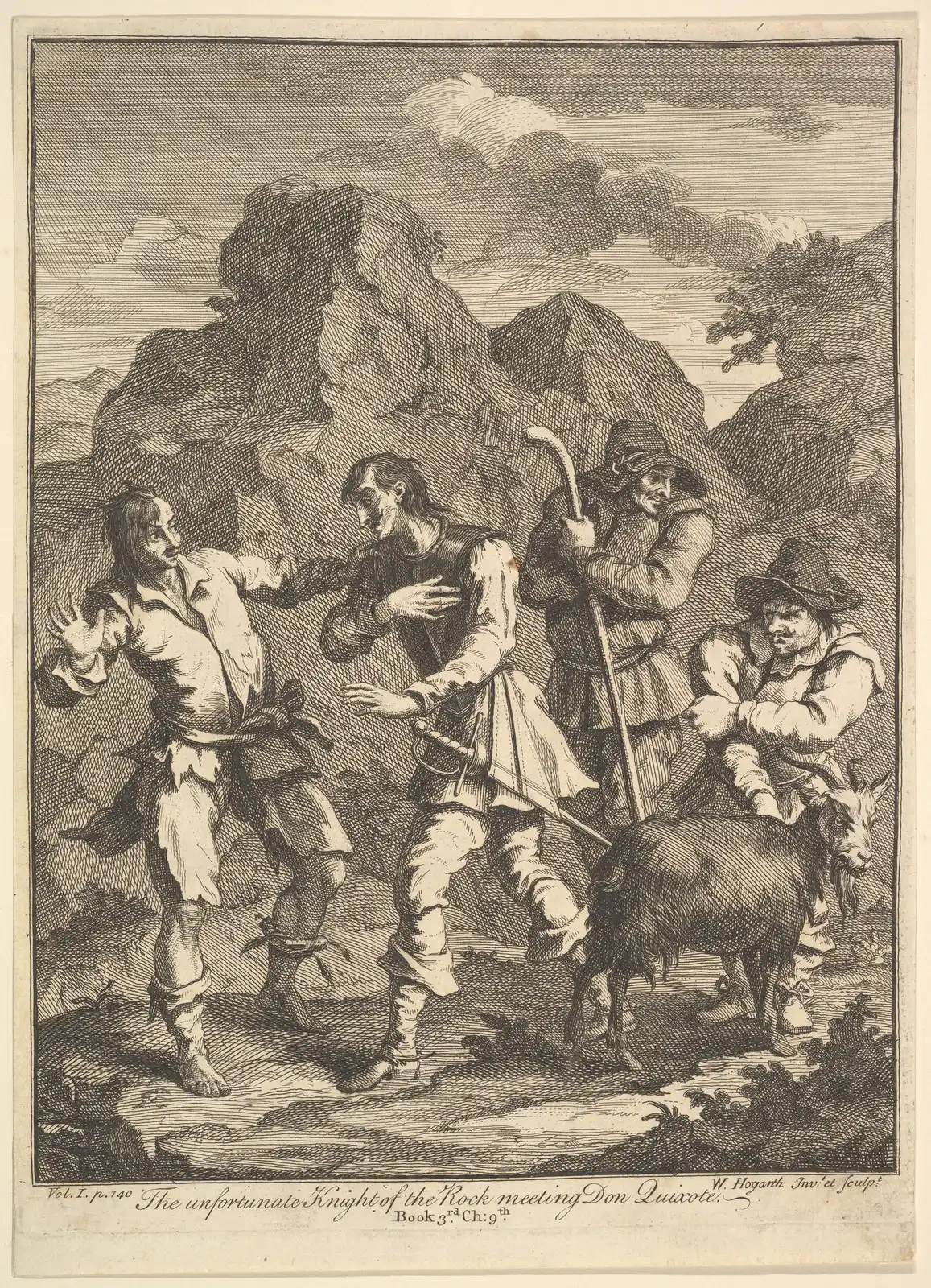
The museum's description of Hayman's painting calls Cardenio lovelorn, driven into the mountains by grief over Lucinda, and William Hogarth etched the same character as “the unfortunate Knight of the Rock.”
"Don Quixote and the Knight of the Rock (Six Illustrations for Don Quixote)" by William Hogarth — https://commons.wikimedia.org/wiki/File:Don_Quixote_and_the_Knight_of_the_Rock_(Six_Illustrations_for_Don_Quixote)_MET_DP824968.jpg — CC0 1.0 (https://creativecommons.org/publicdomain/zero/1.0/)
By dead reckoning, the dates allow Chambers's reading, since Shelton's translation came out in 1612 by Chambers's dating and both warrants fall in 1613. The timing fits. Nothing in the 1613 entries, though, ties the play to that particular story.
Who wrote Cardenio?
The payments name no writer. The first record on file that does is an entry Humphrey Moseley made on 9 September 1653, 40 years after the warrants. Chambers lists it among “the lost plays which he registered” that day: “The History of Cardennio, by Mr. Fletcher. & Shakespeare.” In the same list, Chambers prints a second entry crediting Henry the First and Henry the Second to “Shakespeare, & Dauenport,” and he notes that Robert Davenport's History of Henry the First had been licensed for performance by the King's men on 10 April 1624.
Moseley had written the epistle to the first Beaumont and Fletcher Folio of 1647, according to Chambers. Chambers put little weight on Moseley's credits to Shakespeare. Of other titles that Moseley entered as Shakespeare's, he wrote that “obviously no reliance can be placed on Moseley.” Then he set Cardenio apart as “another matter” and turned to the court record.
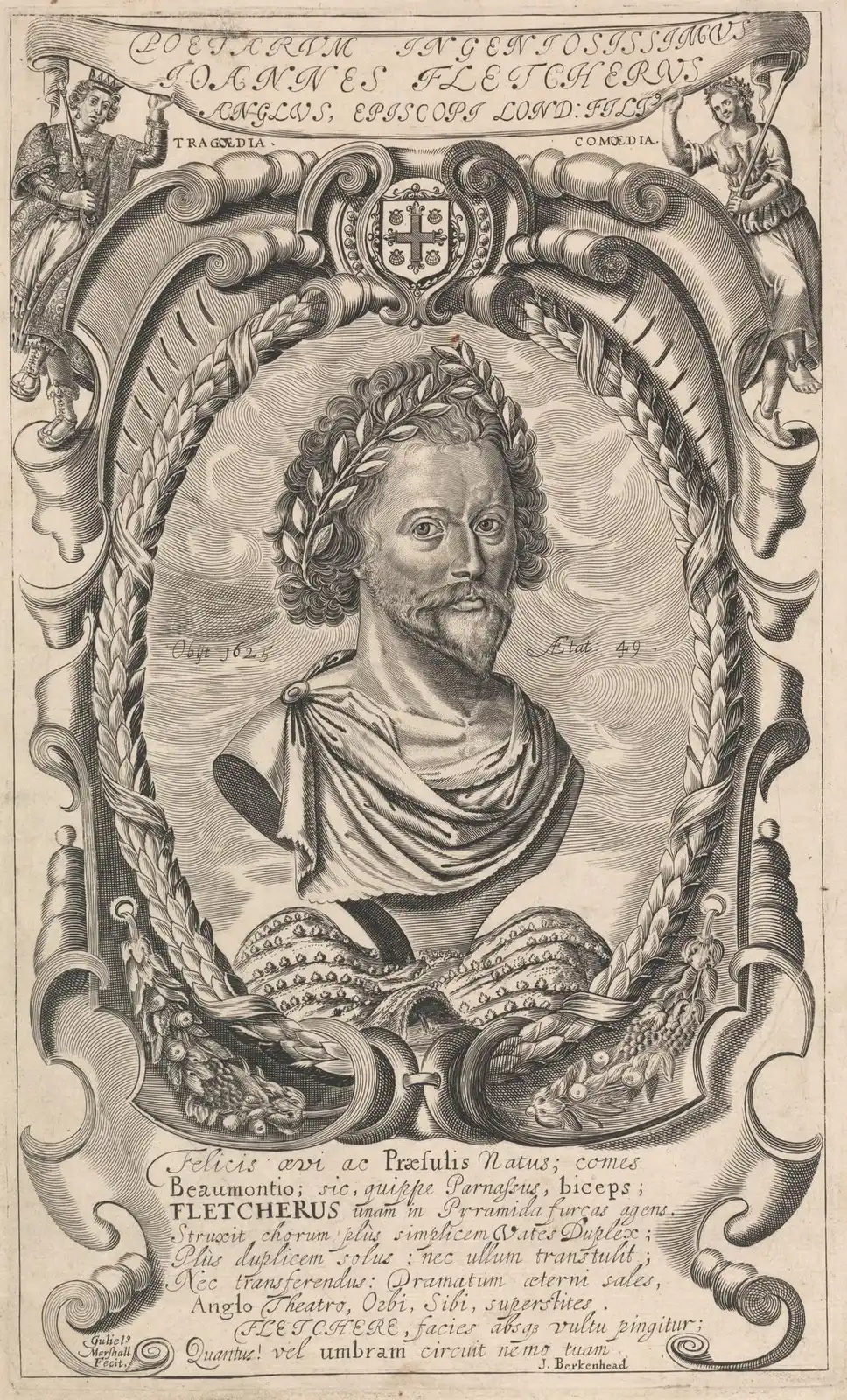
"John Fletcher, frontpiece to Berkenhead's and Beaumont's Comedies and Tragedies" by William Marshall — https://commons.wikimedia.org/wiki/File:William_Marshall_-_John_Fletcher,_frontpiece_to_Berkenhead%27s_and_Beaumont%27s_Comedies_and_Tragedies_-_B1994.4.375_-_Yale_Center_for_British_Art.jpg — CC0 1.0 (https://creativecommons.org/publicdomain/zero/1.0/)
Even so, Chambers did not accept Shakespeare's share. Weighing the case alongside Theobald's later play, he wrote that “it does not follow that Shakespeare had anything to do with the play,” and that he could not “share Oliphant's confidence in Moseley on this point.”
By dead reckoning, every link on file between the court play and a writer runs through Moseley's one entry. Without it, the records would show a play, a company and two fees, and no author at all.
What did Theobald's Double Falshood claim?
On 5 December 1727, a royal licence let Lewis Theobald print a play, and it repeats his petition: he had “Purchased the Manuscript Copy of an Original Play of WILLIAM SHAKESPEARE.” The play was Double Falshood (Chambers spells it Double Falsehood). It was staged at Drury Lane on 13 December 1727, according to Chambers, and printed in 1728 as “Written Originally by W. SHAKESPEARE.”
In his preface, Theobald says he had three copies. One was “of above Sixty Years Standing, in the Handwriting of Mr. Downes, the famous Old Prompter.” From the noble person who gave him one copy he had a “Tradition” that Shakespeare wrote the play for “a Natural Daughter of his.” He answered critics who saw Fletcher's style by calling the point “far from deserving any Answer.”
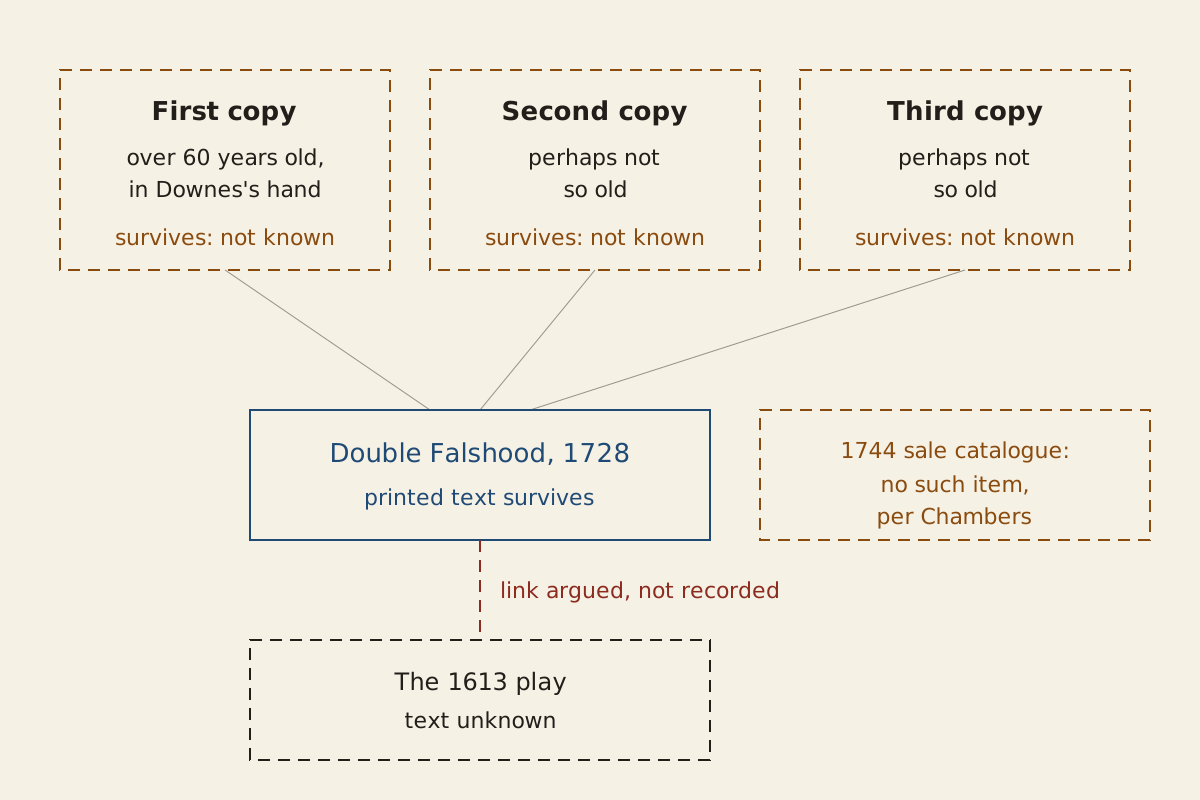
Figure: From the Surviving Record, CC BY 4.0
Full credit line for reuse
"The manuscript copies Theobald described in 1728" by From the Surviving Record, CC BY 4.0. Source: https://fromthesurvivingrecord.com/vanished-texts/cardenio/ — License: https://creativecommons.org/licenses/by/4.0/
Data: Lewis Theobald, Double Falshood; or, The Distrest Lovers (London, 1728), retrieved 2026-11-01, public domain; E. K. Chambers, William Shakespeare: A Study of Facts and Problems, vol. 1 (Oxford, 1930), retrieved 2026-11-01, public domain
Download the table (CSV, cardenio-theobald-copies.csv) (file notes: sources and license) Data: Lewis Theobald, Double Falshood; or, The Distrest Lovers (London, 1728), retrieved 2026-11-01, public domain; E. K. Chambers, William Shakespeare: A Study of Facts and Problems, vol. 1 (Oxford, 1930), retrieved 2026-11-01, public domain
The preface takes up a complaint that the tale was “built upon a Novel in Don Quixot” and does not dispute it, answering only that the novel “was publish'd in the Year 1611.” Yet the cast list has a Julio and a Leonora. Nobody on it is named Cardenio. Chambers read the play as the Cardenio and Lucinda story “with altered names.”
Illustration: From the Surviving Record. Generated schematic image — not a photograph or historical record. © From the Surviving Record, all rights reserved.
Theobald was no stranger to Shakespeare's text. According to Chambers, he had already adapted Richard II in 1719 and published Shakespeare Restored in 1726, and his own edition of the plays followed in 1734. In that edition he still asserted Shakespeare's authorship of Double Falshood, Chambers notes, yet he never published the unadapted text.
Chambers weighed the case in 1930. Theobald could hardly have known of the court record, he thought, which “to some extent” supports his story. But nobody else appears to have seen the manuscripts, and Theobald's sale catalogue of 23 October 1744 lists nothing like them. Chambers judged a fabrication less likely than “an old play of some sort” with a stage tradition behind it.
Studies before 1930 that Chambers lists, among them E. H. C. Oliphant's, leaned on balance toward giving Shakespeare at least a share, by his reading. In the play itself Chambers saw traces “that may well be Fletcher's.” He did not follow them on Shakespeare. The question was still open when he wrote.
Still missing:
- Whether any of the 1613 play survives inside Double Falshood. Chambers could not find “a single passage which compels a belief in Shakespeare,” and the records on file cannot say what, if anything, Theobald's text kept.
- What became of Theobald's manuscripts. He described three copies in 1728; by Chambers's account, no one else appears to have seen them, and none turns up in his 1744 sale catalogue.
- Why no playbook is known to survive. The account entries outlasted any known copy of the play they paid for, and no record on file says what happened to the company's copy. A document can also outlast the claim it makes, as with the Donation of Constantine, written centuries after Constantine.
Cite this page
From the Surviving Record. “Cardenio: A Lost Play Known From Two 1613 Court Payments.” First published 2026-11-01. https://fromthesurvivingrecord.com/vanished-texts/cardenio/ (accessed add the date you read it).
Sources
- Chamber Account, entries for payments to John Heminges on warrants of 20 May and 9 July 1613, as printed in E. K. Chambers, William Shakespeare: A Study of Facts and Problems, vol. 2 (Oxford: Clarendon Press, 1930), App. D, no. II, p. 343. archive.org/details/in.ernet.dli.2015.80390 Read: full text of the two printed entries and the appendix's note on its sources.
- Stationers' Register, entry by Humphrey Moseley, 9 September 1653, as printed in E. K. Chambers, William Shakespeare: A Study of Facts and Problems, vol. 1 (Oxford: Clarendon Press, 1930), p. 538. archive.org/details/in.ernet.dli.2015.212203 Read: full text of the printed entry.
- Lewis Theobald, Double Falshood; or, The Distrest Lovers (London: J. Watts, 1728), royal licence, title page, preface and cast list; Johns Hopkins University copy, catalogued as the second edition. archive.org/details/bib_fict_4103197_2 Read: royal licence, title page, dedication, preface and cast list.
- E. K. Chambers, William Shakespeare: A Study of Facts and Problems, vol. 1 (Oxford: Clarendon Press, 1930), pp. 63–64, 96–97, 538–542. archive.org/details/in.ernet.dli.2015.212203 Read: pages 63–64, 96–97 and 537–542.
- E. K. Chambers, William Shakespeare: A Study of Facts and Problems, vol. 2 (Oxford: Clarendon Press, 1930), App. D, bibliographical note, p. 303. archive.org/details/in.ernet.dli.2015.80390 Read: full text of the note.
Spotted an error? Write to contact@fromthesurvivingrecord.com (the link fills in this page's title as the subject). Changes are logged in the corrections log and at the foot of the entry; the evidence levels page explains how sources are weighed.
Related entries
-
Vanished Texts & Libraries
Library of Alexandria: No Source on File Names Its Last Day
Who burned the Library of Alexandria? Caesar's own account names ships, not books. The main ancient sources, dated and compared, with a free CSV and timeline.
Picture credit
"The Burning of the Library at Alexandria in 391 AD" by Ambrose Dudley — https://commons.wikimedia.org/wiki/File:The_Burning_of_the_Library_at_Alexandria_in_391_AD.jpg — Public domain (author died 1951, so life plus 70 years ended in 2021 in the UK and EU; published in London about 1915, before 1931, for the US; faithful reproduction of a flat artwork)
-
Vanished Texts & Libraries
Love's Labour's Won: A Shakespeare Title Listed in 1598
Love's Labour's Won is a comedy Francis Meres credited to Shakespeare in 1598. No play survives under that title. The list and the matches proposed, with CSV.
Picture credit
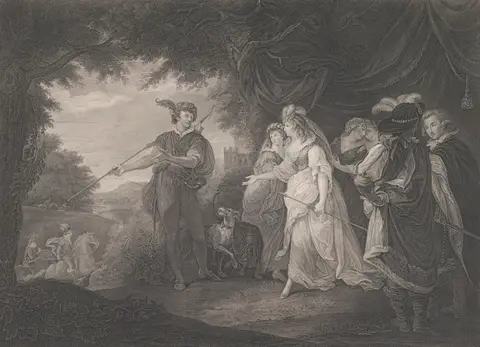
"The Princess, Rosaline, etc. (Shakespeare, Love's Labour Lost, Act 4, Scene 1)" by Thomas Ryder, after William Hamilton — https://commons.wikimedia.org/wiki/File:The_Princess,_Rosaline,_etc._(Shakespeare,_Love%27s_Labour_Lost,_Act_4,_Scene_1)_MET_DP859573.jpg — CC0 1.0 (https://creativecommons.org/publicdomain/zero/1.0/); modified: cropped to the picture area, removing the engraved lettering below it (title, quotation, painter, engraver and publication lines), the plate number and the paper margin with a stain at lower right; the picture itself is not cut