Love's Labour's Won: A Shakespeare Title Listed in 1598
Published Last substantive revision
How to read this page: each point is marked as a cross-checked fix, a single record (“according to”), or inference (“by dead reckoning”).
TL;DR: Love's Labour's Won is a comedy that Francis Meres credited to Shakespeare in Palladis Tamia, a book entered for publication on 7 September 1598, according to E. K. Chambers. No play survives under that title, and whether it was lost or is a known comedy under another name has been argued since at least 1767, by Albert H. Tolman's 1902 count, and the sources on file do not settle it.
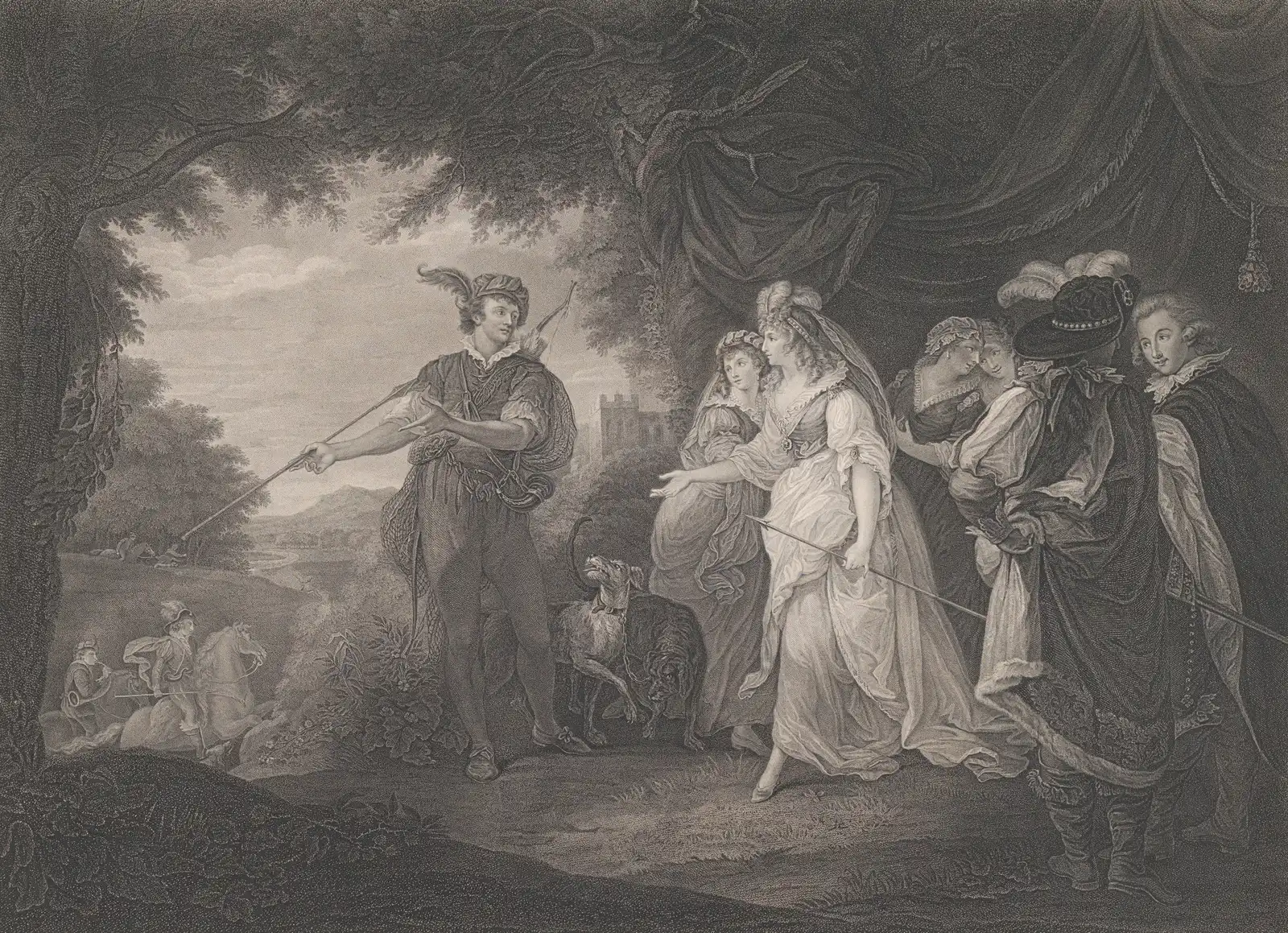
“The Princess, Rosaline, etc. (Shakespeare, Love's Labour Lost, Act 4,…” by Thomas Ryder, after William Hamilton, CC0
Full credit
"The Princess, Rosaline, etc. (Shakespeare, Love's Labour Lost, Act 4, Scene 1)" by Thomas Ryder, after William Hamilton — https://commons.wikimedia.org/wiki/File:The_Princess,_Rosaline,_etc._(Shakespeare,_Love%27s_Labour_Lost,_Act_4,_Scene_1)_MET_DP859573.jpg — CC0 1.0 (https://creativecommons.org/publicdomain/zero/1.0/); modified: cropped to the picture area, removing the engraved lettering below it (title, quotation, painter, engraver and publication lines), the plate number and the paper margin with a stain at lower right; the picture itself is not cut
What did Francis Meres write in 1598?
In 1598, a London book listing Shakespeare's comedies named one Love's Labour's Won; no play by that title survives. The book was Palladis Tamia: Wits Treasury, by Francis Meres. E. K. Chambers, who reprinted the passage in 1930, gives its entry in the Stationers' Register, the London booksellers' record of titles, as 7 September 1598.
Meres was setting English writers beside Greek and Latin ones. Shakespeare, he wrote, is “the most excellent in both kinds for the stage,” and he named the proof. For comedy came “his Gentlemen of Verona, his Errors, his Loue labors lost, his Loue labours wonne, his Midsummers night dreame, & his Merchant of Venice.” Six more titles followed under tragedy.
The wording above follows Chambers's 1930 reprint. Tolman's 1902 printing of the passage gives the same six comedies in the same order and spelling.
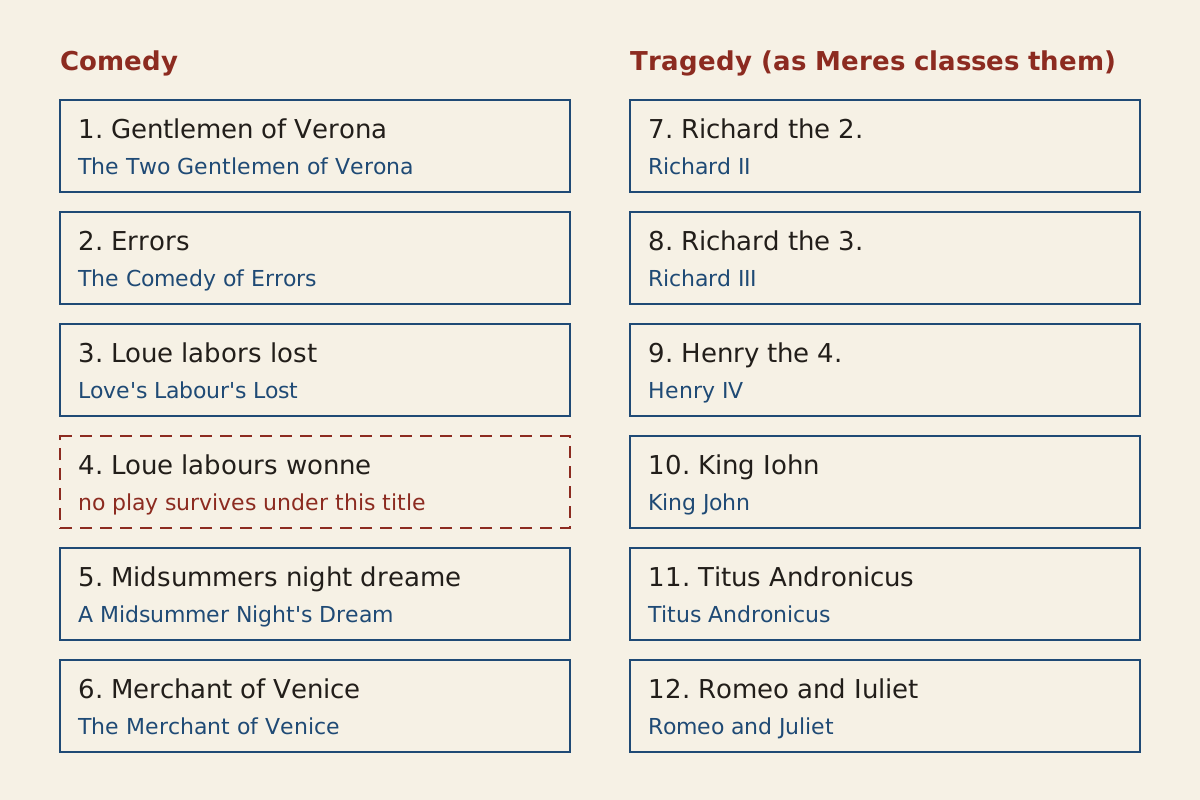
Figure: From the Surviving Record, CC BY 4.0
Full credit line for reuse
"Francis Meres's 1598 list of Shakespeare's plays" by From the Surviving Record, CC BY 4.0. Source: https://fromthesurvivingrecord.com/vanished-texts/loves-labours-won/ — License: https://creativecommons.org/licenses/by/4.0/
Data: Francis Meres, Palladis Tamia (1598), as reprinted in E. K. Chambers, William Shakespeare: A Study of Facts and Problems, vol. 2 (Oxford, 1930), retrieved 2026-11-01, public domain; E. K. Chambers, William Shakespeare: A Study of Facts and Problems, vol. 1 (Oxford, 1930), retrieved 2026-11-01, public domain
| No. | As printed in 1598 | Meres's heading | Play as now titled |
|---|---|---|---|
| 1 | Gentlemen of Verona | comedy | The Two Gentlemen of Verona |
| 2 | Errors | comedy | The Comedy of Errors |
| 3 | Loue labors lost | comedy | Love's Labour's Lost |
| 4 | Loue labours wonne | comedy | no surviving play under this title |
| 5 | Midsummers night dreame | comedy | A Midsummer Night's Dream |
| 6 | Merchant of Venice | comedy | The Merchant of Venice |
| 7 | Richard the 2. | tragedy | Richard II |
| 8 | Richard the 3. | tragedy | Richard III |
| 9 | Henry the 4. | tragedy | Henry IV (one part or both, uncertain) |
| 10 | King Iohn | tragedy | King John |
| 11 | Titus Andronicus | tragedy | Titus Andronicus |
| 12 | Romeo and Iuliet | tragedy | Romeo and Juliet |
Download the table (CSV, loves-labours-won-meres-1598.csv) (file notes: sources and license) Data: Francis Meres, Palladis Tamia (1598), as reprinted in E. K. Chambers, William Shakespeare: A Study of Facts and Problems, vol. 2 (Oxford, 1930), retrieved 2026-11-01, public domain; Albert H. Tolman, What Has Become of Shakespeare's Play "Love's Labour's Won"? (University of Chicago Press, 1902), retrieved 2026-11-01, public domain
Four of Meres's “tragedies” are history plays. Chambers counts six comedies, four histories and two tragedies, and suggests that Meres balanced six against six only by filing the histories under tragedy.
The list may not have been complete. Chambers gives Meres's dates as 1565 to 1647 and notes that he took his M.A. at Cambridge in 1591 and was living in London by 1597. On that reckoning, Chambers argues, a play that was off the stage between 1593 and 1598 may simply have been unknown to him. Meres also knew work that had not reached print: Tolman points out that the “sugred Sonnets among his priuate friends” in the same passage were not published until eleven years later, so a title on Meres's list need not have been a printed book.
Why does no play carry the title?
No surviving script carries that name. Tolman set out the resulting choice in 1902: either the play has been lost, or the title belongs “in some way to one of the plays now in our possession.” He added that no positive evidence ties the title to any particular comedy.
The comedies printed in the 1623 collected edition, the First Folio, do not include it either. Tolman listed those comedies beside Meres's six and noticed something odd: leaving out Love's Labour's Won, Meres's comedies appear in the Folio in the same order he gives, though not side by side.
Tolman drew no firm conclusion from that pattern. If the match in order carries real weight, he wrote, the view that the play has simply disappeared becomes “decidedly the most probable.” He then set the coincidence aside, saying he was not inclined to judge such questions “on the evidence of cryptograms and mystic coincidences.”
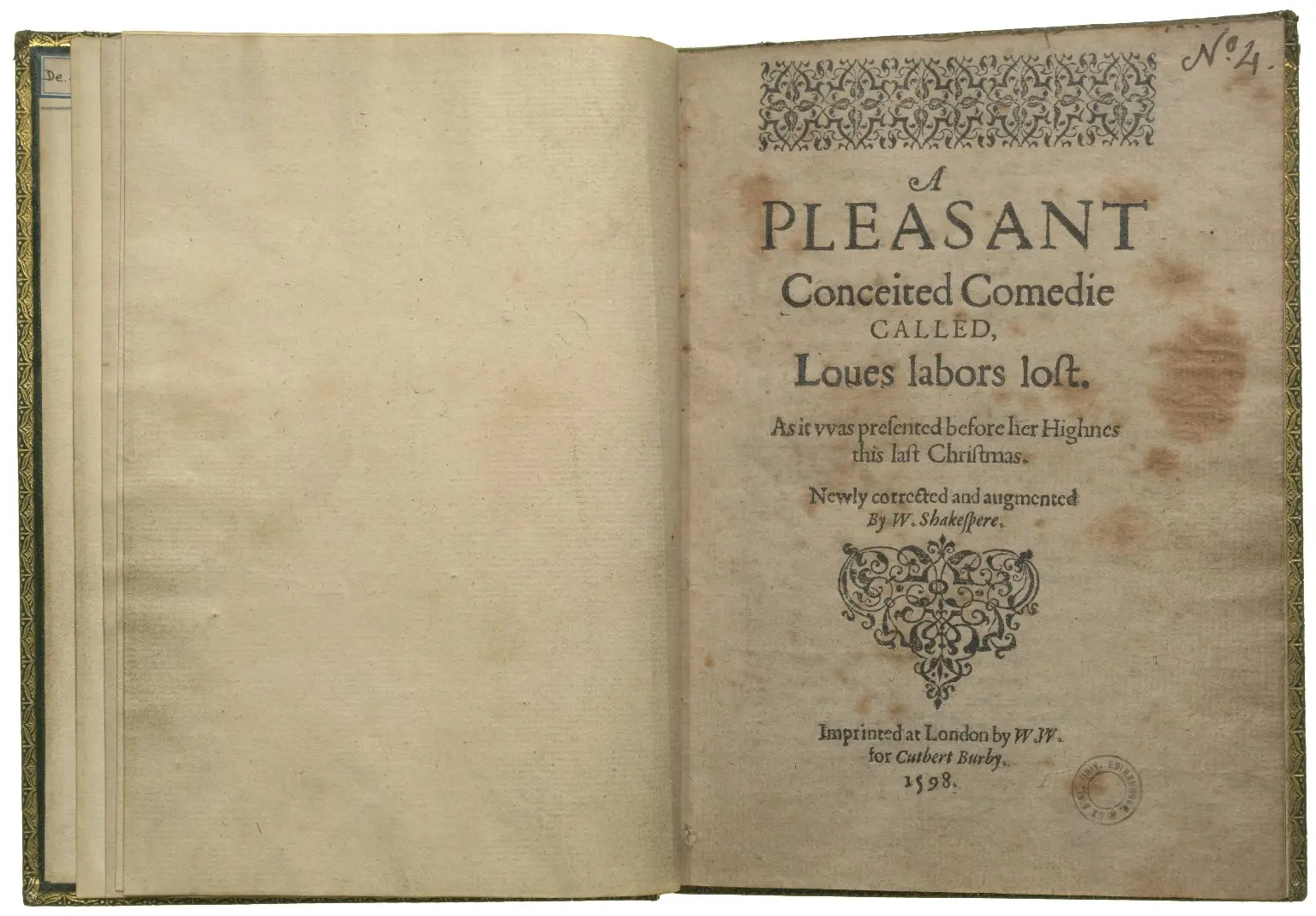
"Shakespeare's Love's Labour's Lost, 1598" by University of Edinburgh — https://commons.wikimedia.org/wiki/File:Love%27s_Labour%27s_Lost,_1598.jpg — CC BY 3.0 (https://creativecommons.org/licenses/by/3.0/)
The companion title did reach print. A 1598 edition of Loues labors lost calls itself “newly corrected and augmented” by W. Shakespere and was printed “for Cutbert Burby.” According to Chambers, the bookseller of Palladis Tamia was also Burby, who cut some of Meres's text.
By dead reckoning, the same bookseller seems to have handled both the surviving comedy and the book that names the missing one, but that link proves nothing about where Love's Labour's Won went.
Alternative titles were not uncommon, Chambers notes. Twelfth Night was printed with the second title What You Will, and other plays were known by a character's name, such as Malvolio for the same comedy. Six of the seven answers Tolman lists look for a known comedy under another name, not for a lost script.
Which plays have been proposed?
Tolman dated the main proposals in 1902. By his dating, Farmer proposed All's Well That Ends Well in 1767, and Hunter suggested The Tempest in 1839. A writer in The Quarterly Review, Tolman records, argued in 1840 for Love's Labour's Lost itself, and offered a lost play as a second answer.
In Tolman's list, Craik proposed The Taming of the Shrew in 1857, and Sievers made the same case in 1866. Brae chose Much Ado About Nothing in 1860, per Tolman. He also lists von Westenholz, who chose A Midsummer Night's Dream in 1902, the year Tolman himself wrote.
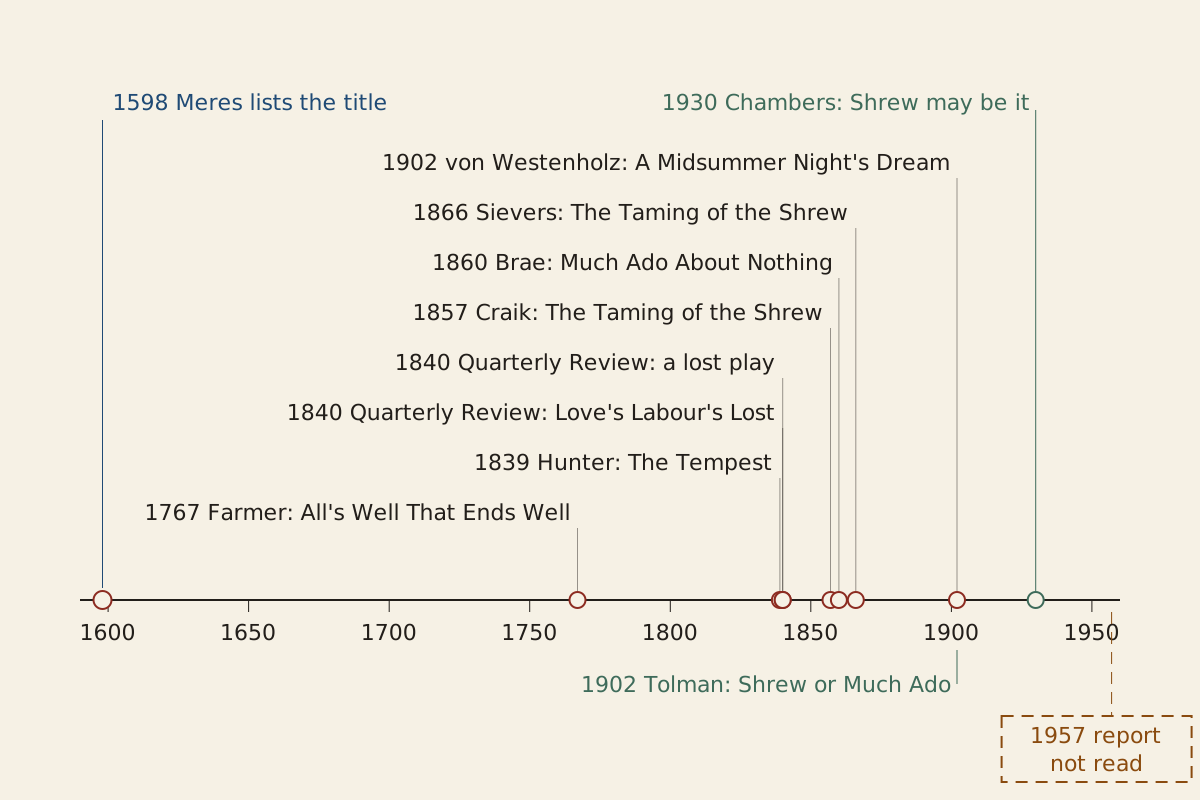
Figure: From the Surviving Record, CC BY 4.0
Full credit line for reuse
"Plays proposed as Love's Labour's Won, by year" by From the Surviving Record, CC BY 4.0. Source: https://fromthesurvivingrecord.com/vanished-texts/loves-labours-won/ — License: https://creativecommons.org/licenses/by/4.0/
Data: Albert H. Tolman, What Has Become of Shakespeare's Play "Love's Labour's Won"? (University of Chicago Press, 1902), retrieved 2026-11-01, public domain; E. K. Chambers, William Shakespeare: A Study of Facts and Problems, vol. 1 (Oxford, 1930), retrieved 2026-11-01, public domain
| Year, per Tolman | Proposed by | Play proposed | Chambers in 1930 |
|---|---|---|---|
| 1767 | Farmer | All's Well That Ends Well | rejected |
| 1839 | Hunter | The Tempest | rejected |
| 1840 | The Quarterly Review | Love's Labour's Lost | dismissed |
| 1840 | The Quarterly Review | a lost play | not his reading |
| 1857 | Craik | The Taming of the Shrew | could fill the gap |
| 1860 | Brae | Much Ado About Nothing | not likely |
| 1866 | Sievers | The Taming of the Shrew | could fill the gap |
| 1902 | von Westenholz | A Midsummer Night's Dream | dismissed |
| not given | not given | Twelfth Night | rejected |
Download the table (CSV, loves-labours-won-proposed-plays.csv) (file notes: sources and license) Data: Albert H. Tolman, What Has Become of Shakespeare's Play "Love's Labour's Won"? (University of Chicago Press, 1902), retrieved 2026-11-01, public domain; E. K. Chambers, William Shakespeare: A Study of Facts and Problems, vol. 1 (Oxford, 1930), retrieved 2026-11-01, public domain
Tolman tested each candidate against three conditions: the play should not be named elsewhere in Meres's list, it should have existed in some form by 1598, and the title should fit its plot reasonably well. None, he found, met all three “in any convincing fashion.” He quoted Wendell's verdict that the question “can never be definitely settled,” and added that this holds unless new evidence turns up.
What did Chambers conclude in 1930?
Chambers went through the same list and narrowed it. He dismissed Love's Labour's Lost and A Midsummer Night's Dream at once, because Meres names both separately in the same sentence, and “his wording makes impossible” a second title attached to either. Close reading of a document's wording settles questions in other entries too. It is how a grant said to come from the emperor Constantine was shown to be a later forgery in Donation of Constantine: Written Centuries After Constantine.
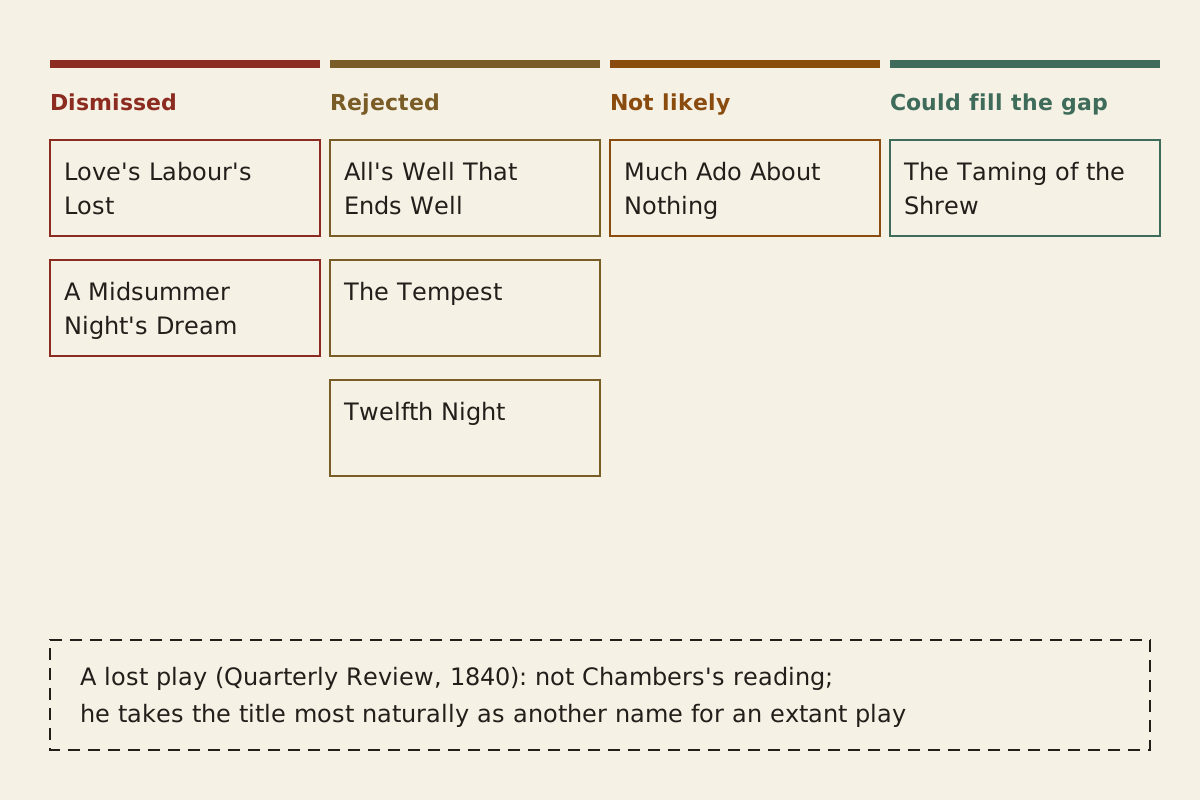
Figure: From the Surviving Record, CC BY 4.0
Full credit line for reuse
"Chambers's 1930 view of each proposed play" by From the Surviving Record, CC BY 4.0. Source: https://fromthesurvivingrecord.com/vanished-texts/loves-labours-won/ — License: https://creativecommons.org/licenses/by/4.0/
Data: E. K. Chambers, William Shakespeare: A Study of Facts and Problems, vol. 1 (Oxford, 1930), retrieved 2026-11-01, public domain; Albert H. Tolman, What Has Become of Shakespeare's Play "Love's Labour's Won"? (University of Chicago Press, 1902), retrieved 2026-11-01, public domain
He saw no reason to assume early versions of Twelfth Night or The Tempest, and he rejected the case for All's Well That Ends Well. The title fits Much Ado About Nothing least, he wrote, and he judged it “not likely.” That left The Taming of the Shrew as “the only comedy which, as it stands, could fill a gap in Meres's list.” In his chapter on that play, Chambers says it “may quite well be” the one Meres meant, and admits the case is “largely an application of the method of exclusions.”
Tolman, writing 28 years earlier, had narrowed the choice to Much Ado About Nothing or The Taming of the Shrew and leaned toward the Shrew. The two scholars reached the same favorite by partly different routes. Neither claimed proof.
By dead reckoning, Love's Labour's Won is a paper survivor only if it was a separate play. If it was another name for The Taming of the Shrew, the text survives; what is missing is any record tying Meres's title to it. The sources on file cannot choose between the two. The same gap between a work and the records about it runs through Library of Alexandria: No Source on File Names Its Last Day.
Still missing:
- Which play the title meant, if any. The two main surveys on file, Tolman's and Chambers's, both rest on elimination, not on a record naming the play. Another play known only from records rests on payments rather than a list: Cardenio: A Lost Play Known From Two 1613 Court Payments.
- What the bookseller's account says. New evidence on the title from an Elizabethan bookseller's account books has been reported in T. W. Baldwin's 1957 study; the study itself could not be read for this page, so what that evidence is, its dates and its wording are not given here.
Cite this page
From the Surviving Record. “Love's Labour's Won: A Shakespeare Title Listed in 1598.” First published 2026-11-01. https://fromthesurvivingrecord.com/vanished-texts/loves-labours-won/ (accessed add the date you read it).
Sources
- Francis Meres, Palladis Tamia: Wits Treasury (London, 1598), “A comparatiue discourse of our English Poets,” as reprinted in E. K. Chambers, William Shakespeare: A Study of Facts and Problems, vol. 2 (Oxford: Clarendon Press, 1930), App. B, no. XIII, pp. 193–195. archive.org/details/in.ernet.dli.2015.80390 Read: full text of the reprinted passage and its headnote.
- A Pleasant Conceited Comedie Called, Loues Labors Lost (London: W. W. for Cutbert Burby, 1598), title page; University of Edinburgh copy, Wikimedia Commons file page. commons.wikimedia.org/wiki/File:Love%27s_Labour%27s_Lost,_1598.jpg Read: title page.
- E. K. Chambers, William Shakespeare: A Study of Facts and Problems, vol. 1 (Oxford: Clarendon Press, 1930), pp. 205–206, 244–245, 272–273, 326, 387, 451. archive.org/details/in.ernet.dli.2015.212203 Read: pages 205–206, 244–245, 272–273, 326, 387 and 451.
- Albert H. Tolman, What Has Become of Shakespeare's Play “Love's Labour's Won”? (Chicago: University of Chicago Press, 1902), printed from the Decennial Publications, vol. 7, pp. 159–190. archive.org/details/cu31924013143064 Read: full text.
- T. W. Baldwin, Shakspere's Love's Labor's Won: New Evidence from the Account Books of an Elizabethan Bookseller (Carbondale: Southern Illinois University Press, 1957). archive.org/details/shakspereslovesl0000thom Read: bibliographic record only.

Spotted an error? Write to contact@fromthesurvivingrecord.com (the link fills in this page's title as the subject). Changes are logged in the corrections log and at the foot of the entry; the evidence levels page explains how sources are weighed.
Related entries
-
Vanished Texts & Libraries
Library of Alexandria: No Source on File Names Its Last Day
Who burned the Library of Alexandria? Caesar's own account names ships, not books. The main ancient sources, dated and compared, with a free CSV and timeline.
Picture credit
"The Burning of the Library at Alexandria in 391 AD" by Ambrose Dudley — https://commons.wikimedia.org/wiki/File:The_Burning_of_the_Library_at_Alexandria_in_391_AD.jpg — Public domain (author died 1951, so life plus 70 years ended in 2021 in the UK and EU; published in London about 1915, before 1931, for the US; faithful reproduction of a flat artwork)
-
Vanished Texts & Libraries
Cardenio: A Lost Play Known From Two 1613 Court Payments
Cardenio is a lost play paid for at court in 1613 under the spellings Cardenno and Cardenna. A 1653 entry credited it to Fletcher and Shakespeare. Records, CSV.
Picture credit
"Don Quixote Disputing with the Mad Cardenio" by Francis Hayman — https://commons.wikimedia.org/wiki/File:Don_Quixote_Disputing_with_the_Mad_Cardenio_-_Francis_Hayman_-_5_1963_4.jpg — CC0 1.0 (https://creativecommons.org/publicdomain/zero/1.0/)