Library of Alexandria: No Source on File Names Its Last Day
Published Last substantive revision
How to read this page: each point is marked as a cross-checked fix, a single record (“according to”), or inference (“by dead reckoning”).
TL;DR: None of the sources on file names a last day for the Library of Alexandria. Books burned near the harbor during Julius Caesar's war in 48 BC, but the Museum it belonged to still turns up in later records, and the story of a caliph ordering the books burned was written down some six centuries after the Arab conquest, as Gibbon noted.
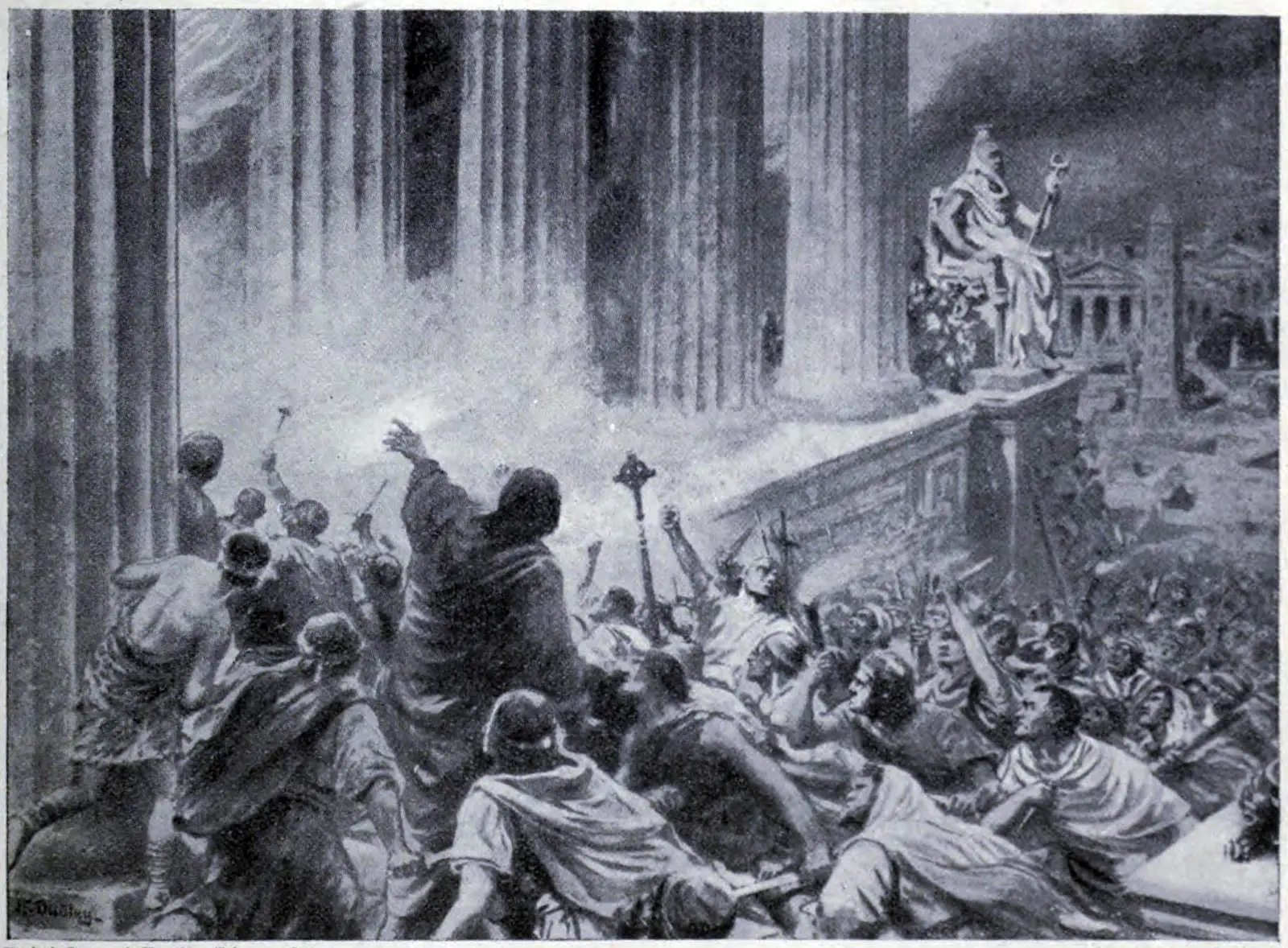
“The Burning of the Library at Alexandria in 391 AD” by Ambrose Dudley, Public Domain Mark
Full credit
"The Burning of the Library at Alexandria in 391 AD" by Ambrose Dudley — https://commons.wikimedia.org/wiki/File:The_Burning_of_the_Library_at_Alexandria_in_391_AD.jpg — Public domain (author died 1951, so life plus 70 years ended in 2021 in the UK and EU; published in London about 1915, before 1931, for the US; faithful reproduction of a flat artwork)
Who burned the Library of Alexandria?
In 48 BC, fire spread from the harbor of Alexandria. Seneca, who names no year, later put the books burned there at 40,000, and writers who lived centuries after the fire gave figures of 400,000 and 700,000. The commander on the scene, Julius Caesar, names something else. “He burnt all those ships and the rest that were in the docks,” his Civil War records, before moving straight on to the landing on Pharos.
The Alexandrian War, a continuation of Caesar's commentaries, calls Alexandria “well-nigh fire-proof,” because its buildings had no wooden joinery. That does not rule out a harbor fire. But it sits uneasily beside later claims that the whole collection burned.
The later writers do not agree on what burned. According to Plutarch's Life of Caesar, the fire “spread from the dockyards and destroyed the great library.” In Herbert Baldwin Foster's 1905 translation of Cassius Dio, “the docks and the storehouses both of grain and of books were burned.” Orosius says the 400,000 books were stored by chance in nearby buildings, proximis forte aedibus condita.
Fix: books burned near the harbor during Caesar's fighting in Alexandria, a point on which Plutarch, Dio and Orosius agree; Seneca gives only a count, with no date. On what burned, a library or books stored by the docks, and on how many, the sources disagree.
The year 48 BC comes from the accounts themselves. Caesar tells of burning the ships in the book of his Civil War that opens with his consulship alongside Publius Servilius, and the 1905 English edition of Dio marks the year of the fire as 48 BC. The Catholic Encyclopedia's 1907 article on the library gives 47 BC instead.
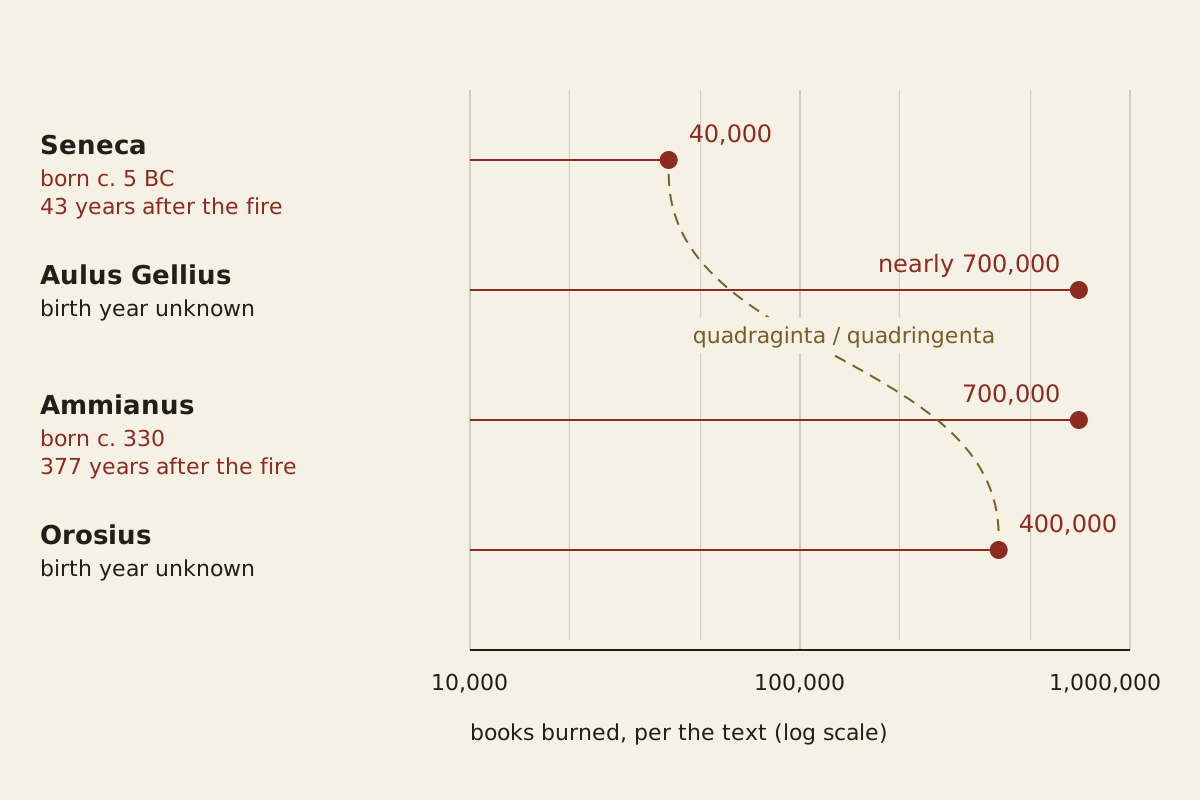
Figure: From the Surviving Record, CC BY 4.0
Full credit line for reuse
"Books burned at Alexandria, as each writer counts them" by From the Surviving Record, CC BY 4.0. Source: https://fromthesurvivingrecord.com/vanished-texts/library-of-alexandria/ — License: https://creativecommons.org/licenses/by/4.0/
Data: Seneca, De Tranquillitate Animi 9.5, Latin text, retrieved 2026-11-01, public domain; Aulus Gellius, Attic Nights 7.17, trans. J. C. Rolfe (Loeb, 1927), retrieved 2026-10-07, public domain; Ammianus Marcellinus, Res Gestae 22.16, trans. J. C. Rolfe (Loeb, 1940), and Latin text, retrieved 2026-11-01, public domain; Orosius, Historiae adversus paganos 6.15, Latin text, retrieved 2026-11-01, public domain; Project Gutenberg catalogue author records (birth and death years), retrieved 2026-11-01, factual data
What do the ancient accounts actually say?
| Writer | Born | Books burned, per the text | What burned, per the text |
|---|---|---|---|
| Julius Caesar | 100 BC (participant) | none named | ships in the harbor and docks |
| Seneca | c. 5 BC | 40,000 | books “at Alexandria” |
| Plutarch | c. AD 46 | not given | “the great library” |
| Aulus Gellius | not on file | nearly 700,000 | all of them, by accident, in the sack of the city |
| Cassius Dio | c. AD 165 | not given | docks, and storehouses “both of grain and of books” |
| Ammianus Marcellinus | c. AD 330 | 700,000 | the collection of the Ptolemies |
| Orosius | not on file | 400,000 | books in buildings near the harbor |
Table: compiled from the passages listed under Sources; birth years approximate, with the source for each in the CSV.
Download the table (CSV, library-of-alexandria-accounts.csv) (file notes: sources and license) Data: Julius Caesar, Civil War 3.111, trans. A. G. Peskett (Loeb, 1914), retrieved 2026-10-07, public domain in the US, short quotation; Strabo, Geography 17.1.8, trans. H. L. Jones (Loeb, 1932), retrieved 2026-10-07, public domain; Seneca, De Tranquillitate Animi 9.5, Latin text, retrieved 2026-11-01, public domain; Plutarch, Life of Caesar 49, trans. B. Perrin (Loeb, 1919), retrieved 2026-10-07, public domain; Aulus Gellius, Attic Nights 7.17, trans. J. C. Rolfe (Loeb, 1927), retrieved 2026-10-07, public domain; Cassius Dio, Roman History 42.38, trans. H. B. Foster, Dio's Rome, vol. 2 (1905), retrieved 2026-11-01, public domain; Ammianus Marcellinus, Res Gestae 22.16, trans. J. C. Rolfe (Loeb, 1940), and Latin text, retrieved 2026-11-01, public domain; Orosius, Historiae adversus paganos 6.15, Latin text, retrieved 2026-11-01, public domain; Edward Gibbon, The History of the Decline and Fall of the Roman Empire, ch. 28, with notes by H. H. Milman (1845), retrieved 2026-11-01, public domain; Edward Gibbon, The History of the Decline and Fall of the Roman Empire, ch. 51, with notes by H. H. Milman (1845), retrieved 2026-11-01, public domain; George Bolling, "The Alexandrian Library," Catholic Encyclopedia, vol. 1 (1907), retrieved 2026-11-01, facts only, paraphrased; Project Gutenberg catalogue author records (birth and death years), retrieved 2026-11-01, factual data; Johann Peter Kirsch, "Paulus Orosius," Catholic Encyclopedia, vol. 11 (1911), retrieved 2026-11-01, public domain
Every writer in the table who reports burned books and has a birth year on file was born after the fire, Seneca about 43 years after and Ammianus about 377 years after. Orosius, whose birth year is not on file, wrote more than four centuries after it.
Seneca brings up the fire in a passage on excess in On Tranquillity of Mind, where he lets “someone else” praise the collection, as Livy did, and calls it studiosa luxuria, learned luxury, gathered for show rather than study. In Latin, his number, quadraginta milia (40,000), and Orosius's quadringenta milia (400,000) look almost alike. By dead reckoning, one figure could be a copyist's slip for the other, but the texts on file cannot say which. The navigator's method behind that label is explained in Dead Reckoning: Why Bowditch Advised Shorter Log-Line Knots.
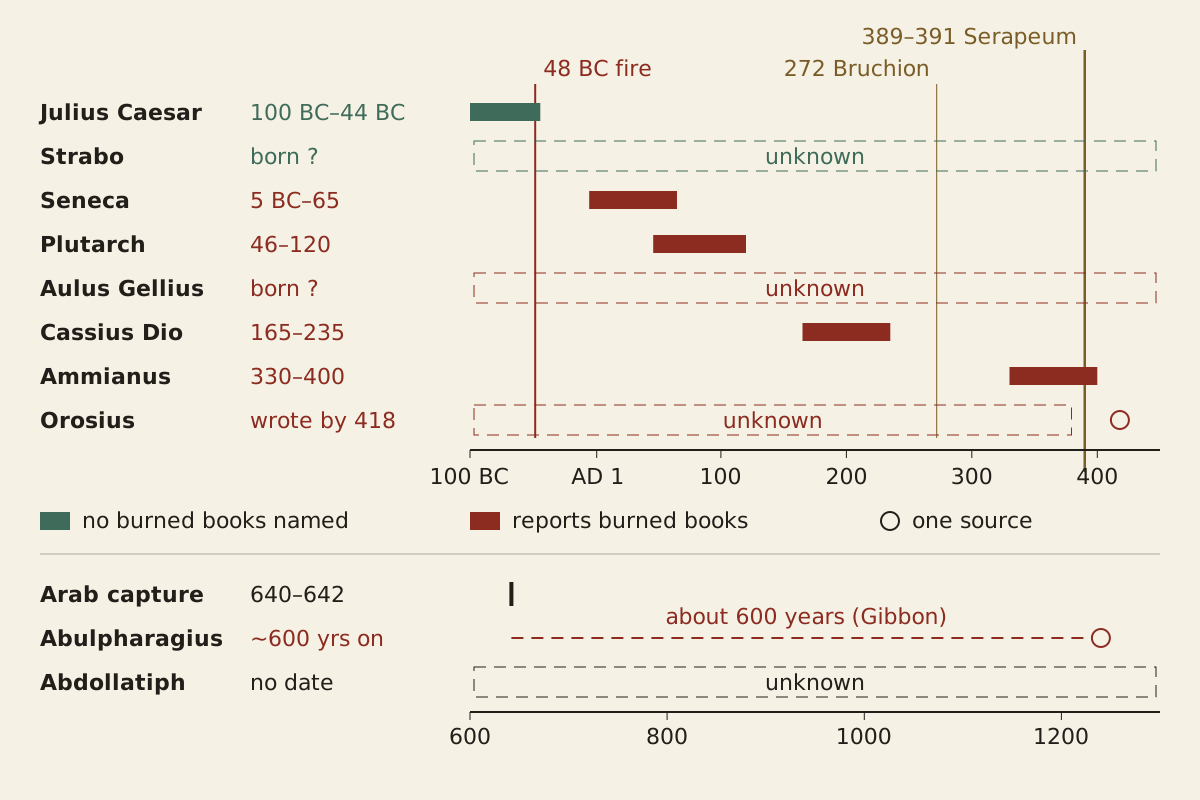
Figure: From the Surviving Record, CC BY 4.0
Full credit line for reuse
"Who recorded the Alexandria fire, and when they lived" by From the Surviving Record, CC BY 4.0. Source: https://fromthesurvivingrecord.com/vanished-texts/library-of-alexandria/ — License: https://creativecommons.org/licenses/by/4.0/
Data: Julius Caesar, Civil War 3.111, trans. A. G. Peskett (Loeb, 1914), retrieved 2026-10-07, public domain in the US, short quotation; Strabo, Geography 17.1.8, trans. H. L. Jones (Loeb, 1932), retrieved 2026-10-07, public domain; Seneca, De Tranquillitate Animi 9.5, Latin text, retrieved 2026-11-01, public domain; Plutarch, Life of Caesar 49, trans. B. Perrin (Loeb, 1919), retrieved 2026-10-07, public domain; Aulus Gellius, Attic Nights 7.17, trans. J. C. Rolfe (Loeb, 1927), retrieved 2026-10-07, public domain; Cassius Dio, Roman History 42.38, trans. H. B. Foster, Dio's Rome, vol. 2 (1905), retrieved 2026-11-01, public domain; Ammianus Marcellinus, Res Gestae 22.16, trans. J. C. Rolfe (Loeb, 1940), and Latin text, retrieved 2026-11-01, public domain; Orosius, Historiae adversus paganos 6.15, Latin text, retrieved 2026-11-01, public domain; Project Gutenberg catalogue author records (birth and death years), retrieved 2026-11-01, factual data; Edward Gibbon, The History of the Decline and Fall of the Roman Empire, ch. 28, with notes by H. H. Milman (1845), retrieved 2026-11-01, public domain; Edward Gibbon, The History of the Decline and Fall of the Roman Empire, ch. 51, with notes by H. H. Milman (1845), retrieved 2026-11-01, public domain; George Bolling, "The Alexandrian Library," Catholic Encyclopedia, vol. 1 (1907), retrieved 2026-11-01, facts only, paraphrased; Herbert Thurston, "Libraries," Catholic Encyclopedia, vol. 9 (1910), retrieved 2026-11-01, public domain; Johann Peter Kirsch, "Paulus Orosius," Catholic Encyclopedia, vol. 11 (1911), retrieved 2026-11-01, public domain
Was the library still there after Caesar?
Strabo describes the Museum in his Geography as part of the royal palaces. It had a public walk, an exedra with seats, and a hall where its scholars ate together. Its priest “formerly was appointed by the kings, but is now appointed by Caesar.” The passage mentions no fire and no library.
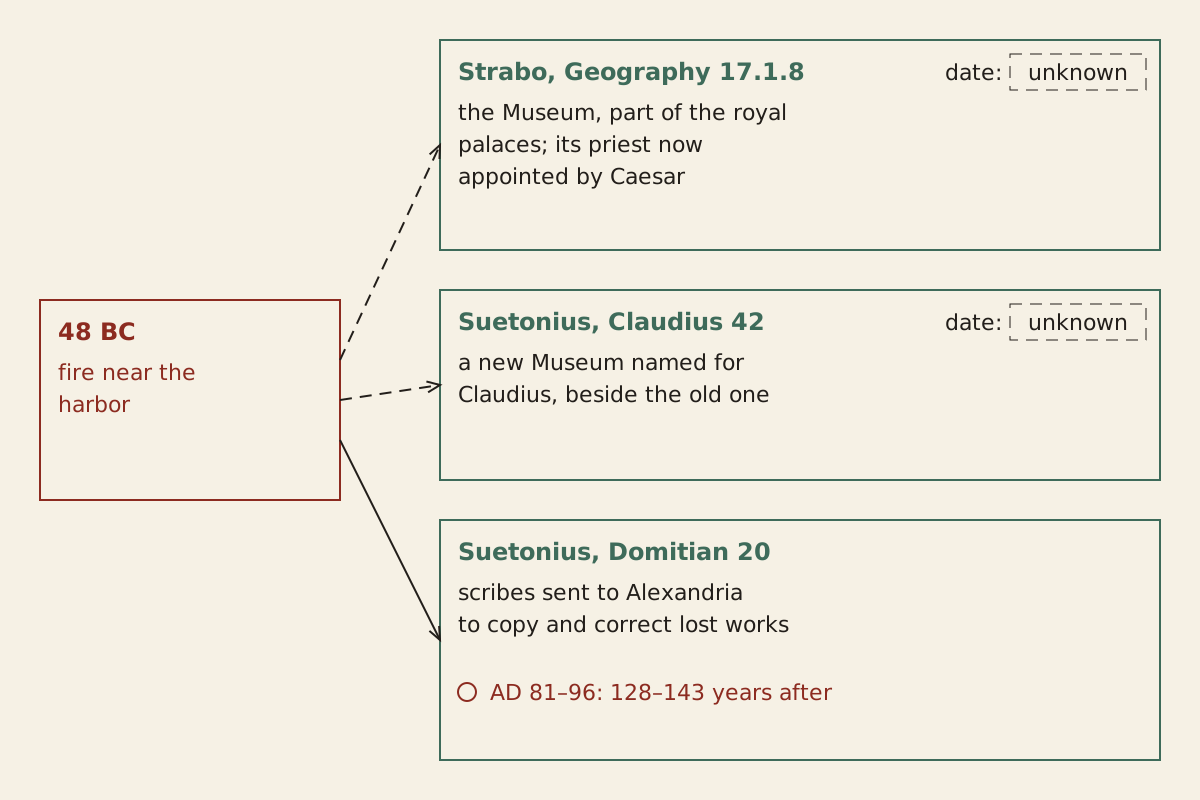
Figure: From the Surviving Record, CC BY 4.0
Full credit line for reuse
"Records of the Museum and of Alexandria's books after the fire" by From the Surviving Record, CC BY 4.0. Source: https://fromthesurvivingrecord.com/vanished-texts/library-of-alexandria/ — License: https://creativecommons.org/licenses/by/4.0/
Data: Strabo, Geography 17.1.8, trans. H. L. Jones (Loeb, 1932), retrieved 2026-10-07, public domain; Suetonius, Life of Claudius 42, trans. J. C. Rolfe (Loeb, 1914), retrieved 2026-10-07, public domain; Suetonius, Life of Domitian 20, trans. J. C. Rolfe (Loeb, 1914), retrieved 2026-10-07, public domain; Thomas Scannell, "Domitian," Catholic Encyclopedia, vol. 5 (1909), retrieved 2026-11-01, public domain
The Museum also appears in imperial records. According to Suetonius, Claudius added a new Museum named after himself and had his two Greek histories read aloud yearly, one in each. Suetonius adds that Domitian renewed libraries destroyed by fire, “sending scribes to Alexandria to transcribe and correct” copies of the lost works. The Catholic Encyclopedia's 1909 article on Domitian dates his reign from 81 to 96.
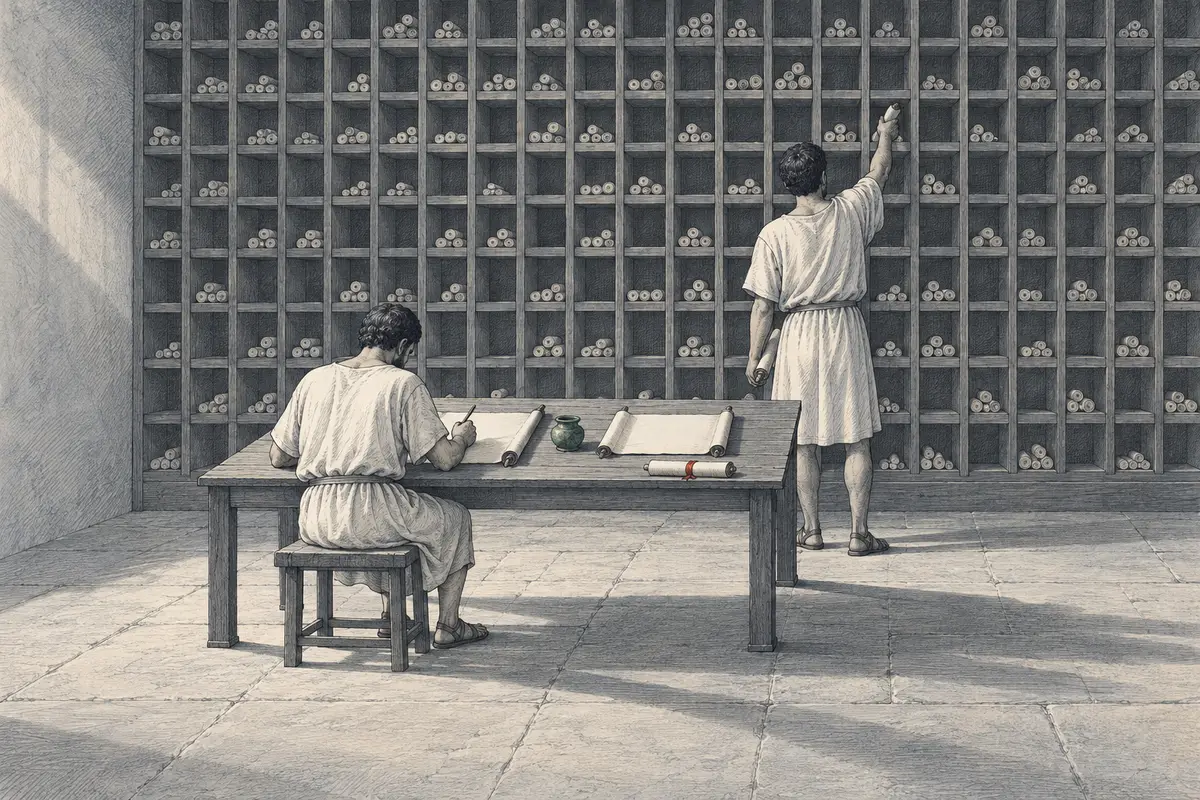
Illustration: From the Surviving Record. Generated schematic image — not a photograph or historical record. © From the Surviving Record, all rights reserved.
By dead reckoning, a city where an emperor sent scribes for lost works 128 to 143 years after Caesar's fire still held copies worth the voyage. Suetonius does not say which libraries had burned.
Why did the Library of Alexandria decline?
Asking which fire ended the library assumes the answer is a fire. A more useful first question is who stopped copying. By dead reckoning, the record points to people before it points to flames.
Athenaeus, citing older chroniclers, says a Ptolemy the Alexandrians nicknamed Kakergetes, “Malefactor,” murdered many citizens and drove scholars into exile. Philologists, philosophers, mathematicians and physicians scattered to the islands and towns and taught there.
Under Emperor Aurelian, Alexandria lost “the greater part of the district called Bruchion, which had long been the abode of distinguished men,” according to Ammianus Marcellinus. The Catholic Encyclopedia's 1907 article on the library dates that loss to AD 272.
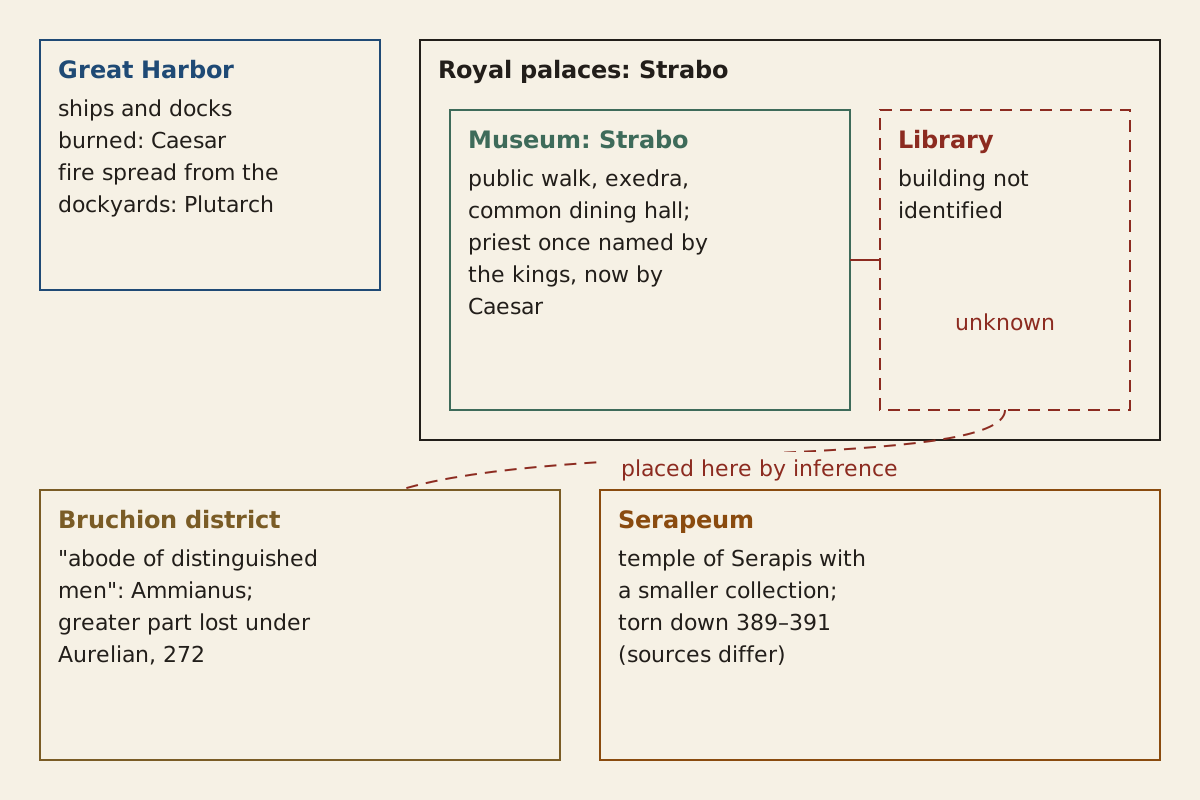
Figure: From the Surviving Record, CC BY 4.0
Full credit line for reuse
"Places tied to the library in the sources on file" by From the Surviving Record, CC BY 4.0. Source: https://fromthesurvivingrecord.com/vanished-texts/library-of-alexandria/ — License: https://creativecommons.org/licenses/by/4.0/
Data: Strabo, Geography 17.1.8, trans. H. L. Jones (Loeb, 1932), retrieved 2026-10-07, public domain; Julius Caesar, Civil War 3.111, trans. A. G. Peskett (Loeb, 1914), retrieved 2026-10-07, public domain in the US, short quotation; Plutarch, Life of Caesar 49, trans. B. Perrin (Loeb, 1919), retrieved 2026-10-07, public domain; Ammianus Marcellinus, Res Gestae 22.16, trans. J. C. Rolfe (Loeb, 1940), and Latin text, retrieved 2026-11-01, public domain; Edward Gibbon, The History of the Decline and Fall of the Roman Empire, ch. 28, with notes by H. H. Milman (1845), retrieved 2026-11-01, public domain; George Bolling, "The Alexandrian Library," Catholic Encyclopedia, vol. 1 (1907), retrieved 2026-11-01, facts only, paraphrased; Herbert Thurston, "Libraries," Catholic Encyclopedia, vol. 9 (1910), retrieved 2026-11-01, public domain
By dead reckoning, the record fits a slow loss: scholars driven out under the king the city called Malefactor, the Ptolemies' patronage gone once Rome appointed the Museum's priest, and the Brucheion wrecked under Aurelian. None of the sources on file names a last day.
What happened at the Serapeum around 390?
The Serapeum, the temple of Serapis, held a smaller collection of its own, according to the Catholic Encyclopedia's 1907 article on the library. Ammianus praises the temple in the present tense, then writes in quo bybliothecae fuerunt inaestimabiles: in it there were priceless libraries. The verb for the libraries, fuerunt, is past tense. The temple's, eminet (“stands out”), is present.
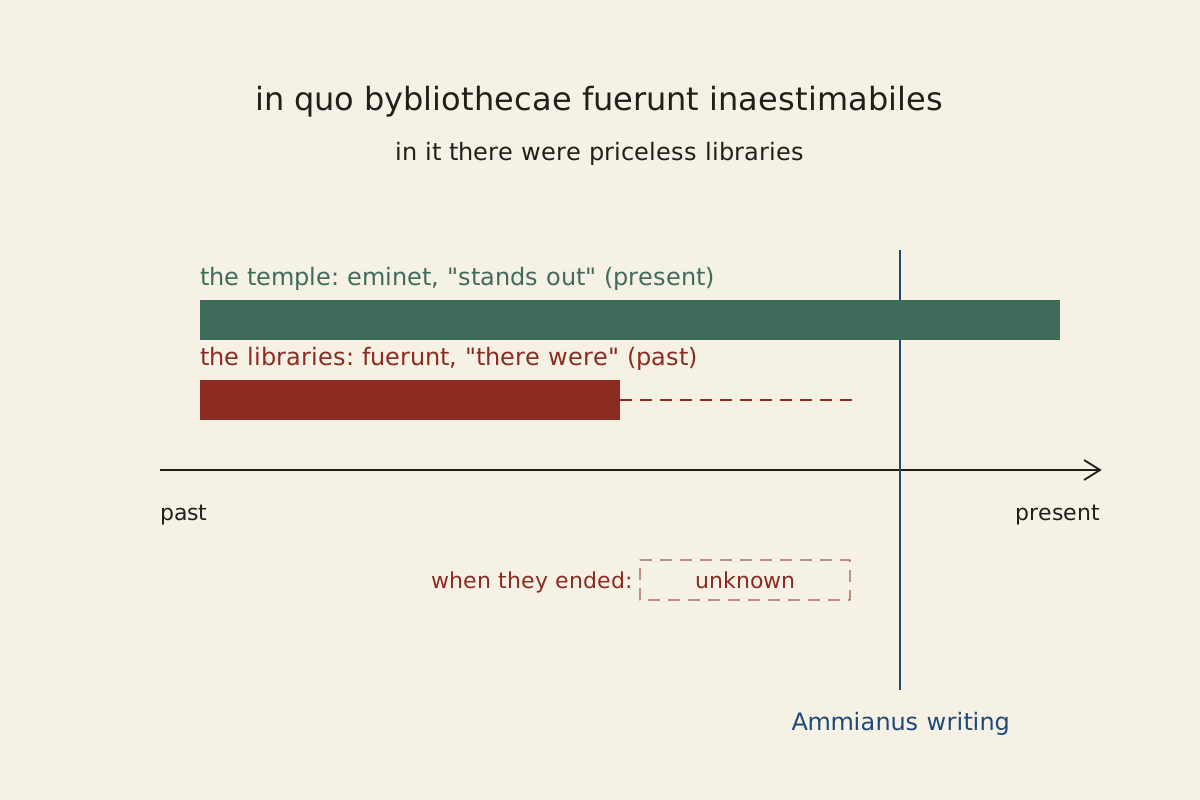
Figure: From the Surviving Record, CC BY 4.0
Full credit line for reuse
"Ammianus's tenses for the Serapeum and its libraries" by From the Surviving Record, CC BY 4.0. Source: https://fromthesurvivingrecord.com/vanished-texts/library-of-alexandria/ — License: https://creativecommons.org/licenses/by/4.0/
Data: Ammianus Marcellinus, Res Gestae 22.16, trans. J. C. Rolfe (Loeb, 1940), and Latin text, retrieved 2026-11-01, public domain
Around 390, under an imperial order, Bishop Theophilus had the Serapeum torn down; Gibbon allows either 389 or 391, and the Catholic Encyclopedia's 1910 article on libraries gives 390. The church historian Socrates of Constantinople describes the demolition and the street fighting that followed and says nothing about books. Orosius says he had seen empty book chests in temples, and he calls true the report that they were emptied “by our own men in our own times.” Gibbon puts that sight near twenty years after the Serapeum fell; the Catholic Encyclopedia's 1911 article on Orosius says his history was completed in 418.
Edward Gibbon later cited those empty chests to argue that “the valuable library of Alexandria was pillaged or destroyed” when the Serapeum fell. Whether any library was left to lose by then is not recorded.
Did the Arabs burn the Library of Alexandria?
In the story, after the Arab capture of Alexandria, Caliph Umar ruled that Greek books agreeing with the Quran were useless and those disagreeing were harmful. The books then fed the city's 4,000 bathhouses for some six months. The sources on file date the capture itself differently: Gibbon gives 22 December 640, and the Catholic Encyclopedia gives 641 in one article and 642 in another.
Gibbon traced the story to the Dynasties of Gregory Abulpharagius, which Edward Pocock published in a Latin version in 1663, and wrote, “I am strongly tempted to deny both the fact and the consequences.” He called it “the solitary report of a stranger who wrote at the end of six hundred years,” set against the silence of two earlier Christian annalists from Egypt. In a note, he credited Renaudot with doubting it.
A note in the 1845 edition of Gibbon, with notes by Henry Hart Milman, lists Muslim writers brought forward since then in support of Abulpharagius, beginning with one it calls Abdollatiph. The note gives no dates for them.
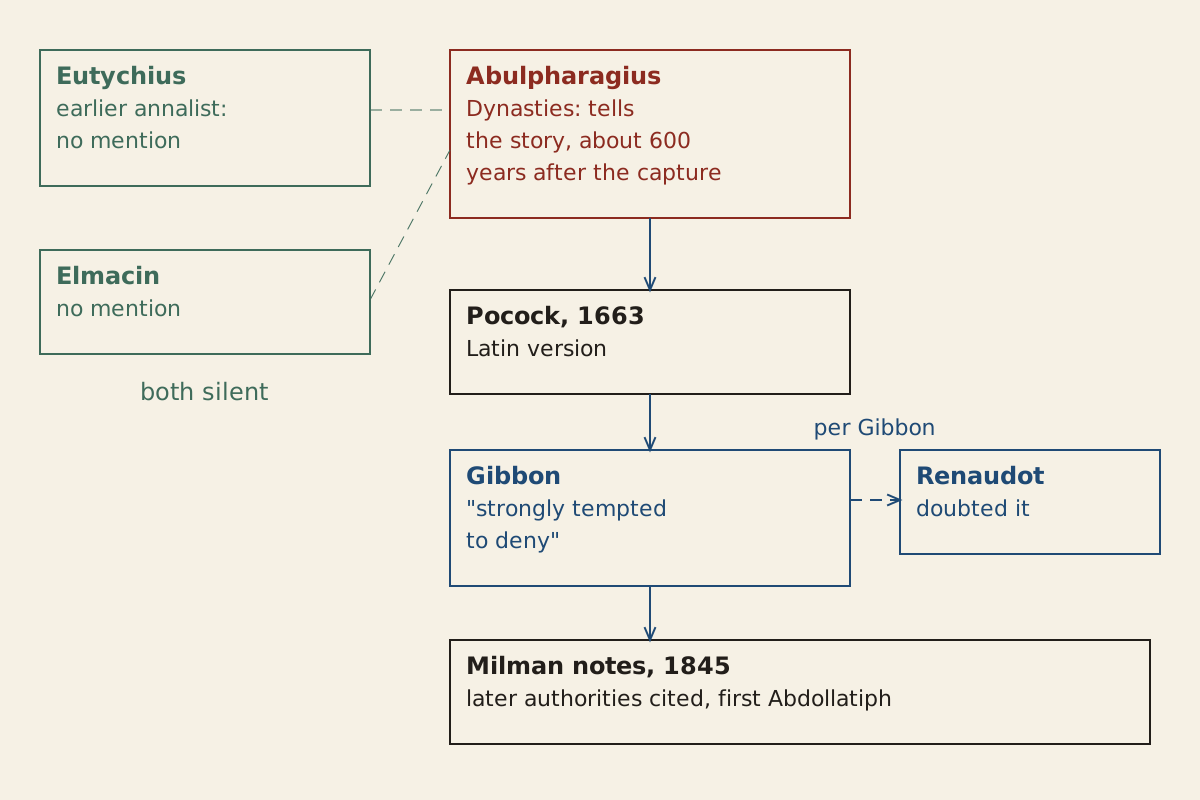
Figure: From the Surviving Record, CC BY 4.0
Full credit line for reuse
"Who tells the caliph story, and who is silent" by From the Surviving Record, CC BY 4.0. Source: https://fromthesurvivingrecord.com/vanished-texts/library-of-alexandria/ — License: https://creativecommons.org/licenses/by/4.0/
Data: Edward Gibbon, The History of the Decline and Fall of the Roman Empire, ch. 51, with notes by H. H. Milman (1845), retrieved 2026-11-01, public domain; George Bolling, "The Alexandrian Library," Catholic Encyclopedia, vol. 1 (1907), retrieved 2026-11-01, facts only, paraphrased
Legend vs. record
| Legend | Record |
|---|---|
| Caesar burned the Library of Alexandria. | Caesar's own account names burned ships. Later writers split between “the great library” (Plutarch) and books stored near the harbor (Orosius). |
| 700,000 scrolls were lost in one fire. | Counts in the sources run from 40,000 (Seneca) to nearly 700,000 (Gellius) and 700,000 (Ammianus). |
| Mark Antony restocked it with 200,000 books from Pergamum. | Plutarch lists a gift of Pergamum's libraries to Cleopatra among Calvisius's charges against Antony, most of which “were thought to be falsehoods.” |
| Caliph Umar had the books burned in the baths. | Told by Abulpharagius some six centuries after the conquest, by Gibbon's reckoning; doubted by Renaudot, per Gibbon. |
FAQ
How many books were in the Library of Alexandria?
The figures conflict. In the Letter of Aristeas, the librarian Demetrius of Phalerum tells the king he holds “more than two hundred thousand” books and aims for 500,000, but the letter has long been judged apocryphal, as the Catholic Encyclopedia noted in 1912. For the books lost in Caesar's war alone, Orosius gives 400,000, Gellius nearly 700,000 and Ammianus 700,000; Seneca, who names no year, gives 40,000. No copy of the Pinakes, the tables of writers and their works that the Suda credits to Callimachus, is among the sources on file, so none of these figures can be checked against it.
Where was the Library of Alexandria?
Strabo describes the Museum, the institution the library belonged to, as part of the royal palaces, and the Catholic Encyclopedia's 1907 article on the library places it in the Brucheion quarter for that reason. No source on file identifies the building's remains, so its exact site is unknown.
What was the Pinakes?
The Suda lists among the works of the poet-scholar Callimachus a set of pinakes, or tables, of those who stood out in every branch of learning and of what they wrote, in 120 books; the work is now called the Pinakes. The Catholic Encyclopedia's 1907 article on the library describes the early librarians' work as classifying and cataloguing Greek literature, and says Callimachus's own place among the librarians rests on slight evidence. By the record on file, the Pinakes is a paper survivor: the Suda gives its title and size, but no copy of the work itself is among the sources here.
Two other entries in this category look at what different kinds of record can show about a lost play: Cardenio: A Lost Play Known From Two 1613 Court Payments and Love's Labour's Won: A Shakespeare Title Listed in 1598.
Still missing:
- Where the main building stood. No source on file identifies its remains.
- Which count is right: Seneca's quadraginta (40,000) or Orosius's quadringenta (400,000)? A one-word slip in a Latin copy is the kind of error close reading can catch, as it did with a papal forgery: Donation of Constantine: Written Centuries After Constantine.
- What was on the Serapeum's shelves around 390. The demolition account on file mentions none.
Cite this page
From the Surviving Record. “Library of Alexandria: No Source on File Names Its Last Day.” First published 2026-11-01. https://fromthesurvivingrecord.com/vanished-texts/library-of-alexandria/ (accessed add the date you read it).
Sources
- Julius Caesar, Civil War 3.111, trans. A. G. Peskett (Loeb, 1914). LacusCurtius. penelope.uchicago.edu/Thayer/E/Roman/Texts/Caesar/Civil_Wars/3D*.html Read: full text of the cited passage.
- The Alexandrian War 1, trans. A. G. Way (Loeb, 1955). LacusCurtius. penelope.uchicago.edu/Thayer/E/Roman/Texts/Caesar/Alexandrian_War/A*.html Read: full text of the cited passage.
- Seneca, De Tranquillitate Animi 9.4–9.5, Latin text. The Latin Library. www.thelatinlibrary.com/sen/sen.tranq.shtml Read: Latin text of the passage; translations of short phrases are this page's own.
- Plutarch, Life of Caesar 49, trans. B. Perrin (Loeb, 1919). LacusCurtius. penelope.uchicago.edu/Thayer/E/Roman/Texts/Plutarch/Lives/Caesar*.html Read: full text of the cited passage.
- Plutarch, Life of Antony 58–59, trans. B. Perrin (Loeb, 1920). LacusCurtius. penelope.uchicago.edu/Thayer/E/Roman/Texts/Plutarch/Lives/Antony*.html Read: full text of the cited passage.
- Cassius Dio, Roman History 42.34–44, trans. Herbert Baldwin Foster, Dio's Rome, vol. 2 (1905). Project Gutenberg eBook #11607. www.gutenberg.org/ebooks/11607 Read: full text of the cited chapters, with the edition's year headings.
- Aulus Gellius, Attic Nights 7.17, trans. J. C. Rolfe (Loeb, 1927). LacusCurtius. penelope.uchicago.edu/Thayer/E/Roman/Texts/Gellius/7*.html Read: full text of the cited passage.
- Ammianus Marcellinus, Res Gestae 22.16.12–17, trans. J. C. Rolfe (Loeb, 1940), and Latin text. LacusCurtius. penelope.uchicago.edu/Thayer/E/Roman/Texts/Ammian/22*.html Read: English and Latin text of the passage.
- Orosius, Historiae adversus paganos 6.15.31–32, Latin text. The Latin Library. www.thelatinlibrary.com/orosius/orosius6.shtml Read: Latin text of the passage; translations of short phrases are this page's own.
- Strabo, Geography 17.1.8, trans. H. L. Jones (Loeb, 1932). LacusCurtius. penelope.uchicago.edu/Thayer/E/Roman/Texts/Strabo/17A1*.html Read: full text of the cited passage.
- Suetonius, Life of Claudius 42, trans. J. C. Rolfe (Loeb, 1914). LacusCurtius. penelope.uchicago.edu/Thayer/E/Roman/Texts/Suetonius/12Caesars/Claudius*.html Read: full text of the cited passage.
- Suetonius, Life of Domitian 20, trans. J. C. Rolfe (Loeb, 1914). LacusCurtius. penelope.uchicago.edu/Thayer/E/Roman/Texts/Suetonius/12Caesars/Domitian*.html Read: full text of the cited passage.
- Athenaeus, Deipnosophists 4.184b–c, trans. C. B. Gulick (Loeb, 1928). LacusCurtius. penelope.uchicago.edu/Thayer/E/Roman/Texts/Athenaeus/4E*.html Read: full text of the cited passage.
- Letter of Aristeas 9–10, trans. R. H. Charles (1913). attalus.org. www.attalus.org/translate/aristeas1.html Read: full text of the cited passage.
- Suda, kappa 227, "Callimachus." Suda On Line. www.cs.uky.edu/~raphael/sol/sol-entries/kappa/227 Read: entry and Greek text; paraphrased here, since the English translation on that site is licensed for non-commercial use only.
- Socrates of Constantinople, Church History 5.16–17, trans. A. C. Zenos (NPNF, 1890). New Advent. www.newadvent.org/fathers/26015.htm Read: full text of the cited chapters.
- Edward Gibbon, The History of the Decline and Fall of the Roman Empire, ch. 28, with notes by H. H. Milman (1845 edition). Project Gutenberg eBook #733. www.gutenberg.org/ebooks/733 Read: full text of the chapter and its notes.
- Edward Gibbon, The History of the Decline and Fall of the Roman Empire, ch. 51, with notes by H. H. Milman (1845 edition). Project Gutenberg eBook #735. www.gutenberg.org/ebooks/735 Read: full text of the chapter and its notes.
- George Bolling, "The Alexandrian Library," The Catholic Encyclopedia, vol. 1 (1907). New Advent. www.newadvent.org/cathen/01303a.htm Read: full article; paraphrased only.
- Herbert Thurston, "Libraries," The Catholic Encyclopedia, vol. 9 (1910). New Advent. www.newadvent.org/cathen/09227b.htm Read: full article.
- Achille Vander Heeren, "Septuagint Version," The Catholic Encyclopedia, vol. 13 (1912). New Advent. www.newadvent.org/cathen/13722a.htm Read: full article; paraphrased only.
- Thomas Scannell, "Domitian," The Catholic Encyclopedia, vol. 5 (1909). New Advent. www.newadvent.org/cathen/05114b.htm Read: full article.
- Johann Peter Kirsch, "Paulus Orosius," The Catholic Encyclopedia, vol. 11 (1911). New Advent. www.newadvent.org/cathen/11322a.htm Read: full article.
- Project Gutenberg catalogue, author records for Julius Caesar, Seneca, Plutarch, Cassius Dio and Ammianus Marcellinus (birth and death years as catalogued). www.gutenberg.org/cache/epub/feeds/pg_catalog.csv Read: catalogue author records.
Spotted an error? Write to contact@fromthesurvivingrecord.com (the link fills in this page's title as the subject). Changes are logged in the corrections log and at the foot of the entry; the evidence levels page explains how sources are weighed.
Related entries
-
Vanished Texts & Libraries
Love's Labour's Won: A Shakespeare Title Listed in 1598
Love's Labour's Won is a comedy Francis Meres credited to Shakespeare in 1598. No play survives under that title. The list and the matches proposed, with CSV.
Picture credit
"The Princess, Rosaline, etc. (Shakespeare, Love's Labour Lost, Act 4, Scene 1)" by Thomas Ryder, after William Hamilton — https://commons.wikimedia.org/wiki/File:The_Princess,_Rosaline,_etc._(Shakespeare,_Love%27s_Labour_Lost,_Act_4,_Scene_1)_MET_DP859573.jpg — CC0 1.0 (https://creativecommons.org/publicdomain/zero/1.0/); modified: cropped to the picture area, removing the engraved lettering below it (title, quotation, painter, engraver and publication lines), the plate number and the paper margin with a stain at lower right; the picture itself is not cut
-
Vanished Texts & Libraries
Cardenio: A Lost Play Known From Two 1613 Court Payments
Cardenio is a lost play paid for at court in 1613 under the spellings Cardenno and Cardenna. A 1653 entry credited it to Fletcher and Shakespeare. Records, CSV.
Picture credit
"Don Quixote Disputing with the Mad Cardenio" by Francis Hayman — https://commons.wikimedia.org/wiki/File:Don_Quixote_Disputing_with_the_Mad_Cardenio_-_Francis_Hayman_-_5_1963_4.jpg — CC0 1.0 (https://creativecommons.org/publicdomain/zero/1.0/)